When you click on links to various merchants on this site and make a purchase, this can result in this site earning a commission. Affiliate programs and affiliations include, but are not limited to, the eBay Partner Network.
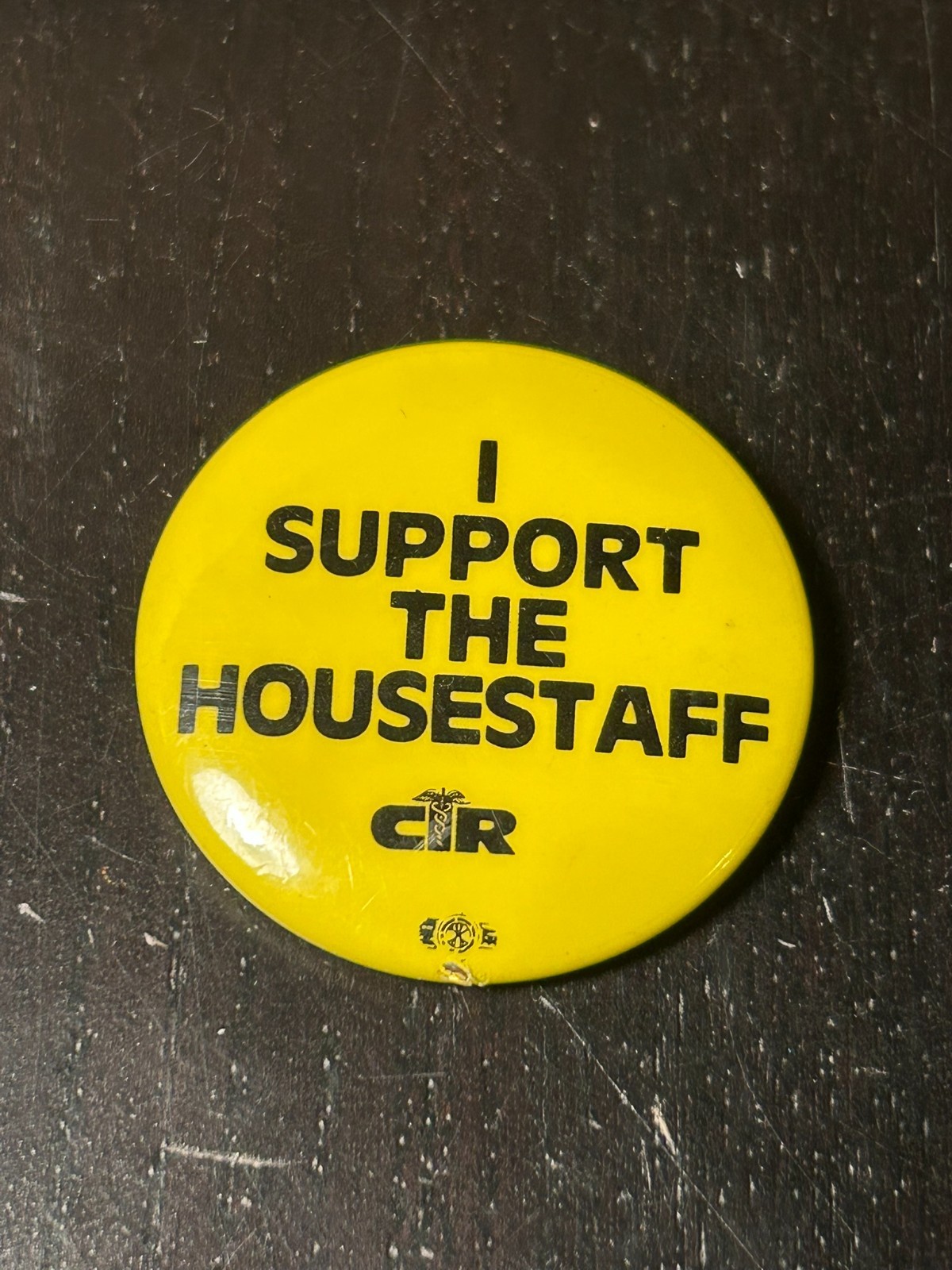
Vintage CIR Committee of Interns & Residents Union Labor Button Pin Healthcare
"I SUPPORT THE HOUSESTAFF"
Pin made by "Joy Products" several decades ago.
--
Several available. The more you buy, the more you save.
--
These buttons are emblematic of the Committee of Interns and Residents (CIR), the nation's oldest and largest house staff union, which represents over 30,000 medical interns, residents, and fellows across the United States. Founded in 1957, CIR emerged from the critical need for physician unions to advocate for those in graduate medical education (GME) who, despite their essential role in the healthcare system, often faced excessively long work hours, inadequate stipends, and unsafe working conditions. As a resident-led union, CIR's primary mission is to empower these early-career physicians through collective bargaining to secure fair contracts that address not only wages and benefits but also patient care standards, workplace safety, and professional development. The union operates on the fundamental principle that improving the working conditions of house staff directly correlates with enhancing quality of care for patients and fostering a more equitable healthcare system.
As a labor union specifically for doctors in training, CIR's advocacy extends far beyond traditional collective bargaining agreements. The union is a pivotal force in combating physician burnout by negotiating enforceable limits on consecutive work hours and mandatory overtime, while also fighting for improved mental health resources and resident wellness programs. CIR engages in fierce contract negotiations to win competitive salaries, comprehensive health insurance, childcare subsidies, and secure housing for its members. Furthermore, the union provides robust representation through grievance procedures to protect members from discrimination, harassment, and retaliation, ensuring due process in academic and disciplinary matters. Through political action and legislative advocacy, CIR also campaigns for broader healthcare reform, medical education funding, and social justice issues that impact both healthcare workers and the communities they serve, solidifying its role as a social justice union within the medical labor movement.
The broader context of these buttons places CIR within the landscape of organized labor and healthcare unionization. CIR is an affiliate of the Service Employees International Union (SEIU), part of the Physicians for Responsible Negotiation (PRN) lineage, and currently a member of the American Federation of State, County and Municipal Employees (AFSCME) through its affiliation with the Doctors Council. This affiliation connects house staff to a powerful network of public sector unions and amplifies their collective voice. The buttons themselves, with slogans like "Support the Housestaff," are tools for mobilization, solidarity, and visibility, used during organizing drives, strike actions, and rallies to build union density. They symbolize a critical labor struggle within academic medical centers, where trainee physicians assert their rights as employees while navigating the dual pressures of medical training and clinical service. Ultimately, CIR's history and ongoing work underscore the vital intersection of labor rights and healthcare equity, demonstrating how unionized residents are instrumental in shaping a more sustainable and just future for the healthcare workforce.
--
The "I SUPPORT THE HOUSESTAFF" pin is a solidarity button that plays a crucial role in the organizing and public advocacy campaigns of the Committee of Interns and Residents (CIR). It serves as a visible declaration of allyship and collective support for medical interns, residents, and fellows—collectively known as housestaff—who are in graduate medical education and form the essential frontline workforce of teaching hospitals. The pin is typically worn not only by the housestaff themselves but also by attending physicians, nurses, hospital staff, medical students, and even patients and community members. Its primary purpose is to build a broad coalition and create visible, widespread solidarity around the demands of the resident union, especially during critical periods like contract negotiations, strike authorizations, or public rallies. By stating "I SUPPORT," the button explicitly frames the housestaff's struggle for fair wages, safe working conditions, and reasonable hours as a cause worthy of public and institutional backing, helping to legitimize their labor movement within the healthcare system.
This button refers directly to the campaigns and labor disputes where housestaff are advocating for a fair contract and better working conditions. In practical terms, the pin is distributed during organizing drives to boost union density and morale, and it is prominently displayed during bargaining sessions and protests to show unity. The message counters the narrative that resident physicians are merely trainees who should accept poor conditions as part of their education; instead, it asserts their role as essential employees deserving of dignity, respect, and a voice at work. The call for "support" is particularly strategic, as it seeks to garner public sympathy and apply moral pressure on hospital administration and academic leadership by demonstrating that the housestaff's fight is interconnected with patient care quality and overall hospital safety. When the public and other healthcare workers wear this pin, it signals a shared understanding that the well-being of doctors in training is directly linked to the health outcomes of the community, a key tenet of social justice unionism.
Historically and contextually, such pins gain prominence during heightened periods of labor activism within the medical field. For instance, during major strike threats or actual work stoppages—like those seen in New York City hospital systems in 2022 and 2023—these solidarity buttons become ubiquitous symbols. They help mobilize not just the union members but also the broader hospital workforce and the patient community, creating a visible sea of support that hospital management cannot ignore. The button, therefore, is more than a piece of union swag; it is a tool of strategic communication and mobilization within healthcare labor movements. It embodies the principle that collective bargaining is not an isolated battle but a community-wide issue, reinforcing the idea that supporting the housestaff is fundamental to advocating for a more equitable, safe, and sustainable healthcare system for all.--
Shelf 1