When you click on links to various merchants on this site and make a purchase, this can result in this site earning a commission. Affiliate programs and affiliations include, but are not limited to, the eBay Partner Network.
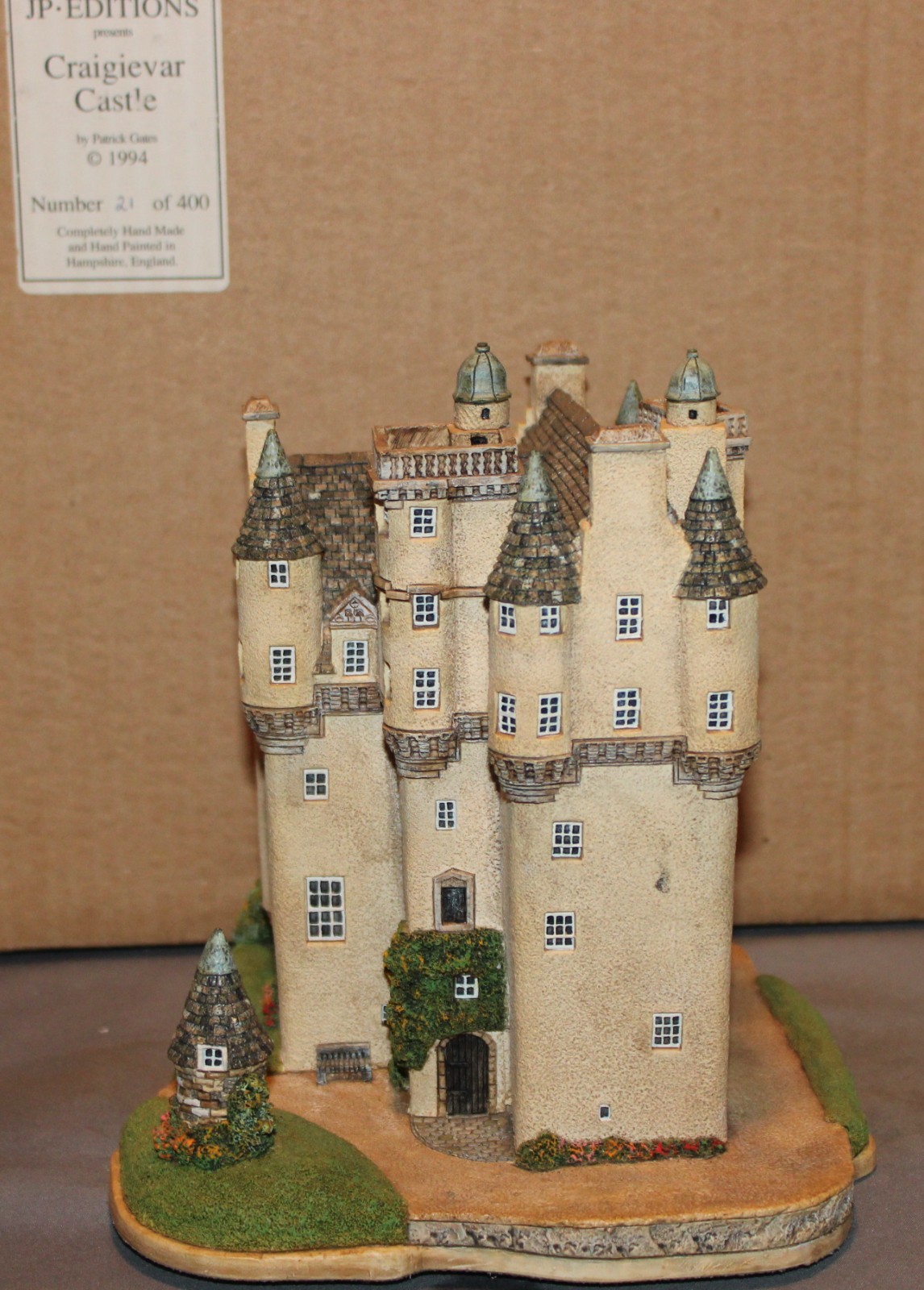
ereis the JP Editions #21 of Craigievar Castle.
Thismodel was produced in 1994 in the standard 400 edition size.
Seeexpanded description below.
Asseen in photos, original external labeled box is included. Box mayshow some storage wear.
NoCOA is available for this model.
Approximatedimensions are 6.5” x 7.25” x 7.0”
Thislisting does not qualify for combined shipping.
Collectorscan take advantage of reduced shipping cost for this model.
Previouslydisplayed. No damages, fixes or repairs. Almost Mint.
Aswith all previously displayed JP Editions models, there is a chancefor some minor imperfections. Photos may not indicate all defects. Be sure to review photos prior to committing to purchase. Contactseller to request any additional photos or if there are anyquestions.
Expandeddescription of actual structure:
Standingdue West from Aberdeen in the Grampian area of Scotland, CraigievarCastle sits on the eastern slope of a hill from which it takes itsname. Craigievar, from the Gaelic, means "therock (or hill) of Mar". Theancient Celtic province of Mar included the valleys of both the Donand the Dee. Being near the center of the province, Craigievar maywell have assumed importance in pre-feudal times. It is only in 1457however, that the name appears in any record, and then it is as thepossession of the ancient family of Mortimer, and it is to them thatthe raising of the Castle in about 1600 is attributed. However, in1610 financial troubles forced the Mortimers to sell the lands ofCraigievar along with the unfinished Castle, to William Forbes ofMenie. William was the younger brother to the famous Patrick Forbes,otherwise known as ‘the bishop’ (of Aberdeen). For centuriesthere had been a brisk trade between Scotland, Scandinavia, theBaltic and the Low Countries. Coal, cloth, salt and fish wereexported in return for iron and great quantities of timber, inparticular the ‘Memel Pine’ found in many Scottish buildings. William is recorded as having ‘madea goodly pile merchandizing at Danzig’– hence his nickname, Willie the Merchant of Danzig or DanzigWillie. With his success in the Baltic trade, William set aboutacquiring land in Aberdeenshire and throughout the East of Scotland. As a wealthy man, when he commenced work on the unfinished castle, hecould afford to employ the best masons and craftsmen available duringthe first stages of tower-house building. It is generally acceptedthat the master mason employed for the work was John Bell.
Throughsucceeding generations, the Bell family of masons gave Aberdeenshirean outstanding group of castles including Crathes, Midmar, Drum andCastle Fraser. The partnership between the well-traveled, cultured,educated and wealthy patron, William, and a gifted and skillfulmaster mason combined to create a tower-house, that in its mature17thcentury form, is perhaps Scotland's greatest contribution to Europeanarchitecture, for though its Gallic affiliations are plain enough,the style is unique.
In1627, just one year after the completion of his castle, Willie theMerchant died. He had lived in a very special age - the brief respiteof time between the Reformation and the Civil Wars, a time duringwhich the northeast of Scotland witnessed both economic prosperityand cultural vitality. He was succeeded by his son, also William,who was made a Baronet of Nova Scotia in 1630. Sir William and hiskinsmen were the victims of ‘great oppressions at the hands of anotorious band of raiders whose continuous cattle raiding, sporadicfeuding and stealing of crops wreaked havoc in the Highlands until1636 when seven of the band were captured, taken to Edinburgh wherethey were hanged, their heads cut off and ‘setup in exemplary places’.
OnceCivil War broke out, Sir William was involved in many battles,leading the capture of Harthill Castle in 1640 and being captured at(and escaping from) the battle of Aberdeen in 1644. In 1647 he becamethe Sheriff of Aberdeenshire but died the following year. He wassucceeded by his son ‘Red’ Sir John the second Baronet. Thenickname derived from his complexion; colors were not ascribed topolitical beliefs in the 17thCentury. Sir John’s personal motto ‘Do not vaiken sleeping dogs’is to be found in various places throughout the castle, and hisreputation suggests a temperament as fiery as his looks.
In1823 Sir John the seventh baronet, found the castle greatly in needof repair and after the work had been carried out, retained thearchitect to build a large, modern mansion on his other estate atFintray rather than compromise Craigievar by alteration or addition.This astute decision is perhaps the earliest example in Scotland ofthe recognition, by an owner and architect, of the importance ofprotecting a building for its architectural and historic value - asupreme compliment to the earlier partnership of Danzig Willie andhis master mason.
CraigievarCastle is an architectural masterpiece in pink harled granite,standing six stories high with corbelled towers and conical roofs andit has the distinction of being the last of the true tower-houses,since after the Civil War, styles and tastes changed and Scotlandwas about to embrace classicism.