When you click on links to various merchants on this site and make a purchase, this can result in this site earning a commission. Affiliate programs and affiliations include, but are not limited to, the eBay Partner Network.
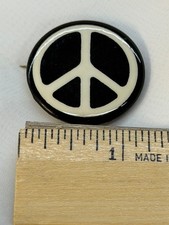
Size: 1.25 inches
✌️ Remember When a Two-Inch Button Could Say Everything a Speech Couldn't?
There was a stretch of American life when you didn't need a caption, a hashtag, or an artist's statement to tell the world exactly where you stood.You pinned a button to a denim jacket, a book bag strap, a lapel, a collar — and let it do the talking for you, all day long, no explanation required. Anyone who caught the flash of it on a sidewalk, across a diner counter, or in a crowded quad knew instantly what you meant. This little pinback belongs squarely to that world.It's small enough to sit in the palm of your hand and large enough in what it once carried to stop a room. Held onto rather than worn, it comes down to us today the way the best survivors of that era do — quiet, unspent, and ready to say the same thing it was made to say the day it came off the press.
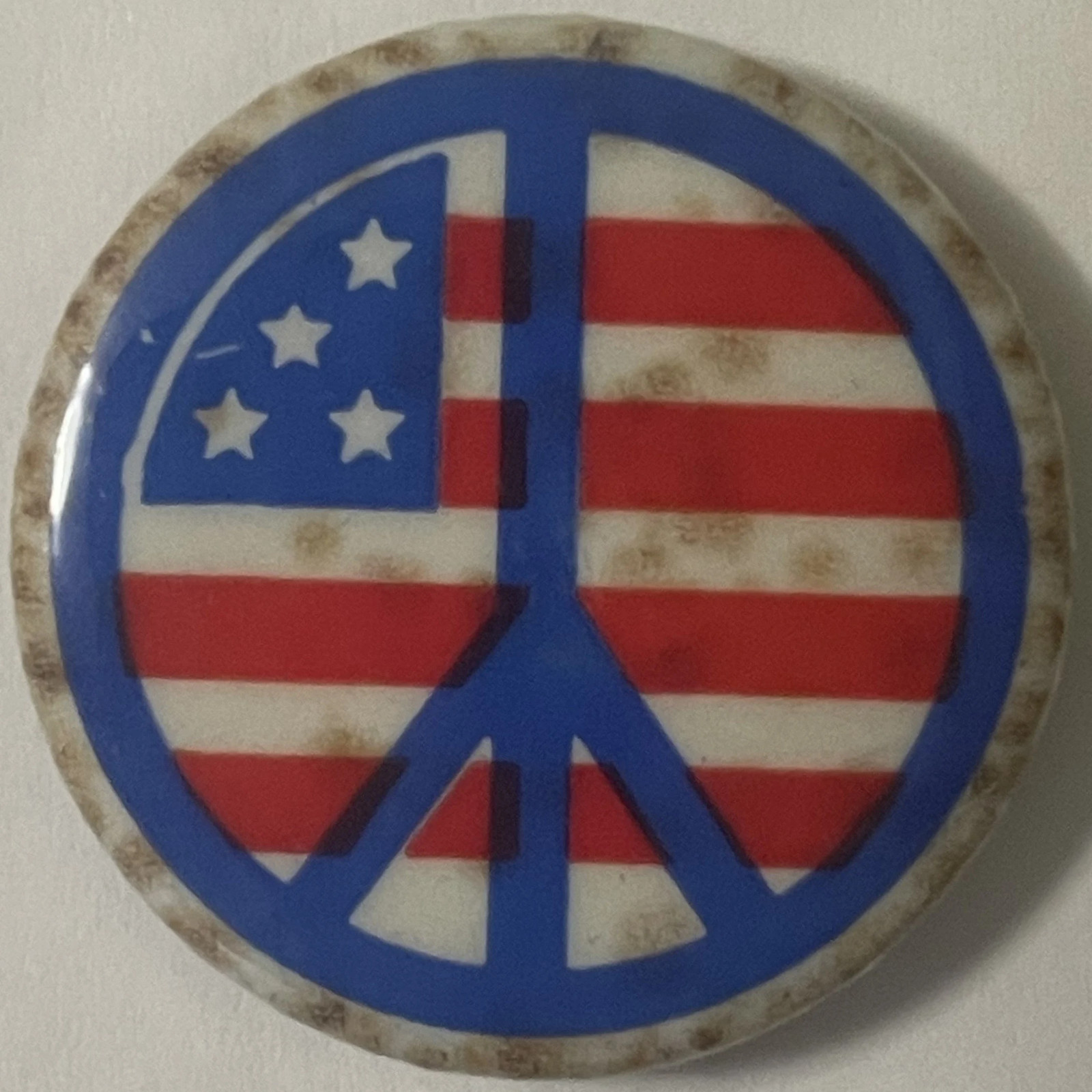
What you're looking at is a lithographed tin pinback button pairing two of the most loaded visual symbols in twentieth-century American life: the peace symbol and the Stars and Stripes, fused into a single graphic.A bold blue peace symbol is laid directly over red-and-white stripes, with a wedge of white stars set into a blue field in the upper corner echoing the canton of the flag itself. The printing is flat, solid-color lithography — clean spot colors of blue, red, and white with no halftone dot pattern, the crisp, confident, low-cost offset work that let a shop run these off by the thousands and still have them read boldly from across a room.This example is offered as New Old Stock — unused inventory that sat tucked away rather than out on a jacket, which is exactly why it survives today as a strong, honest piece of its era rather than a faded memory of one. No maker's name has ever surfaced tied to this design, which is true to how the vast majority of these buttons entered the world: unbranded, uncredited, made fast and cheap by shops that never expected — or wanted — their name remembered.The pairing of peace symbol and flag belongs to the run of years when that fusion became a shorthand understood from coast to coast — the 1960s into the 1970s, the working years of the peace-movement button trade, when flat spot-color litho on a crimped metal disc with a simple wire pin was the standard, unglamorous way these things got made before plastic-backed and photo-halftone buttons took over the trade.
🕊️ Before It Was "The Peace Sign," It Was a Cry Against the Bomb
The mark at the center of this button carries one of the best-documented origin stories in modern graphic design, and it doesn't begin in America — it begins in Britain, in February of 1958, when a graphic artist named Gerald Holtom sat down to design a badge for the very first Aldermaston March, a protest walk organized against Britain's nuclear weapons establishment.Holtom built the image out of flag semaphore, the old maritime signal alphabet sailors once used to talk ship-to-ship without a word spoken: the vertical line down the center is the semaphore signal for the letter "D," the two downward angled lines form the letter "N." Together — N and D, for Nuclear Disarmament.
Holtom gave the symbol a second, far more personal reading of his own.In a letter to a fellow campaigner he described being in deep despair when he drew it, picturing himself as an individual in despair, arms flung outward and down "in the manner of Goya's peasant before the firing squad" — a reference to Goya's famous 1808 painting of a doomed man before an execution. He formalized the gesture, drew a circle around it, and handed the world a symbol born out of grief rather than hope.What makes the story even more remarkable for collectors is that Holtom apparently came to regret the choice: he had also sketched an inverted version, with the arms pointing up instead of down, meant to read as a "U" for unilateral disarmament, and reportedly wished he had used that version instead — feeling the downward arms spoke too much of despair when he had wanted a symbol of hope.Whether or not the design ever ended up carved anywhere as he is said to have wished, the story is one collectors of peace-era ephemera pass along as part of the mark's true history.
The single most important fact for anyone chasing this design across seventy years of buttons, patches, jewelry, and printed ephemera: Holtom's mark was never trademarked or copyrighted.That one decision is the entire reason a symbol drawn for one march to one nuclear weapons plant in England could, within a decade, turn up unbranded and uncredited on buttons pressed by shops with no connection whatsoever to the original campaign — which is exactly the situation with a piece like this one.
🎨 Two Color Stories Colliding in One Button
What makes this particular button so rich is that it stacks two entirely separate, deliberately chosen color systems on top of one another — and the collision between them is almost too perfect to be an accident of history.
The peace symbol's very first appearance carried a liturgical color scheme.Of the original cardboard signs carried at that first 1958 march, half were painted black on white and half white on green — meant to change over the Easter weekend exactly as a church's own liturgical colors change, moving, as the campaign itself described it, "from Winter to Spring, from Death to Life." Even more striking is the lore behind the first wearable badges: they are said to have been made from white clay fired hard and painted with the black symbol, and distributed with a note explaining that in the event of nuclear war, these small fired-pottery badges might be among the only human-made objects left to survive it.That is the origin story of the peace symbol as a thing worn on the body — a badge designed, quite literally, to outlive the people wearing it.
Layer onto that grim, hopeful little bit of Cold War lore the flag's own long-declared color meanings. When Charles Thomson, Secretary of the Continental Congress, explained the colors chosen for the Great Seal in 1782 — meanings that came to be applied to the flag as well — he wrote that white signifies purity and innocence, red signifies hardiness and valour, and blue, the color of the Chief, signifies vigilance, perseverance, and justice.A mark born out of one man's despair, dressed in colors meant to mark the turn from death to life, pressed directly over a field of stripes and stars officially declared to mean valour and justice — that tension is the entire American argument of the peace era, compressed onto a disc you could pin to a jacket in under three seconds.
🏙️ How a British Anti-Bomb Symbol Landed on an American Flag in Chicago
The symbol crossed the Atlantic quickly.Pacifist Albert Bigelow sailed a small boat flying the campaign's banner near a nuclear test site in 1958, putting the mark in front of American eyes almost as soon as it existed in Britain. From there, the mark is believed — reported, not certain — to have been carried into the American civil rights movement by Bayard Rustin, a close collaborator of Martin Luther King Jr. who had joined the original 1958 march in England himself.
The button trail into American hands has a firmer, more specific address.In 1960, Philip Altbach, a freshman at the University of Chicago who had traveled to England as a delegate of the Student Peace Union, brought a batch of the symbol's buttons back to campus. His organization began printing its own, and between 1960 and 1964 the Student Peace Union sold thousands of them across American college campuses — by Altbach's own later account, it was the first time most Americans had ever laid eyes on the peace symbol at all.
Here is the detail that turns this from a footnote into genuine local legend: the Student Peace Union's headquarters sat near the University of Chicago campus, in Hyde Park on the city's South Side — the very same few blocks where, back in December of 1942, Enrico Fermi and his team achieved the world's first controlled, self-sustaining nuclear chain reaction beneath the old Stagg Field stands, the literal opening of the nuclear age.It goes further still: the Bulletin of the Atomic Scientists, founded in Chicago in 1945 by Manhattan Project veterans from that same university, created the Doomsday Clock in 1947 — and decades later, the reactor site itself came to be marked by sculptor Henry Moore's bronze *Nuclear Energy*, a form widely read as suggesting a mushroom cloud, a skull, or a helmet all at once.Put plainly: the first American-made peace-symbol buttons were printed and handed out a short walk from the exact spot where the atomic age began, in the same city that gave the world the Doomsday Clock, at almost the same moment a British sculptor was casting a bronze cloud over the reactor site itself. Every link in that chain is separately documented history — though it's worth saying plainly that this is the story of how the American peace-symbol button was born as a category, not proof of where any one surviving example, including this one, was actually printed.
✊ The Student Peace Union — Rise, Reach, and a Quiet Merger
The organization behind that first wave of American peace buttons has its own fully documented arc.The Student Peace Union was founded at the University of Chicago in 1959 by Ken Calkins, a young pacifist who had already gained notoriety for sitting down in front of a truck during a demonstration at an Atlas missile site outside Cheyenne, Wyoming, and fracturing his pelvis for the trouble. Calkins returned to Chicago to run peace seminars in the city's high schools while his new organization grew.It merged with the College Peace Union in 1960, and under national chairman Philip Altbach — the same student who had carried those first buttons back from England — membership climbed to a peak of roughly 3,500 by 1962. The Student Peace Union stayed headquartered in Chicago until 1964, when the office moved to New York, and the organization finally merged with Campus Americans for Democratic Action in February of 1967 to form the Independent Student Union — its own moment quietly closing as the rising New Left and Students for a Democratic Society came to dominate the campus protest landscape it had helped build.
🎗️ A Design Nobody Owned
Because Holtom's mark was never trademarked, it belonged to everyone the moment it left his drawing board — which is precisely why, within little more than a decade, it could be found stamped onto tin buttons, cast into jewelry, sewn onto patches, and, as here, fused directly into the American flag by print shops with no formal tie to the original British campaign at all.That openness is the reason a single design drawn for one 1958 march in England ended up as the default visual shorthand for an entire American decade of protest, and it's the reason pieces like this one exist in the first place: cheap to produce, easy to copy, and made to be everywhere at once rather than traced back to any one source.
🖼️ Display Ideas
- 📌 Pinned to a cork board or memo board alongside other small pieces of period ephemera, letting the flat spot colors carry the whole arrangement
- 🖼️ Set into a small shadow box or riker mount on its own, treated as the miniature graphic statement it was always meant to be
- 👕 Clipped onto a denim jacket collar or canvas bag exactly the way it would have traveled the first time around
- 📚 Displayed alongside period protest ephemera, campus newspapers, or civil-rights and anti-war era paper goods for a grouped Cold War-era vignette
- 🎓 Given as a thoughtful gift to anyone with a personal or family tie to the 1960s–70s peace movement or campus activism
- 🗂️ Kept as the anchor piece in a small pinback button collection built around protest, patriotic, or Americana graphic design
🎁 Who Collects These
This is a piece that pulls from several different collecting worlds at once.Pinback button collectors chase it for the classic litho-tin construction and flat spot-color printing typical of the trade's mass-production years. Peace-symbol and Cold War historians want it for the way it visually collapses the era's central argument — dissent versus patriotism — into one small object. Americana and protest-ephemera collectors value it as a genuine survivor of the campus button culture that groups like the Student Peace Union helped build.And plenty of buyers simply want it as a warm, honest piece of personal or family nostalgia — something that instantly returns them, or a parent or grandparent, to a very specific American moment, with no explanation needed at all.
❓ FAQ
Is this an original vintage button or a modern reproduction?
It is offered as New Old Stock — genuine unused inventory from the era, not a reissue or a reproduction, held back rather than worn.
Who manufactured this button?
No maker's name or company has been confidently identified with this design.Buttons of this type were overwhelmingly produced by small, unbranded shops during the peace-movement era, which is exactly why so many surviving examples, including this one, carry no traceable maker.
What does the peace symbol inside the flag actually represent?
The symbol itself was designed in 1958 by British artist Gerald Holtom for the first Aldermaston anti-nuclear march, built from semaphore signals for "N" and "D" (Nuclear Disarmament).Fusing it with the American flag became a widespread visual shorthand during the American peace movement of the 1960s and 1970s.
Was the peace symbol ever trademarked?
No — and that's a key part of its history. Because Holtom never trademarked or copyrighted the design, it spread freely and was reproduced by countless unrelated makers, which is why it appears on so many different buttons, patches, and pieces of jewelry with no single traceable source.
How was this button actually made?
It's a lithographed tin pinback, printed in flat solid spot colors of blue, red, and white with no halftone screen — a classic, economical printing method used widely for mass-produced novelty and protest buttons of its era.
Does the Chicago history mean this specific button was made there?
No.The documented Chicago story explains how the American peace-symbol button as a category first took hold — through the Student Peace Union at the University of Chicago in 1960 — but it isn't a claim about where this individual button was printed.
Is this a good gift item?
Yes — its small size and instantly recognizable imagery make it a natural gift for anyone nostalgic for the era, interested in protest-era Americana, or building a pinback button collection.