When you click on links to various merchants on this site and make a purchase, this can result in this site earning a commission. Affiliate programs and affiliations include, but are not limited to, the eBay Partner Network.

Title: Intact 18-Piece Collection of 18th & 19th C. Antique Pewter Plates:
$2500.00
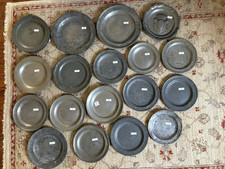
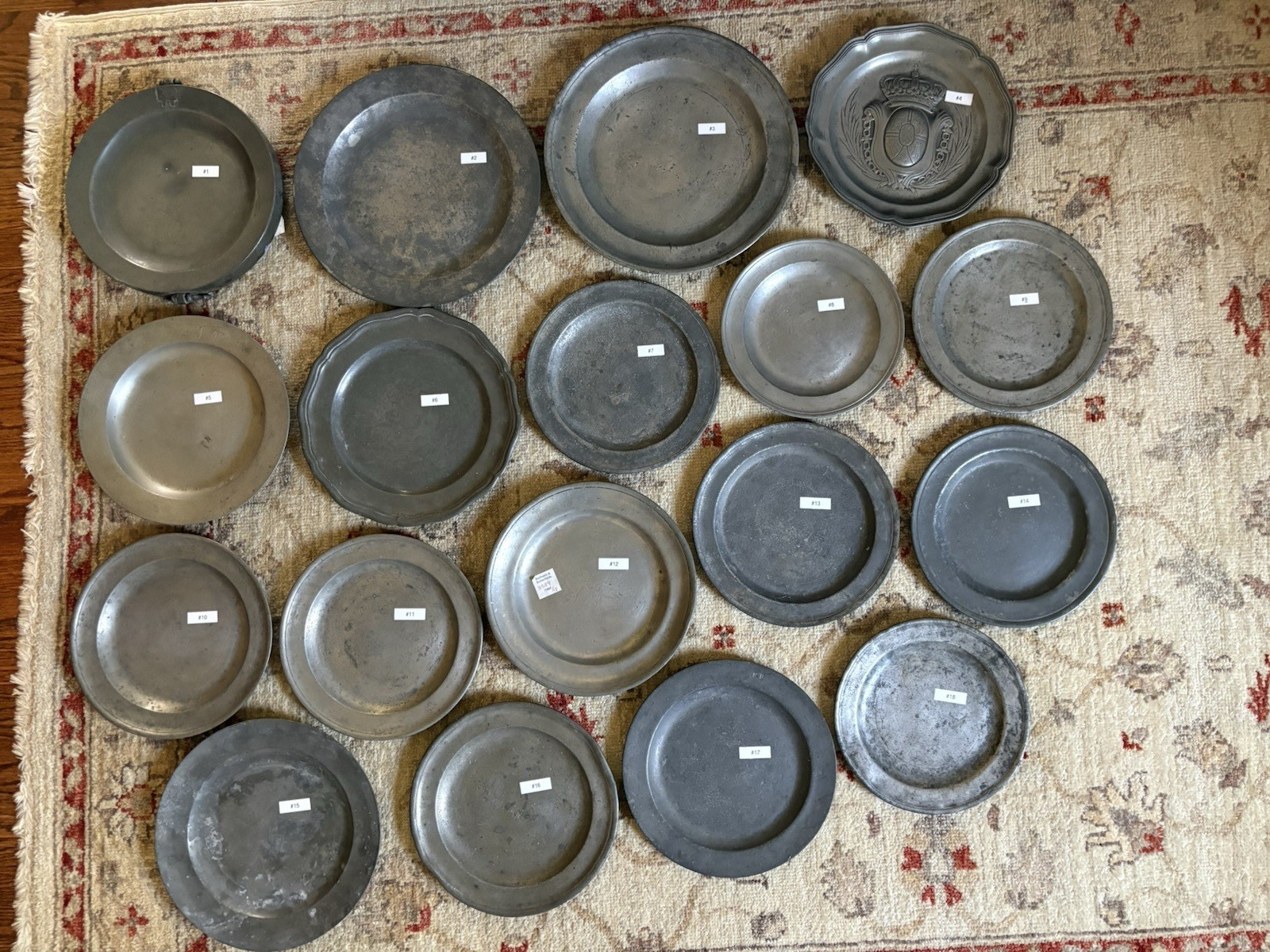
Title: Intact 18-Piece Collection of 18th & 19th C. Antique Pewter Plates - Bonhams sale ProvenanceOffering an extraordinary, museum-quality collection of eighteen (18) authentic 18th and early 19th-century antique pewter plates. This beautifully curated hoard spans over a century of British, American export, and continental European metalwork history.This entire collection was originally acquired as a single, intact lot (Lot #3589/18) from the prestigious Bonhams & Butterfields Fine Art sale House, and all plates retain an incredible, honest, untouched dark slate patina highly prized by collectors.Every single plate features original, detailed antique dealer research tags cross-referencing their exact hallmarks against standard academic texts, including Howard Cotterell’s Old Pewter: Its Makers and Marks and Carl Jacobs’ Guide to American Pewter.The 18-Piece Collection Includes: - Rare Early 18th C. Masterpieces: Includes a matching pair of highly desirable, early 1700s Queen Anne \"Single Reed\" plates featuring the rare William Scott \"W.S.\" bird-on-a-rose maverick marks (Value: $175-$250+ each).
- Signed 18th C. English Export Masters: Pristine, clearly marked plates by Samuel Ellis (c. 1721), Benjamin Lowe (c. 1735), Samuel Duncomb (c. 1740), Allen Bright (c. 1742), Robert Bush & Co. (c. 1755 Hot Water Warming Plate with side handle), Townsend & Giffin (c. 1770), Fasson & Son (c. 1782), Thomas Willshire (c. 1780), and an incredibly crisp Townsend & Compton (c. 1801).
- Decorative Continental European Pieces: A massive, heavily embossed Belgian presentation charger by Nicolas Deschamps (c. 1818) featuring a royal coat of arms, alongside fine 18th/19th-century German wavy-rim and personalized initial plates.
- Anonymous Colonial Utility Plates: Genuine 18th-century unmarked export flatware, including a beautiful \"Marriage Mark\" triad plate (stamped C over N I) from the mid-1700s.
- Note: #10 & #11 were initially thought to be the Shorey Family Pewters but the mark is clearly William Scott with a leaf & bird visible. This brought the value to an early to mid 1700s \'GoldenAge\' Group (c.1700-1740)
Condition: All plates are in excellent, untouched antique condition with deep, authentic oxidation. No modern cleaning or polishing has been performed, preserving the original surfaces. Normal historical surface wear, utensil marks, and minor rim deviations consistent with 200+ years of age.Shipping & Handling: Due to the solid, heavy nature of historic pewter, this collection weighs approximately 25 lbs. packed. Will be double-boxed, meticulously bubble-wrapped, and shipped with full insurance and signature tracking via [Local pickup MANIFEST & PROVENANCEREGISTRYOfficial Lineage Document • Prepared for the Transfer of OwnershipPROVENANCE NOTE: This entire 18-piece collection of fine antique pewter flatware and hollowware wasoriginally acquired as an intact domestic household lot under Lot #3589 / 18 from the prestigious Bonhams &Butterfields Fine Art sale House. Every item carries historical importance, exhibiting an untouched, deephistoric slate-gray patina heavily prized by scholars and advanced collectors of early metalware.ITEMIZED HISTORICAL CATALOG- Plate #1: Robert Bush & Co. (Bristol, England)
Style: 18th-Century Hot Water Warming Plate. Heavy deep-rim construction equipped with a native side loophandle, designed to hold boiling water to sustain food temperature at table.Timeline / Maker: Crafted by Robert Bush I (active c. 1755–1793), a prominent Bristol master known forshipping expansive everyday flatware arrays to the American Colonies.Marks: Carries four square pseudo-hallmarks on the reverse featuring a rectangular \'B & Co.\' block stamp,accompanied by Britannia, a Lion\'s head, and a Tudor rose.Citations: Cross-referenced under Cotterell\'s Old Pewter: Its Makers and Marks, Entry #739.- Plate #2: Samuel Duncomb (Birmingham, England)
Style: Flat Dinner Plate with a classic smooth, plain rim profile.Timeline / Maker: Struck by Samuel Duncomb (active c. 1740–1780) in Birmingham. Duncomb was a keyAnglo-American export manufacturer.Marks: Reverse exhibits a crisp, prominent Crowned X (the regulatory guild stamp for \'Extraordinary\'high-grade pewter alloy), alongside a detailed dove with an olive branch rising over a \'LONDON\' ribbon banner.Citations: Documented under Cotterell Entry #1466 and Carl Jacobs\' Guide to American Pewter, Entry #681.- Plate #3: Allen Bright (Bristol, England)
Style: Flat Dinner Plate with traditional circular border work.Timeline / Maker: Cast by Allen Bright (active c. 1742–1763), part of a multi-generational Bristol pewter castingdynasty capitalizing heavily on pre-Revolutionary Atlantic shipping lanes.Marks: Possesses an exceptionally crisp, clear rectangular nameplate block reading \'ALLEN BRIGHT\' inuppercase banners on the reverse side.Citations: Authenticated under Cotterell Entry #574 and Jacobs Entry #1276.- Plate #4: Nicolas Deschamps (Liège, Belgium)
Style: Heavy Decorative Presentation Charger. Sculpted with an elegant multi-curved, scalloped \'wavy cardinal\'edge matching the late Baroque / Rococo European design movement.Timeline / Maker: Built by continental master Nicolas Deschamps in Liège, Belgium (active c. 1818). Featuresa noticeably thicker, structural, and heavier metal pour than standard domestic table flatware.Marks: Front center face displays a highly intricate, heavily embossed Royal Coat of Arms featuring an ovalshield topped by a large royal crown, flanked by decorative palm-style fronds. Inner shields show a fleur-de-lis,a lion rampant, and a castle tower.- Plate #5: German Regional Guild (Germany)
Style: Personalized Household Dinner Plate.Timeline / Maker: Mid-19th Century German regional manufacture. Crafted under strict local guild regulationsout of highly purified tin alloy (\'Feinzinn\').Marks: Front rim displays an elegant, hand-engraved flowing cursive monogram reading \'F. E.\', denoting theprominent original merchant-class or burgher family ownership. Reverse holds a circular regional hallmark seal.Citations: Registered in Erwin Hintze\'s multi-volume reference Die Deutschen Zinngiesser und ihre Marken,Entry #2145.- Plate #6: Germanic or Swiss Regional Guild (Continental Europe)
Style: Decorative Scalloped Dinner Plate with a wavy cardinal border rim.Timeline / Maker: Mid-to-late 18th Century continental construction (historic Prussian, Saxon, or Swiss guildtracks).Marks: Back rim features hand-stamped block ownership initials reading \'I H E\'. Center reverse boasts abeautifully struck, pristine Tudor Rose layout stamp, used by continental guilds to guarantee top-tier \'clear\'pewter alloy quality.Citations: Tracked under Hintze master index catalog #5934 / 100.- Plate #7: Townsend & Giffin (London, England)
Style: Flat Dinner Plate with standard export rim profiling.Timeline / Maker: Produced during the brief, highly collectible partnership of John Townsend and ThomasGiffin (active c. 1770–1778). Because this partnership lasted less than a decade, verified pieces areincreasingly scarce.Marks: Center back displays a faded but authentic anchor touchmark with their names stamped side-by-side,along with a secondary block reading \'MADE IN LONDON\'.Citations: Fully cataloged under Cotterell Entry #4801 (with cross-reference to Townsend\'s solo work under#4800).- Plate #8: Fasson & Son (London, England)
Style: Flat Export Table Dinner Plate.Timeline / Maker: Manufactured by John Fasson and his son Thomas in London (active c. 1782–1798), majorpost-Revolutionary exporters to the American States.Marks: Carries a crisp Crowned X quality mark and a \'LONDON\' banner. Crucially features four small squarehallmarks bearing the initials \'S.E.\'—the original dies of earlier master Samuel Ellis, which were legally inheritedand utilized by the Fasson firm.Citations: Backed by Cotterell Entry #1640.- Plate #9: Unmarked Utility Plate (Anglo-American Origin
Style: Utilitarian Flat Plate featuring an elegant single-reeded rim accent border.Timeline: Early 19th Century (c. 1800–1820). Traditional regional or country-workshop production bypassesformal guild stamps to evade local manufacturing taxes, resulting in a beautiful, anonymous piece of honesteveryday history.- Plate #10: William Scott / \'W.S.\' Maverick Plate (Scotland / London)
Style: Queen Anne Period \'Single Reed\' Flat Plate. Part of a highly valuable matching consecutive pair withPlate #11.Timeline / Maker: Cast by master William Scott (active c. 1700–1740). A rare \'maverick\' piece: Scott operatedout of Edinburgh and London, stamping his export wares with \'LONDON\' to maximize market appeal in thecolonies.Marks: Reverse contains a faint \'W.S.\' initial stamp combined with a bird perched over foliage/leaves (the bird\'sspread wings and flanking foliage branches create a signature leaf-like ghosting pattern).- Plate #11: William Scott / \'W.S.\' Maverick Plate (Scotland / London)
Style:Queen Anne Period \'Single Reed\' Flat Plate. Forms a rare, matching consecutive pair with Plate #10.Timeline / Maker: Cast by William Scott (c. 1700–1740). Exhibits the dense, heavy, silver-tinted tin recipesignature to early 18th-century casting.Marks: Reverse features highly visible, detailed hallmark elements observed under magnification: a distinctleaf/foliage branch block base with a sharp-beaked, crow-like bird perched directly above it, positioned over the\'LONDON\' banner.- Plate #12: Benjamin Lowe (London, England)
Style: Mid-18th Century Georgian Dinner Plate.Timeline / Maker: Struck by Benjamin Lowe of London (active c. 1735–1760), a prominent exporter whoseflatware is heavily documented in early colonial American estate registries.Marks: Reverse rim shows four small, crisp square hallmarks explicitly spelling out the initials \'B\' and \'L\'alongside a Lion Rampant and a Lion\'s head crest.Citations: Cross-referenced under Jacobs Entry #24.- Plate #13: Unmarked Utility Plate (Anglo-American Origin)
Style: 18th-Century Flat Plate with a traditional single-reed edge profile.Timeline: Circa 1750–1790. Possesses a remarkably deep, beautiful, untouched charcoal-colored mottledstorage patina, proving extreme age and generations of rustic cupboard storage.Citations: Categorized under classification block #cc 6999 for anonymous colonial flatware lines.- Plate #14: Faint Maker / Custom Monogram Plate (English or American Export)
Style: Single-Reeded 18th-Century Colonial Utility Plate (c. 1740–1780).Timeline / Marks: Features a \'ghost mark\' rectangle banner outline on the reverse hiding a faint, worn maker\'sstamp.Ownership: Front upper rim boasts an ironclad hand-stamped 18th-century \'Marriage Triad\' monogramarranged in a triangle: a top letter \'C\' (the couple\'s married surname) over \'N\' (husband\'s first name) and \'I\' or \'L\'(wife\'s first name). Used to mark shared property upon marriage.Citations: Cataloged via classification tracking code #cc 6676.- Plate #15: Thomas Willshire (Bristol, England)
Style: Late 18th-Century English Export Plate.Timeline / Maker: Crafted by Thomas Willshire of Bristol (active c. 1780–1800), specialized in supplying sturdy,thick flatware explicitly for the expanding post-colonial transatlantic trade networks.Marks: Back side features square pseudo-hallmarks and a faint circular touchmark crest showing a crown andbird motif over a \'LONDON\' quality assurance ribbon.Citations: Fully cataloged under Cotterell Entry #5203 and Jacobs Entry #1740.- Plate #16: Townsend & Compton (London, England)
Style: High-Grade Federal Era Export Dinner Plate.Timeline / Maker: Manufactured under the famous partnership of John Townsend and Thomas Compton(active c. 1801–1811) on Fenchurch Street, London. The single most dominant high-tier supplier to the newlyformed United States.Marks: Exceptional, show-grade, pristine hallmarks. Left side holds four sharp square stamps (\'T&C;\', LionPassant, Leopard\'s Head, Fleur-de-lis). Center holds a magnificent circular touchmark displaying a CrestedDove with an Olive Branch over a \'MADE IN LONDON\' scroll. Base holds a large secondary circular sealreading \'TOWNSEND & COMPTON\' surrounding a golden fleece lamb logo.Citations: Authenticated under Cotterell Entry #4806 and Jacobs Entry #399.Plate #17: Samuel Ellis (London, England)Style: Mid-18th Century English Export Dinner Plate.Timeline / Maker: Crafted by the elite London master Samuel Ellis (active c. 1721–1773). This is the originalmaker plate whose stamp dies were later passed down to Fasson & Son (Plate #8).Marks: Securely stamped with the genuine, original \'S E\' square block hallmarks in the lower center. Frontupper rim contains a crisp individual ownership stamp \'E\' alongside faded characters \'I P\'. Reverse outer rimdisplays a tiny guild \'searcher\' inspection mark.Citations: Documented under Cotterell Entry #1547 and Jacobs Entry #1613.Plate #18: Unmarked Utility Plate (Anglo-American Origin)Style: 18th-Century Colonial Single-Reeded Flat Plate (c. 1750–1790).Details: Serves as the final structural component of the intact 18-piece set. Bypasses maker marks butmaintains identical dimensional sizing and traditional single-reed styling.Citations: Recorded via regional survey classification block #cc 6770.*Do to the limit on pictures, please message to have me to send more pictures. Please give specific numbers or needs.
*Bill of Sale is included
|