When you click on links to various merchants on this site and make a purchase, this can result in this site earning a commission. Affiliate programs and affiliations include, but are not limited to, the eBay Partner Network.
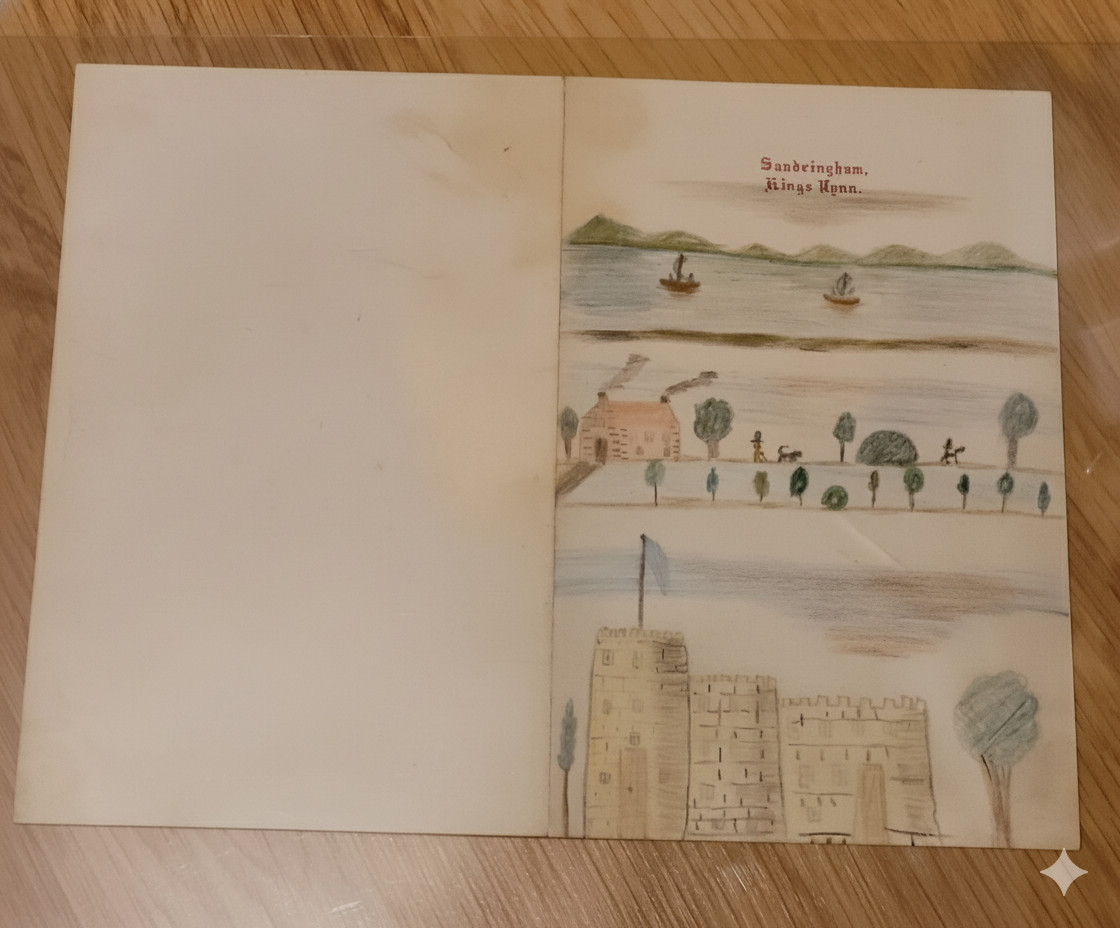
This is an extraordinary and delightfuloriginal pencil sketch and watercolor drawingcreated byPrincess Louise Victoria (1867-1931), the Princess Royal and Duchess of Fife, daughter of King Edward VII.
The drawing is signed and inscribed by the Princess herself, dating it toMay 1st, 1877, when she was justten years old.
Detailed Description:
Artist:H.R.H. Princess Louise Victoria Alexandra Dagmar, Princess Royal, Duchess of Fife (1867-1931).
Date:May 1st, 1877.
Location:Sandringham, Kings Lynn (as noted on the drawing).
Condition:The drawing is a folded sheet, showing signs of age consistent with a 147-year-old paper item, including slight toning and foxing, but the colorful pencil work is clear. It is currently preserved in a mylar sleeve (which causes the minor glare/brightness).
Artistic Content:
The drawing is an early, charming example of the Princess\'s artistic talent:
Page 1 (Front/Outer):A rustic scene titled \"Sandringham, Kings Lynn.\" It depicts a castle (likely Sandringham House, or a local castle like King\'s Lynn\'s), a house, trees, men with dogs, a lake/river, and two small boats sailing.
Page 2 (Inner Left):Features two small, charming drawings: a well/thimble(?) and a cross/grave marker.
Page 3 (Inner Right - Inscription Side):Features a drawing of asmoking frying panand an inscription written in neat cursive:\"From Louise to dear Jennie May$1^{st}$1877.\"(Note: The accompanying description confirms the inscription is \"To Dear Jonnie,\" but the name in the image appears to be \"Jennie\" or a similar style, a point of historical detail). LOUISE VICTORIA (Alexandra Dagmar, 1867-1931, Princess Royal, Duchess of Fife,. Daughter of Edward VII). Delightful original coloured picture signed and inscribed \"From Louise To Dear Jonnie May 1st 1877\", in pencil, the picture on the inside with the inscription shows a smoking frying pan, a cross and a thimble(?), on the front is a delightful picture of a castle near a lake with boats sailing on it, a house, trees and men with dogs, 3 sides 8vo., Sandringham, Kings Lynn, 1st May 1877. Drawn when she was ten years old.
This piece offers an incredibly rare and intimate glimpse into the childhood and artistic pursuits of a high-ranking member of the British Royal Family, predating her title as Princess Royal. A true collector\'s item of significant historical and royal provenance.
Sandringham is the much-loved Country Retreat of the Royal family, and has been the private home to four generations of British monarchs since 1862.
Sandringham Royal Parkland spans over 243 hectares for visitors to enjoy. Planted with a mixture of evergreen and deciduous trees, mainly Corsican and Scots Pine mixed with Oak, Sweet Chestnut and Birch, and supports an abundance of animals, birds and plants.
The Royal Park is open daily throughout the year to walk or cycle and is dog friendly with a natural woodland Children’s Play Area, there are also two waymarked Nature Trails and an orienteering trail. The Courtyard in the Parkland has the Sandringham Shop, Sandringham Restaurant offering Afternoon Tea and Terrace Take Away Café.The Children’s Play Area in the Royal Park is open all year (tickets are not needed to visit but car parking charges apply)
Sandringham is the much-loved country retreat of Their Majesties King Charles III and Queen Camilla. Including an organic farm, sawmill, residential and commercial properties, local parishes and communities nestled in the heart of The Norfolk Coast Area of Outstanding Natural Beauty.
Louise, Princess Royal (Louise Victoria Alexandra Dagmar; 20 February 1867 – 4 January 1931) was the third child and eldest daughter of King Edward VII and Queen Alexandra of the United Kingdom. She was a younger sister of King George V. Louise was granted the title of Princess Royal in 1905. Known for her reserved and quiet nature, she remained a low-profile member of the royal family throughout her life.
Early life
Portrait of Princess Louise by James Sant, 1872Louise was born on 20 February 1867 at Marlborough House, the London residence of her parents, the Prince and Princess of Wales.[2] Louise\'s father was the eldest son of Queen Victoria and Prince Albert. Her mother was the eldest daughter of Christian IX and Queen Louise of Denmark. She was named Louise Victoria Alexandra Dagmar, after her maternal grandmother Queen Louise; her paternal grandmother, Queen Victoria; her mother, Alexandra, Princess of Wales; and her aunt, the Tsesarevna of Russia.[3] From birth, as a male-line granddaughter of the British monarch, she had the title Her Royal Highness Princess Louise of Wales.[4][5] She was baptized at Marlborough House on 10 May by Charles Longley, Archbishop of Canterbury.[a]Her mother, Alexandra, suffered from rheumatic fever shortly before Louise\'s birth, leaving her with a permanent limp. Louise herself was considered a delicate child and was frequently unwell.[6] The Wales children were brought up largely at Marlborough House and Sandringham, where they enjoyed a relatively informal and happy childhood.[7][2] In her youth, Louise was described as a very withdrawn girl.[8][9]Louise and her sisters, Victoria and Maud were educated at home under the supervision of private tutors and studied guitar under Catharina Pratten.[10] They were noted for their spirited and playful behavior, often engaging in pillow fights and other \"unladylike pastimes.\"[11] Their mother\'s strong influence meant the girls remained close to home.As a child, Louise accompanied her mother and siblings on several extended family visits to Copenhagen and to Bernstorff Palace, where her mother had grown up.[12] Like her sisters, she was a bridesmaid at the wedding of her paternal aunt Princess Beatrice to Prince Henry of Battenberg in 1885.[13]Louise was an accomplished musician, and sometimes played the organ in services at St Mary Magdalene Church at Sandringham.[14] She was known as Lulu or Toots to her close family.[15]
Marriage and children
The Duke and Duchess of Fife, 1889As daughter of the Prince of Wales, Louise was considered a very desirable match as a bride. She was tiring of her over-protective mother and longed to escape, yet without making a \'grand marriage\' to a European prince, following her aunt the Duchess of Argyll, who married outside royalty.[16] Louise was introduced to Alexander Duff, 6th Earl of Fife at the wedding of her aunt Princess Beatrice in 1885, who was a regular companion of her father and eighteen years her senior. Four years later, she asked for her grandmother, Queen Victoria\'s permission to marry the Earl, insisting that if she was not allowed to marry him she would surely die an old maid.[17]Queen Victoria gave Louise consent, and in June 1889 their engagement was announced.[16] There was criticism at court where it was thought to be wrong for a princess to marry someone not of royal blood.[16] Princess Victoria Mary of Teck expressed to her aunt, Augusta, Grand Duchess of Mecklenburg-Strelitz that \"for a future Princess Royal to marry a subject seems rather strange.\"[16]Despite her mother\'s attempts to keep her daughters unmarried and by her side, on 27 July 1889, Louise married Alexander Duff, 6th Earl Fife, who was eighteen years her senior, at the Private Chapel in Buckingham Palace with the Archbishop of Canterbury officiating at the service.[18] They were third cousins through an illegitimate line, as Alexander was a great-grandchild of William IV and his mistress, Dorothea Jordan. Her bridesmaids were Princesses Maud and Victoria of Wales, Victoria Mary of Teck, Marie Louise and Helena Victoria of Schleswig-Holstein and the Countesses Feodora, Helena and Valda Gleichen.[18] “O Perfect Love, all human thought transcending\", was written by Dorothy Blomfield for her sister\'s marriage in 1883, and was intended to be sung to Strength and Stay, in Hymns Ancient & Modern, No. 12. Subsequently, it was set as an anthem by J. Barnby for the marriage of the Duke of Fife with the Princess Louise of Wales that day. The Duchess of Teck wrote soon after the wedding, \"They both seem so thoroughly happy and contented that it does one\'s heart good to see them.\"[19]Two days after the wedding, Queen Victoria created him Duke of Fife and Marquess of Macduff in the Peerage of the United Kingdom. The letters patent creating this dukedom contained the standard remainder to heirs male of the body lawfully begotten.[20] After the birth of their two daughters, on 24 April 1900, Queen Victoria signed letters patent creating a second Dukedom of Fife, along with the Earldom of Macduff in the Peerage of the United Kingdom with a special remainder: in default of a male heir, these peerages would pass to the daughters of the 1st Duke, and then to their male descendants.
Louise with her daughters, Maud and Alexandra, 1911The Duke and Duchess of Fife had three children:[8] Alastair Duff, Marquess of Macduff (stillborn 16 June 1890)
Princess Alexandra, 2nd Duchess of Fife (17 May 1891 – 26 February 1959); married her first cousin once removed Prince Arthur of Connaught (13 January 1883 – 12 September 1938), and had issue.
Princess Maud (3 April 1893 – 14 December 1945); married Charles Carnegie, 11th Earl of Southesk, and had issue.Family homes and interestsPrior to her marriage, Louise\'s principal artistic pursuits were music and the family hobby of photography.[21] Following her marriage, she developed a previously untapped talent for painting and interior design,[22][23] which she first applied in planning the interior decoration of Fife House. When a plumber\'s candle accidentally caused a fire that destroyed the original Mar Lodge,[24] the new Mar Lodge, comprising one hundred and twenty rooms, was constructed based on a rough sketch drawn by Louise and further elaborated on by their architect.[21]Though always happiest in the country, when in London Louise was an enthusiastic patron of theatre and the opera, and her opinions were always sought by King George V and her sister-in-law, Queen Mary.[25] Louise was an accomplished amateur actress in her younger days and on one occasion was coached by Ellen Terry.[26]The Duke and the Duchess made their main home at Mar Lodge, a sporting lodge built for them by Alexander Marshall Mackenzie.[27] They owned Fife House in Brighton, sometimes residing there and East Sheen Lodge in Richmond from 1889 until they sold the Lodge in 1908.[28]
London residenceIn the lead up to their marriage, Lord Fife purchased the lease of a London townhouse at 15 Portman Square, London in July 1889.[29] Louise continued to live at 15 Portman Square following her husband\'s death in 1912 until her own death in 1931, following which a large sale of the contents of the house was held in February 1932.[30] In December 1933 newspapers reported that Louise\'s younger daughter Princess Maud, Countess of Southesk had agreed to loan the house for an exhibition of English needlework in aid of the Artists\' Benevolent Institution, to be held during February and March 1935.[31] The houses at 15 to 18 Portman Square were demolished in 1935,[32] and a large apartment building was constructed in their place by May 1936.[33]
Princess Royal
Louise, Princess Royal, 1905On 9 November 1905, Edward VII created Louise the Princess Royal,[16] the highest honour bestowed on a female member of the royal family, succeeding her aunt, Victoria, German Empress, who died in 1901.[5][34] At the same time, the King declared that the two daughters of the Princess Royal would be styled as princesses, with the style and attribute of \"Highness\" and with precedence immediately after all members of the royal family bearing the style of \"Royal Highness\".[35]In August 1910, Princess Louise\'s daughter, Alexandra, secretly became engaged to Prince Christopher of Greece and Denmark. Upon hearing the news, the Duke of Fife disapproved of the match and forbade the union.[4] On 15 October 1913, Alexandra married Louise\'s first cousin, Prince Arthur of Connaught.[36]The Princess Royal was noted for her steady involvement in charitable and public-service work throughout her life.[37] She supported a wide range of organisations, taking a particular interest in the activities of the Church Army and serving as a patron of the Alexandra Girls\' Club. In addition to her regular charitable visits and engagements, she held roles in several civic and philanthropic bodies, including serving as President of the London branch of the British Red Cross Society and supporting groups such as the Theatrical Ladies\' Guild, the Greater London Fund for the Blind, the RSPCA, and the British and Foreign Sailors\' Society. She also served as patron of the Ladies\' Association in aid of Princess Christian\'s Fund for the Deaf and Dumb, a charitable organisation established under her aunt, Princess Christian. Although known for her generally reserved public profile, she maintained a consistent commitment to charitable causes and undertook various ceremonial duties, including the launch of HMS Princess Royal in 1911.[38][39]On 12 December 1911, she attended the coronation of her brother, King George V.[40] Later that month, while sailing aboard the P&O\'s SS Delhi, to Egypt, the Princess Royal and her family were shipwrecked off the coast of Morocco.[41] Louise and her husband refused to leave until all the women and children had been rescued and were among the last to leave. During the rescue, Louise lost her jewel case and both Alexandra and Maud, and herself were thrown into the sea by a large wave.[42] Although they were otherwise unharmed, the Duke of Fife fell ill with pleurisy, probably contracted as a result of the shipwreck.[2] He died at Assuan, Egypt, in January 1912, and Princess Alexandra succeeded to his dukedom, becoming Duchess of Fife in her own right.[8][43]
Later life and death
Louise with her daughter Maud and grandson Alastair, 1918After the death of her husband, the Princess Royal led a reclusive life.[44] She spent most of her time in Braemar, Scotland, at the Mar Lodge, but frequently made visits to London.[44] In her later years, Princess Louise faced financial difficulties due to the affairs of her family friend Lord Farquhar. Farquhar, a close family friend and advisor, had managed or been involved in investments and assets connected to the Fife family. Although generally a shrewd businessman, in his later years he reportedly suffered mental decline and neglected his affairs, and when he died in 1923 his estate was found in chaotic disorder, leaving unpaid debts and legacies. Although Louise was not legally liable, she arranged the sale of part of her art collection, including Romneys, and some furnishings from her London residence to protect her finances and the family\'s reputation.[45]The Princess Royal was taken ill with gastric haemorrhaging, including attacks in April 1925 and October 1929 at Mar Lodge, and was brought back to London to receive nursing care.[34][46] At her house in Portman Square she was given the best nursing and medical attention possible as befitted a king\'s sister, but all to no avail. She lingered on listlessly for another fifteen months, soothed by the solicitude of her family. Her last letter to Queen Mary talked of going out of a morning, and then back to bed. Spending so much time resting, she was grateful for the regular gifts of flowers, \'which make my room so light.\'[47]
Grave in St Ninian\'s Chapel, BraemarOn 4 January 1931 at 2:30 pm, Louise died in her sleep at her home at 15 Portman Square London, with her two daughters, Alexandra and Maud, at her bedside.[34] She was 63 years old. Per her death certificate, her cause of death was attributed to valvular heart disease, which then led to heart failure.[34] She was tenth in line to the throne at the time of her death. Her sister Princess Victoria saw her passing as a release, and wrote to their sister, Queen Maud; \"Louise suffered so terribly these last few months that one can but thank God. She is at peace with her dear ones. But it\'s sad for us, and the loss of a sister comes very near one\'s heart.\"[48]A simple funeral took place on 10 January 1931 at St. George\'s Chapel, Windsor Castle, where she was initially interred.[34] Her remains were later removed to the Private Chapel, Mar Lodge, Braemar, Aberdeenshire.[5] Her will was sealed and her estate was valued at £46,383 (or £2.2 million in 2022 when adjusted for inflation).[49]
Honours and arms 1885: Royal Order of Victoria and Albert
6 August 1887: Imperial Order of the Crown of India[50]
1929: Dame Grand Cross of the Venerable Order of St John of Jerusalem (GCStJ)
1888–1929: Lady of the Venerable Order of St John of Jerusalem (LJStJ)Honorary military appointments 1911: Lady Sponsor of HMS Princess Royal[51]
1914: Colonel-in-chief of the 7th Dragoon Guards[52]
1922: Colonel-in-chief of the 4th/7th Royal Dragoon Guards[52]ArmsUpon her marriage, Louise was granted a coat of arms, being the Royal Arms of the United Kingdom with an inescutcheon for Saxony, all differenced with a label argent of five points, the outer pair and centre bearing crosses gules, and the inner pair bearing thistles proper.[53] The inescutcheon was dropped by royal warrant in 1917.
Princess Louise\'s coat of arms until 1917
Fife Arms Hotel, Braemar: Arms of the Duke and Duchess of Fife
AncestorsDuchess of Fife is typically the wife of the Duke of Fife, an extant title in the Peerage of the United Kingdom which has been created twice, in both cases for Alexander Duff, 6th Earl Fife. In one case, however, the incumbent was Duchess of Fife in her own right (suo jure).
Photo Name Arms Father Birth Marriage Became Duchess Ceased to be Duchess Death Spouse
Princes Louise of Wales Edward VII 20 February 1867 22 April 1900 24 April 1900 29 January 1912husband\'s death
4 January 1931 Alexander Duff, 1st Duke of Fife
Princess Alexandra, 2nd Duchess of Fife[1] Alexander Duff, 1st Duke of Fife 17 May 1891 15 October 1913 4 January 1931Fathers\'s death
26 February 1959her death
Prince Arthur of Connaught(m. 1913; died 1938)
The Hon. Caroline Dewar Henry Dewar, 3rd Baron Forteviot 12 February 1934 11 September 1956 26 February 1959 1966Divorce
Alive James Carnegie, 3rd Duke of Fife
Caroline Bunting Martin Brian Bunting 13 November 1961 16 June 1987 22 June 2015 Incumbent David Carnegie, 4th Duke of FifePrincess Royal is a title customarily (but not automatically) awarded by British monarchs to their eldest daughters. Although purely honorary, it is the highest honour that may be given to a female member of the royal family.[1] There have been seven Princesses Royal; Princess Anne became Princess Royal in 1987.[2]The title Princess Royal came into existence when Queen Henrietta Maria (1609–1669), daughter of Henry IV, King of France, and wife of King Charles I (1600–1649), wanted to imitate the way the eldest daughter of the King of France was styled \"Madame Royale\".[3] Thus, Princess Mary (born 1631), the daughter of Henrietta Maria and Charles, became the first Princess Royal in 1642.It has become established that the title belongs to no one by right, but is given entirely at the sovereign\'s discretion. Princess Mary (later Queen Mary II) (1662–1694), the elder daughter of King James II, and Princess Sophia Dorothea (1687–1757), the only daughter of King George I, were eligible for this honour but did not receive it. At the time they respectively became eligible for the style, Princess Mary was already Princess of Orange, and Sophia Dorothea was already Queen in Prussia.[1] A Princess Royal has never acceded to the British throne; Princess Victoria, the eldest daughter of Queen Victoria, was the only Princess Royal to simultaneously be heiress presumptive, until she was displaced by the birth of her brother Prince Albert Edward.Princess Louisa Maria (1692–1712), the youngest daughter of King James II (died 1701), born after he lost his crown in the Glorious Revolution of 1688–1689, was considered to be Princess Royal during James\'s exile by Jacobites at Saint-Germain-en-Laye and was so called by them, even though she was not James\'s eldest living daughter at any time during her life.[3]The title is held for life, even if the holder outlives her parent the monarch. On the death of a Princess Royal, the style is not inherited by any of her daughters; instead, if the monarch parent of the late Princess Royal has also died, the new monarch may bestow it upon his or her own eldest daughter. Thus, Princess Louise was granted the style of Princess Royal by her father King Edward VII in 1905; she retained it until her death in 1931, more than twenty years into the reign of her brother King George V. Only upon Louise\'s death did the title become available for George\'s own daughter, Princess Mary, who was granted the title in 1932, retaining it until her death in 1965. Because Mary outlived not only her father but also her brother King George VI, the title was never available during George VI\'s reign to be granted to his elder daughter Princess Elizabeth (later Queen Elizabeth II), though she would otherwise have been eligible to hold it.[1]Customarily, when a princess marries, she takes on her husband\'s title. If her husband has a lower title or style, her style as a princess remains in use, although it may then be combined with her style by marriage, e.g. HRH The Princess Louise, Duchess of Argyll or HRH Princess Alice, Countess of Athlone – if that princess had a territorial designation, she may cease its use. Exceptionally, however, a princess who has been granted the title of HRH The Princess Royal will not customarily combine it with her style by marriage. For example, Princess Anne has been Her Royal Highness The Princess Royal since being given the title in 1987; prior to that, her formal title was Her Royal Highness The Princess Anne, Mrs Mark Phillips.[4]
List of title holdersThe following is a complete list of women formally styled Princess Royal:
Order Princess Royal (from [date] to [date]) Portrait Coat of Arms Born Tenure Marriages Died
1 Princess Mary
1642–1660
(also: Princess of Orange and Countess of Nassau (1647)) 4 November 1631, St. James\'s Palace, London; daughter of King Charles I and Queen Henrietta Maria 18 years 2 May 1641
William II, Prince of Orange (1 son) 24 December 1660, Whitehall Palace, London
2 Princess Anne
1727–1759
(also: Princess of Orange (1734)) 2 November 1709, Herrenhausen Palace, Hanover; daughter of King George II and Queen Caroline 32 years 25 March 1734
William IV of Orange (3 children) 12 January 1759, The Hague, Netherlands
3 Princess Charlotte
1789–1828
(also: Duchess of Württemberg (1797), Queen consort of Württemberg (1806)) 29 September 1766, Buckingham House, London; daughter of King George III and Queen Charlotte 39 years 18 May 1797
Frederick I of Württemberg (1 daughter) 5 October 1828, Ludwigsburg Palace, Baden-Württemberg
4 Princess Victoria
1841–1901
(also: German Empress and Queen consort of Prussia (1888)) 21 November 1840, Buckingham Palace, London; daughter of Queen Victoria and Prince Albert 60 years 25 January 1858
Frederick III, German Emperor (8 children) 5 August 1901, Schloss Friedrichshof, Hesse
5 Princess Louise
1905–1931
(also: Duchess of Fife (1889)) 20 February 1867, Marlborough House, London; daughter of King Edward VII and Queen Alexandra 26 years 27 July 1889
Alexander Duff, 1st Duke of Fife (3 children) 4 January 1931, Portman Square, London
6 Princess Mary
1932–1965
(also: Countess of Harewood (1929)) 25 April 1897, York Cottage, Sandringham; daughter of King George V and Queen Mary 33 years 28 February 1922
Henry Lascelles, 6th Earl of Harewood (2 sons) 28 March 1965, Harewood House, West Yorkshire
7 Princess Anne
1987–present
15 August 1950, Clarence House, London; daughter of Queen Elizabeth II and Prince Philip 38 years 14 November 1973
Mark Phillips (2 children)
—
12 December 1992
Sir Timothy Laurence —
now 75 years, 81 daysEdward VII (Albert Edward; 9 November 1841 – 6 May 1910) was King of the United Kingdom and the British Dominions, and Emperor of India, from 22 January 1901 until his death in 1910.The second child and eldest son of Queen Victoria and Prince Albert of Saxe-Coburg and Gotha, Edward, nicknamed \"Bertie\", was Prince of Wales and heir apparent to the British throne for almost 60 years. During his mother\'s long reign, he was largely excluded from political influence and came to personify the leisured elite. He married Princess Alexandra of Denmark in 1863; the couple had six children. As Prince of Wales, Edward travelled throughout Britain performing ceremonial public duties and represented Britain on visits abroad. His tours of North America in 1860 and of the Indian subcontinent in 1875 proved popular successes. Despite this public approval, his reputation as a playboy prince soured his relationship with his mother.Edward inherited the throne on his mother\'s death in 1901. He played a role in the modernisation of the British Home Fleet and the reorganisation of the British Army after the Second Boer War of 1899 to 1902. He re-instituted traditional ceremonies as public displays and broadened the range of people with whom royalty socialised. He fostered good relations between Britain and other European countries, especially France, for which he was popularly called \"Peacemaker\", but his relationship with his nephew, German Emperor Wilhelm II, was poor.The Edwardian era, which covered Edward\'s reign and was named after him, coincided with the start of a new century and heralded significant changes in technology and society, including steam turbine propulsion and the rise of socialism. Edward died in the midst of a constitutional crisis that was resolved by the Parliament Act 1911, which restricted the power of the unelected House of Lords. Edward was succeeded by his only surviving son, George V.
Early life and education
Portrait of Edward by Franz Xaver Winterhalter, 1846
The Christening of the Prince of Wales in St. George\'s Chapel, Windsor, 25 January 1842Edward was born at 10:48 am on 9 November 1841 at Buckingham Palace.[1] He was the eldest son and second child of Queen Victoria and her husband, Prince Albert of Saxe-Coburg and Gotha. He was christened Albert Edward at St George\'s Chapel, Windsor Castle, on 25 January 1842.[a] He was named Albert after his father and Edward after his maternal grandfather, Prince Edward, Duke of Kent and Strathearn. He was known as Bertie to the royal family throughout his life.[3]As the eldest son of the British sovereign, Edward was automatically Duke of Cornwall and Duke of Rothesay at birth. As a son of Prince Albert, he also held the titles of Prince of Saxe-Coburg and Gotha and Duke of Saxony. He was created Prince of Wales and Earl of Chester on 8 December 1841, Earl of Dublin on 17 January 1850,[4][5][b] a Knight of the Garter on 9 November 1858, and a Knight of the Thistle on 24 May 1867.[4] In 1863, he renounced his succession rights to the Duchy of Saxe-Coburg and Gotha in favour of his younger brother Alfred.[7]The Queen and Prince Albert were determined that their eldest son should have an education that would prepare him to be a model constitutional monarch. At age seven, Edward embarked on a rigorous educational programme devised by Albert, and supervised by several tutors. Unlike his elder sister Victoria, he did not excel in his studies.[8] He tried to meet the expectations of his parents, but to no avail. Although Edward was not a diligent student—his true talents were those of charm, sociability and tact—Benjamin Disraeli described him as informed, intelligent and of sweet manner.[9] After the completion of his secondary-level studies, his tutor Frederick Waymouth Gibbs was replaced by Robert Bruce as his personal governor.[10]After an educational trip to Rome, undertaken in the first few months of 1859, Edward spent the summer of that year studying at the University of Edinburgh under, among others, the chemist Lyon Playfair. In October, he matriculated as an undergraduate at Christ Church, Oxford.[11] Now released from the educational strictures imposed by his parents, he enjoyed studying for the first time and performed satisfactorily in examinations.[12] In 1861, he transferred to Trinity College, Cambridge,[13] where he was tutored in history by Charles Kingsley, Regius Professor of Modern History.[14] Kingsley\'s efforts brought forth the best academic performances of Edward\'s life, and Edward actually looked forward to his lectures.[15]
Early adulthood
Edward and his entourage at Niagara Falls, 1860In 1860, Edward undertook the first tour of North America by a Prince of Wales. His genial good humour and confident bonhomie made the tour a great success.[16] He inaugurated the Victoria Bridge, Montreal, across the St Lawrence River, and laid the cornerstone of Parliament Hill, Ottawa. He watched Charles Blondin traverse Niagara Falls by highwire, and stayed for three days with President James Buchanan at the White House. Buchanan accompanied the prince to Mount Vernon, to pay his respects at the tomb of George Washington. Vast crowds greeted Edward everywhere. He met Henry Wadsworth Longfellow, Ralph Waldo Emerson and Oliver Wendell Holmes Sr. Prayers for the royal family were said in Trinity Church, New York, for the first time since 1776.[16] The four-month tour throughout Canada and the United States considerably boosted Edward\'s confidence and self-esteem, and had many diplomatic benefits for Great Britain.[17]Edward had hoped to pursue a career in the British Army, but his mother vetoed an active military career.[18] He had been gazetted colonel on 9 November 1858[19]—to his disappointment, as he had wanted to earn his commission by examination.[12] In September 1861, he was sent to Germany, supposedly to watch military manoeuvres, but actually in order to engineer a meeting between him and Princess Alexandra of Denmark. The Queen and Prince Albert had already decided that Edward and Alexandra should marry. They met at Speyer on 24 September under the auspices of Edward\'s elder sister, Victoria, who had married the Crown Prince of Prussia in 1858.[20] Princess Victoria, acting upon instructions from her mother, had met Alexandra at Strelitz in June; Alexandra made a very favourable impression. She and Edward were friendly from the start, and marriage plans advanced.[21]Edward gained a reputation as a playboy. Determined to get some army experience, he attended manoeuvres in Ireland, during which he spent three nights with an actress, Nellie Clifden, who was hidden in the camp by his fellow officers.[22] Albert, though ill, was appalled and visited Edward at Cambridge to issue a reprimand. Albert died in December 1861, just two weeks after the visit. The Queen was inconsolable, wore mourning clothes for the rest of her life and blamed Edward for his father\'s death.[23] At first, she regarded her son with distaste as frivolous, indiscreet and irresponsible. She wrote to her eldest daughter, \"I never can, or shall, look at him without a shudder.\"[24]
Marriage
Main article: Wedding of Prince Albert Edward and Princess Alexandra
Edward and Alexandra, 1863Once widowed, the Queen effectively withdrew from public life. Shortly after Prince Albert\'s death, she arranged for Edward to embark on an extensive tour of the Middle East, visiting Egypt, Jerusalem, Damascus, Beirut and Istanbul.[25] The British government wanted Edward to secure the friendship of Egypt\'s ruler, Said Pasha, to prevent French control of the Suez Canal if the Ottoman Empire collapsed. It was the first royal tour on which an official photographer, Francis Bedford, was in attendance.As soon as Edward returned to Britain, preparations were made for his engagement, which was sealed at Laeken in Belgium on 9 September 1862.[26] Edward married Alexandra at St George\'s Chapel, Windsor Castle, on 10 March 1863. He was 21; she was 18.
Edward and Alexandra on their wedding day, 1863The couple established Marlborough House as their London residence and Sandringham House in Norfolk as their country retreat. They entertained on a lavish scale. Their marriage met with disapproval in certain circles because most of the Queen\'s relations were German, and Denmark was at loggerheads with Germany over the territories of Schleswig and Holstein. When Alexandra\'s father, King Christian IX, inherited the throne of Denmark in November 1863, the German Confederation took the opportunity to invade and annex Schleswig-Holstein. The Queen was of two minds as to whether it was a suitable match, given the political climate.[27] After the marriage, she expressed anxiety about their socialite lifestyle and attempted to dictate to them on various matters, including the names of their children.[28]
London Bridge on the Night of the Marriage of the Prince and Princess of Wales, by William Holman Hunt (1864)Edward had mistresses throughout his married life. He socialised with actress Lillie Langtry; Lady Randolph Churchill;[c] Daisy Greville, Countess of Warwick; actress Sarah Bernhardt; noblewoman Lady Susan Vane-Tempest; singer Hortense Schneider; prostitute Giulia Beneni (known as \"La Barucci\"); wealthy humanitarian Agnes Keyser; and Alice Keppel. At least fifty-five liaisons are conjectured.[30][31] How far these relationships went is not always clear. Edward always strove to be discreet, but this did not prevent society gossip or press speculation.[32] Keppel\'s great-granddaughter Camilla Parker Bowles became the mistress and subsequent wife of King Charles III, Edward\'s great-great-grandson. It was rumoured that Camilla\'s grandmother Sonia Keppel was fathered by Edward, but she was \"almost certainly\" the daughter of George Keppel, whom she resembled.[33] Edward never acknowledged any illegitimate children.[34] Alexandra was aware of his affairs, and seems to have accepted them.[35]In 1869, Sir Charles Mordaunt, a British Member of Parliament, threatened to name Edward as co-respondent in his divorce suit. Ultimately, he did not do so but Edward was called as a witness in the case in early 1870. It was shown that Edward had visited the Mordaunts\' house while Sir Charles was away sitting in the House of Commons. Although nothing further was proven and Edward denied he had committed adultery, the suggestion of impropriety was damaging.[12][36]
Heir apparentDuring his mother\'s widowhood, Edward pioneered the idea of royal public appearances as they are understood today—for example, opening the Thames Embankment in 1871, the Mersey Railway Tunnel in 1886, and Tower Bridge in 1894[37]—but his mother did not allow him an active role in the running of the country until 1898.[38][39] He was sent summaries of important government documents, but she refused to give him access to the originals.[12] Edward annoyed his mother, who favoured the Germans, by siding with Denmark on the Schleswig-Holstein Question in 1864 and in the same year annoyed her again by making a special effort to meet Giuseppe Garibaldi, the Italian general and revolutionary, who was a leader in the movement for Italian unification.[40] Liberal Prime Minister William Ewart Gladstone sent him papers secretly.[12] From 1886, Foreign Secretary Lord Rosebery sent him Foreign Office despatches, and from 1892 some Cabinet papers were opened to him.[12]In 1870 republican sentiment in Britain was given a boost when the French Emperor, Napoleon III, was defeated in the Franco-Prussian War and the French Third Republic was declared.[41] However, in the winter of 1871, a brush with death led to an improvement in both Edward\'s popularity with the public and his relationship with his mother. While staying at Londesborough Lodge, near Scarborough, North Yorkshire, Edward contracted typhoid fever, the disease that was believed to have killed his father. There was great national concern, and one of his fellow guests (Lord Chesterfield) died. Edward\'s recovery was greeted with almost universal relief.[12] Public celebrations included the composition of Arthur Sullivan\'s Festival Te Deum. Edward cultivated politicians from all parties, including republicans, as his friends, and thereby largely dissipated any residual feelings against him.[42]
Edward beside an elephant
Edward (front left) in India, 1875–76On 26 September 1875, Edward set off for India on an extensive eight-month tour; on the way, he visited Malta, Brindisi and Greece. His advisors remarked on his habit of treating all people the same, regardless of their social station or colour. In letters home, he complained of the treatment of the native Indians by the British officials: \"Because a man has a black face and a different religion from our own, there is no reason why he should be treated as a brute.\"[43] Consequently, Lord Salisbury, the Secretary of State for India, issued new guidance and at least one resident was removed from office.[12] He returned to England on 11 May 1876, after stopping off at Portugal.[44] At the end of the tour, Queen Victoria was given the title Empress of India by Parliament, in part as a result of the tour\'s success.[45]Edward was regarded worldwide as an arbiter of men\'s fashions.[46][47] He made wearing tweed, Homburg hats and Norfolk jackets fashionable, and popularised the wearing of black ties with dinner jackets, instead of white tie and tails.[48] He pioneered the pressing of trouser legs from side to side in preference to the now normal front and back creases,[49] and was thought to have introduced the stand-up turn-down shirt collar, created for him by Charvet.[50] A stickler for proper dress, he is said to have admonished Lord Salisbury for wearing the trousers of an Elder Brother of Trinity House with a privy councillor\'s coat. Deep in an international crisis, Salisbury informed Edward that it had been a dark morning, and that \"my mind must have been occupied by some subject of less importance.\"[51] The tradition of men not buttoning the bottom button of waistcoats is said to be linked to Edward, who supposedly left his undone because of his large girth.[12][52] His waist measured 48 inches (122 cm) shortly before his coronation.[53] He introduced the practice of eating roast beef and potatoes with horseradish sauce and Yorkshire pudding on Sundays, a meal that remains a staple British favourite for Sunday lunch.[54] He was a lifelong heavy smoker, but not a heavy drinker, though he did drink champagne and, occasionally, port.[55]Edward was a patron of the arts and sciences and helped found the Royal College of Music. He opened the college in 1883 with the words, \"Class can no longer stand apart from class ... I claim for music that it produces that union of feeling which I much desire to promote.\"[45] At the same time, he enjoyed gambling and country sports, and was an enthusiastic hunter. He ordered all the clocks at Sandringham to run half an hour ahead to provide more daylight time for shooting. This tradition of so-called Sandringham time continued until 1936, when it was abolished by Edward VIII.[56] He also laid out a golf course at Windsor. By the 1870s Edward had taken a keen interest in horseracing and steeplechasing. In 1896, his horse Persimmon won both the Derby and the St Leger. In 1900, Persimmon\'s brother, Diamond Jubilee, won five races, including the Triple Crown of Derby, St Leger and 2000 Guineas, as well as the Newmarket Stakes and Eclipse Stakes.[57] The same year, another of Edward\'s horses, Ambush II, won the Grand National.[58]
Edward (right) with his mother (centre); his niece Empress Alexandra of Russia (far left); her husband, Tsar Nicholas II; and their daughter Olga, 1896In 1891 Edward was embroiled in the royal baccarat scandal, when it was revealed he had played an illegal card game for money the previous year. He was forced to appear as a witness in court for a second time when one of the participants unsuccessfully sued his fellow players for slander after being accused of cheating.[59] In the same year Edward was involved in a personal conflict, when Lord Charles Beresford threatened to reveal details of Edward\'s private life to the press, as a protest against Edward interfering with Beresford\'s affair with Daisy Greville, Countess of Warwick. The friendship between the two men was irreversibly damaged, and their bitterness would last for the remainder of their lives.[60] Usually, Edward\'s outbursts of temper were short-lived, and \"after he had let himself go ... [he would] smooth matters by being especially nice\".[61]In late 1891, Edward\'s eldest son, Albert Victor, was engaged to Princess Victoria Mary of Teck. Just a few weeks later, in early 1892, Albert Victor died of pneumonia. Edward was grief-stricken. \"To lose our eldest son\", he wrote, \"is one of those calamities one can never really get over\". Edward told the Queen, \"[I would] have given my life for him, as I put no value on mine\".[62] Albert Victor was the second of Edward\'s children to die. In 1871, his youngest son, Alexander John, had died just 24 hours after being born. Edward had insisted on placing Alexander John in a coffin personally with \"the tears rolling down his cheeks\".[63]On his way to Denmark through Belgium on 4 April 1900, Edward was the victim of an attempted assassination when 15-year-old Jean-Baptiste Sipido shot at him in protest over the Second Boer War. The culprit was acquitted by a Belgian court because he was underage.[64] The perceived laxity of the Belgian authorities, combined with British disgust at Belgian atrocities in the Congo, worsened the already poor relations between the United Kingdom and the Continent. However, in the next ten years, Edward\'s affability and popularity, as well as his use of family connections, assisted Britain in building European in coronation robes holding a sceptre. A crown and orb are on the table to his right.
Portrait by Sir Luke Fildes, 1901When his mother died on 22 January 1901, Edward became King of the United Kingdom, Emperor of India and, in an innovation, King of the British Dominions.[66] He chose to reign under the name of Edward VII, instead of Albert Edward—the name his mother had intended for him to use[d]—declaring that he did not wish to \"undervalue the name of Albert\" and diminish the status of his father with whom the \"name should stand alone\".[67] The numeral VII was occasionally omitted in Scotland, even by the national church, in deference to protests that the previous Edwards were English kings who had \"been excluded from Scotland by battle\".[12] J. B. Priestley recalled, \"I was only a child when he succeeded Victoria in 1901, but I can testify to his extraordinary popularity. He was in fact the most popular king England had known since the earlier 1660s.\"[68]
Caricature in Puck magazine, 1901Edward donated his parents\' house, Osborne on the Isle of Wight, to the state and continued to live at Sandringham.[69] He could afford to be magnanimous; his private secretary, Sir Francis Knollys, claimed that he was the first heir to succeed to the throne in credit.[70] Edward\'s finances had been ably managed by Sir Dighton Probyn, Comptroller of the Household, and had benefited from advice from Edward\'s financier friends, some of whom were Jewish, such as Ernest Cassel, Maurice de Hirsch and the Rothschild family.[71] At a time of widespread antisemitism, Edward attracted criticism for openly socialising with Jews.[72][73]Edward\'s coronation had originally been scheduled for 26 June 1902. However, two days before, he was diagnosed with appendicitis.[74] The disease was generally not treated operatively. It carried a high mortality rate, but developments in anaesthesia and antisepsis in the preceding 50 years made life-saving surgery possible.[75] Sir Frederick Treves, with the support of Lord Lister, performed a then-radical operation of draining a pint of pus from the infected abscess through an incision in the king\'s abdomen; this outcome showed that the cause was not cancer.[76] The next day, Edward was sitting up in bed, smoking a cigar.[77] Two weeks later, it was announced that he was out of danger. Treves was honoured with a baronetcy (which the King had arranged before the operation)[78] and appendix surgery entered the medical mainstream.[75] Edward was crowned at Westminster Abbey on 9 August 1902 by the Archbishop of Canterbury, Frederick Temple.[74]Edward refurbished the royal palaces, reintroduced the traditional ceremonies, such as the State Opening of Parliament, that his mother had foregone, and founded new honours, such as the Order of Merit, to recognise contributions to the arts and sciences.[79] In 1902, the Shah of Persia, Mozzafar-al-Din, visited England expecting to receive the Order of the Garter. The King refused to bestow the honour on the Shah because the order was meant to be in his personal gift and the Foreign Secretary, Lord Lansdowne, had promised it without his consent. He also objected to inducting a Muslim into a Christian order of chivalry. His refusal threatened to damage British attempts to gain influence in Persia,[80] but Edward resented his ministers\' attempts to reduce his traditional powers.[81] Eventually, he relented and Britain sent a special embassy to the Shah with a full Order of the Garter the following year.[82]
\"Uncle of Europe\"
Relaxing at Balmoral Castle, photograph by Queen AlexandraAs King, Edward\'s main interests lay in the fields of foreign affairs and naval and military matters. Fluent in French and German, he reinvented royal diplomacy by numerous state visits across Europe.[83] He took annual holidays in Biarritz and Marienbad.[56] One of his most important foreign trips was an official visit to France in May 1903 as the guest of President Émile Loubet. Following a visit to Pope Leo XIII in Rome, this trip helped create the atmosphere for the Anglo-French Entente Cordiale, an agreement delineating British and French colonies in North Africa, and ruling out any future war between the two countries. The Entente was negotiated in 1904 between the French foreign minister, Théophile Delcassé, and the British foreign secretary, Lord Lansdowne. It marked the end of centuries of Anglo-French rivalry and Britain\'s splendid isolation from Continental affairs, and attempted to counterbalance the growing dominance of the German Empire and its ally, Austria-Hungary.[84]Edward was related to nearly every other European monarch, and came to be known as the \"uncle of Europe\".[38] German Emperor Wilhelm II and Emperor Nicholas II of Russia were his nephews; Queen Victoria Eugenia of Spain, Crown Princess Margaret of Sweden, Crown Princess Marie of Romania, Crown Princess Sophia of Greece, and Empress Alexandra of Russia were his nieces; King Haakon VII of Norway was both his nephew and his son-in-law; kings Frederick VIII of Denmark and George I of Greece were his brothers-in-law; kings Albert I of Belgium, Ferdinand I of Bulgaria, and Carlos I and Manuel II of Portugal were his second cousins. Edward doted on his grandchildren, and indulged them, to the consternation of their governesses.[85] However, there was one relation whom Edward did not like: Wilhelm II. His difficult relationship with his nephew exacerbated the tensions between Germany and Britain.[86]In April 1908, during Edward\'s annual stay at Biarritz, he accepted the resignation of British Prime Minister Sir Henry Campbell-Bannerman. In a break with precedent, Edward asked Campbell-Bannerman\'s successor, H. H. Asquith, to travel to Biarritz to kiss hands. Asquith complied, but the press criticised the action of the King in appointing a prime minister on foreign soil instead of returning to Britain.[87] In June 1908, Edward became the first reigning British monarch to visit the Russian Empire, despite refusing to visit in 1906, when Anglo-Russian relations were strained in the aftermath of the Russo-Japanese War, the Dogger Bank incident, and the Tsar\'s dissolution of the Duma.[88] The previous month, he visited the Scandinavian countries, becoming the first British monarch to visit Sweden.[89]
Political opinions
Portrait in naval uniform by Vanity Fair magazine, 1902
Edward VII on British 1-penny stamp of 1902While Prince of Wales, Edward had to be dissuaded from breaking with constitutional precedent by openly voting for W. E. Gladstone\'s Representation of the People Bill (1884) in the House of Lords.[12][90] On other matters, he was more conservative; for example, he did not favour giving votes to women,[12][91] although he did suggest that the social reformer Octavia Hill serve on the Commission for Working Class Housing.[92] He was also opposed to Irish Home Rule, instead preferring a form of dual monarchy.[12]As Prince of Wales, Edward had come to enjoy warm and mutually respectful relations with Gladstone, whom his mother detested,[93] but the statesman\'s son, Home Secretary Herbert Gladstone, angered the King by planning to permit Roman Catholic priests in vestments to carry the Host through the streets of London, and by appointing two ladies, Lady Frances Balfour and May Tennant (wife of H. J. Tennant), to serve on a Royal Commission on reforming divorce law—Edward thought divorce could not be discussed with \"delicacy or even decency\" before ladies. Edward\'s biographer Philip Magnus-Allcroft suggests that Gladstone may have become a whipping boy for the King\'s general irritation with the Liberal government. Gladstone was sacked in the reshuffle the following year and the King agreed, with some reluctance, to appoint him Governor-General of South Africa.[94]Edward involved himself heavily in discussions over army reform, the need for which had become apparent with the failings of the Second Boer War.[95] He supported the redesign of army command, the creation of the Territorial Force, and the decision to provide an Expeditionary Force supporting France in the event of war with Germany.[96] Reform of the Royal Navy was also suggested, partly due to the ever-increasing Naval Estimates, and because of the emergence of the Imperial German Navy as a new strategic threat.[97] Ultimately a dispute arose between Admiral Lord Charles Beresford, who favoured increased spending and a broad deployment, and the First Sea Lord Admiral Sir John Fisher, who favoured efficiency savings, scrapping obsolete vessels, and a strategic realignment of the Royal Navy relying on torpedo craft for home defence backed by the new dreadnoughts.[98][99]The King lent support to Fisher, in part because he disliked Beresford, and eventually Beresford was dismissed. Beresford continued his campaign outside of the navy and Fisher ultimately announced his resignation in late 1909, although the bulk of his policies were retained.[100] The King was intimately involved in the appointment of Fisher\'s successor as the Fisher-Beresford feud had split the service, and the only truly qualified figure known to be outside of both camps was Sir Arthur Wilson, who had retired in 1907.[101] Wilson was reluctant to return to active duty, but Edward persuaded him to do so, and Wilson became First Sea Lord on 25 January 1910.[102]
Edward VII (left) and Kaiser Wilhelm II (right)Edward was rarely interested in politics, although his views on some issues were notably progressive for the time. During his reign, he said use of the word nigger was \"disgraceful\", despite it then being in common parlance.[103] In 1904, Wilhelm II and Edward met during an Anglo-German summit in Kiel. Wilhelm, with the Russo-Japanese War in mind, started to go on about the \"Yellow Peril\", which he called \"the greatest peril menacing ... Christendom and European civilisation. If the Russians went on giving ground, the yellow race would, in twenty years time, be in Moscow and Posen\".[104] Wilhelm went on to attack his British guests for supporting Japan against Russia, suggesting that the British were committing \"race treason\". In response, Edward stated that he \"could not see it. The Japanese were an intelligent, brave and chivalrous nation, quite as civilised as the Europeans, from whom they only differed by the pigmentation of their skin\".[104] Although Edward lived a life of luxury often far removed from that of the majority of his subjects, they expected it, and his personal charm with all levels of society and his strong condemnation of prejudice went some way to assuage republican and racial tensions building during his lifetime.[12]
Constitutional crisisIn the last year of his life, Edward became embroiled in a constitutional crisis when the Conservative majority in the House of Lords refused to pass the \"People\'s Budget\" proposed by the Liberal government of Prime Minister Asquith. The crisis eventually led—after Edward\'s death—to the removal of the Lords\' right to veto legislation. The King was displeased at Liberal attacks on the peers, which included a polemical speech by David Lloyd George at Limehouse.[105] Cabinet minister Winston Churchill publicly demanded a general election, for which Asquith apologised to the King\'s adviser Lord Knollys and rebuked Churchill at a Cabinet meeting. Edward was so dispirited at the tone of class warfare—although Asquith told him that party rancour had been just as bad over the First Home Rule Bill in 1886—that he introduced his son to Secretary of State for War Richard Haldane as \"the last King of England\".[106] After the King\'s horse Minoru won the Derby on 26 July 1909, he returned to the racetrack the following day and laughed when a man shouted: \"Now, King. You\'ve won the Derby. Go back home and dissolve this bloody Parliament!\"[107]In vain, the King urged Conservative leaders Arthur Balfour and Lord Lansdowne to pass the budget, which Lord Esher had advised him was not unusual, as Queen Victoria had helped to broker agreements between the two Houses over Irish disestablishment in 1869 and the Third Reform Act in 1884.[108] On Asquith\'s advice, however, he did not offer them an election (at which, to judge from recent by-elections, they were likely to gain seats) as a reward for doing so.[109]
Bust by Francis Derwent Wood
Profile of Edward VII on a halfpenny, 1902The Finance Bill passed the Commons on 5 November 1909, but was rejected by the Lords on 30 November; they instead passed a resolution of Lord Lansdowne\'s stating that they were entitled to oppose the bill as it lacked an electoral mandate. The King was annoyed that his efforts to urge passage of the budget had become public knowledge[110] and had forofferden Knollys, who was an active Liberal peer, from voting for the budget, although Knollys had suggested that this would be a suitable gesture to indicate royal desire to see the budget pass.[111] In December 1909, a proposal to create peers (to give the Liberals a majority in the Lords) or give the prime minister the right to do so was considered \"outrageous\" by Knollys, who thought the King should abdicate rather than agree to it.[112]Talk of removing the Lords\' veto played a major role in the January 1910 election. Early in the election campaign, Lloyd George talked of \"guarantees\" and Asquith of \"safeguards\" that would be necessary before forming another Liberal government, but such talk ceased after the King informed Asquith that he would not be willing to contemplate creating peers until after a second general election.[12][113] Balfour refused to say whether or not he would be willing to form a Conservative government, but advised the King not to promise to create peers until he had seen the terms of any proposed constitutional change.[114] During the campaign, the leading Conservative Walter Long asked Knollys for permission to state that the King did not favour Irish Home Rule, but Knollys refused on the grounds that it was not appropriate for the monarch\'s views to be known in public.[115]The election resulted in a hung parliament, with the Liberal government dependent on the support of the third-largest party, the nationalist Irish Parliamentary Party. The King suggested a compromise whereby only 50 peers from each side would be allowed to vote, which would also obviate the large Conservative majority in the Lords, but Lord Crewe, Liberal leader in the Lords, advised that this would reduce the Lords\' independence, as only peers who were loyal party supporters would be picked.[115] Pressure to remove the Lords\' veto now came from the Irish nationalist MPs, who wanted to remove the Lords\' ability to block the introduction of Home Rule. They threatened to vote against the budget unless they had their way (an attempt by Lloyd George to win their support by amending whiskey duties was abandoned as the Cabinet felt this would recast the budget too much). Asquith now revealed that there were no \"guarantees\" for the creation of peers. The Cabinet considered resigning and leaving it up to Balfour to try to form a Conservative government.[116]The King\'s speech from the throne on 21 February made reference to introducing measures restricting the Lords\' power of veto to one of delay, but Asquith inserted a phrase \"in the opinion of my advisers\" so the King could be seen to be distancing himself from the planned legislation.[117] The Commons passed resolutions on 14 April that would form the basis for the Parliament Act 1911: to remove the power of the Lords to veto money bills, to replace their veto of other bills with a power to delay, and to reduce the term of Parliament from seven years to five (the King would have preferred four[114]). However, in that debate Asquith hinted—to ensure the support of the nationalist MPs—that he would ask the King to break the deadlock \"in that Parliament\" (i.e. contrary to Edward\'s earlier stipulation that there be a second election). The budget was passed by both Commons and Lords in April.[118]By April, the Palace was having secret talks with Balfour and Randall Davidson, Archbishop of Canterbury, who both advised that the Liberals did not have sufficient mandate to demand the creation of peers. The King thought the whole proposal \"simply disgusting\" and that the government was \"in the hands of Redmond & Co\". Lord Crewe announced publicly that the government\'s wish to create peers should be treated as formal \"ministerial advice\" (which, by convention, the monarch must accept), although Lord Esher argued that the monarch was entitled in extremis to dismiss the government rather than take their \"advice\".[119] Esher\'s view has been called \"obsolete and unhelpful\".[120]
Death
Main article: Death and state funeral of Edward VII
Deathbed photograph, May 1910
Duration: 3 minutes and 51 seconds.3:51
Funeral procession of Edward VII, London, 1910Edward habitually smoked twenty cigarettes and twelve cigars a day. In 1907, a rodent ulcer, a type of cancer affecting the skin next to his nose, was cured with radium.[121] Towards the end of his life he increasingly suffered from bronchitis.[12] He suffered a momentary loss of consciousness during a state visit to Berlin in February 1909.[122] In March 1910, he was staying at Biarritz when he collapsed. He remained there to convalesce, while in London Asquith tried to get the Finance Bill passed. The King\'s continued ill health was unreported, and he attracted criticism for staying in France while political tensions were so high.[12] On 27 April he returned to Buckingham Palace, still suffering from severe bronchitis. Alexandra returned from visiting her brother, George I of Greece, in Corfu a week later on 5 May.On 6 May, Edward suffered several heart attacks, but refused to go to bed, saying, \"No, I shall not give in; I shall go on; I shall work to the end.\"[123] Between moments of faintness, his son the Prince of Wales (shortly to be King George V) told him that his horse, Witch of the Air, had won at Kempton Park that afternoon. The King replied, \"Yes, I have heard of it. I am very glad\": his final words.[12] At 11:30 pm he lost consciousness for the last time and was put to bed. He died 15 minutes later.[123]Alexandra refused to allow Edward\'s body to be moved for eight days afterwards, though she allowed small groups of visitors to enter his room.[124] On 11 May, the late king was dressed in his uniform and placed in a massive oak coffin, which was moved on 14 May to the throne room, where it was sealed and lay in state, with a guardsman standing at each corner of the bier. Despite the time that had elapsed since his death, Alexandra noted his body remained \"wonderfully preserved\".[125] On the morning of 17 May, the coffin was placed on a gun carriage and drawn by black horses to Westminster Hall, with the new king, his family and Edward\'s favourite dog, Caesar, walking behind. Following a brief service, the royal family left, and the hall was opened to the public; over 400,000 people filed past the coffin over the next two days.[126] As Barbara Tuchman noted in The Guns of August, his funeral, held on 20 May 1910, marked \"the greatest assemblage of royalty and rank ever gathered in one place and, of its kind, the last.\" A royal train conveyed the King\'s coffin from London to Windsor Castle, where Edward was buried at St George\'s Chapel.[127]
Legacy
Further information: Cultural depictions of Edward VII and Royal eponyms in Canada
Statue in Queen Victoria Gardens, Melbourne
Statue outside Holyrood Palace, Edinburgh
Statue of Edward VII, Bangalore, India
Statues of Edward can be found throughout the former empire.Before his accession to the throne, Edward was the longest-serving heir apparent in British history. He was surpassed by his great-great-grandson Charles III on 20 April 2011.[128] The title Prince of Wales is not automatically held by the heir apparent; it is bestowed by the reigning monarch at a time of his or her choosing.[129] Edward was the longest-serving holder of that title until surpassed by Charles on 9 September 2017.[130] Edward was Prince of Wales between 8 December 1841 and 22 January 1901 (59 years, 45 days); Charles held the title between 26 July 1958 and 8 September 2022 (64 years, 44 days).[129][131][132]As king, Edward VII proved a greater success than anyone had expected,[133] but he was already past the average life expectancy and had little time left to fulfil the role. In his short reign, he ensured that his second son and heir, George V, was better prepared to take the throne. Contemporaries described their relationship as more like affectionate brothers than father and son,[134] and on Edward\'s death George wrote in his diary that he had lost his \"best friend and the best of fathers ... I never had a [cross] word with him in my life. I am heart-broken and overwhelmed with grief\".[135]Edward has been recognised as the first truly constitutional British sovereign and the last sovereign to wield effective political power.[136] Though lauded as \"Peacemaker\",[137] he had been afraid that German Emperor Wilhelm II, who was one of his nephews, would tip Europe into war.[138] Four years after Edward\'s death, the First World War broke out. The naval reforms he had supported and his part in securing the Triple Entente between Britain, France, and Russia, as well as his relationships with his extended family, fed the paranoia of the German Emperor, who blamed Edward for the war.[139] Publication of the official biography of Edward was delayed until 1927 by its author, Sidney Lee, who feared German propagandists would select material to portray Edward as an anti-German warmonger.[140] Lee was also hampered by the extensive destruction of Edward\'s personal papers; Edward had left orders that all his letters should be burned on his death.[141] Subsequent biographers have been able to construct a more rounded picture of Edward by using material and sources that were unavailable to Lee.[142]Historian R. C. K. Ensor, writing in 1936, praised the King\'s political personality: ...he had in many respects great natural ability. He knew how to be both dignified and charming; he had an excellent memory; and his tact in handling people was quite exceptional. He had a store of varied, though unsystematised, knowledge gathered at first-hand through talking to all sorts of eminent men. His tastes were not particularly elevated, but they were thoroughly English; and he showed much (though not unfailing) comprehension for the common instincts of the people over whom he reigned. This was not the less remarkable because, though a good linguist in French and German, he never learned to speak English without a German accent.[143]Ensor rejects the widespread notion that the King exerted an important influence on British foreign policy, believing he gained that reputation by making frequent trips abroad, with many highly publicised visits to foreign courts. Ensor thought surviving documents showed \"how comparatively crude his views on foreign policy were, how little he read, and of what naïve indiscretions he was capable.\"[144] Edward received criticism for his apparent pursuit of self-indulgent pleasure, but he received great praise for his affable manners and diplomatic tact. As his grandson Edward VIII wrote, \"his lighter side ... obscured the fact that he had both insight and influence.\"[145] \"He had a tremendous zest for pleasure but he also had a real sense of duty\", wrote J. B. Priestley.[146] Lord Esher wrote that Edward VII was \"kind and debonair and not undignified—but too human\".[147]
Honours
Edward VII wearing the Order of the Star of India. He became an extra knight of the order in 1861, while Prince of Wales.[148] Portrait by Alfred James Downey.British honours[5] KG: Royal Knight Companion of the Garter, 9 November 1858[149]
GCSI: Extra Knight Companion of the Star of India, 25 June 1861;[148] Extra Knight Grand Commander, 24 May 1866[150]
FRS: Fellow of the Royal Society, 12 February 1863
PC: Member of the Privy Council of the United Kingdom, 8 December 1863
GCB: Knight Grand Cross of the Bath (military), 10 February 1865;[151] Great Master, 22 June 1897[152]
KT: Extra Knight of the Thistle, 24 May 1867[153]
KP: Extra Knight of St. Patrick, 18 March 1868[154]
PC(I): Member of the Privy Council of Ireland, 21 April 1868
GCStJ: Knight of Justice of St. John, 1876;[155] Grand Prior, 1888[156]
GCMG: Extra Knight Grand Cross of St Michael and St George, 31 May 1877[157]
GCIE: Extra Knight Grand Commander of the Indian Empire, 21 June 1887[158]
GCVO: Knight Grand Cross of the Royal Victorian Order, 6 May 1896[159]
Albert Medal of the Royal Society of Arts, 1901[160]
Founder and Sovereign of the Order of Merit, 26 June 1902[161]
Founder and Sovereign of the Imperial Service Order, 8 August 1902[162]
Founder of the Royal Victorian Chain, 1902[163]Foreign honoursArmorial achievement of the Spanish Army 62nd Regiment of Infantry \"Arapiles\".
King Edward\'s cypher and the name of the British Army unit that played a prominent role in the Battle of Salamanca were added at the beginning of the Peninsular War Centenary (1908).[164] Saxony: Knight of the Rue Crown, 1844[165]
Russia:[166]
Knight of St. Andrew, with Collar, 1844
Knight of St. Alexander Nevsky, 1844
Knight of the White Eagle, 1844
Knight of St. Anna, 1st Class, 1844
Knight of St. Stanislaus, 1st Class, 1844
Knight of St. Vladimir, 3rd Class, 1881
Netherlands: Grand Cross of the Netherlands Lion, 1849[166]
Spain:
Knight of the Golden Fleece, 7 May 1852[167]
Grand Cross of the Order of Charles III, with Collar, 6 May 1876[168]
Portugal:[169]
Grand Cross of the Tower and Sword, 25 November 1858
Grand Cross of the Sash of the Two Orders, 7 June 1865; Three Orders, 8 February 1901
Prussia:[170]
Knight of the Black Eagle, 22 December 1858; with Collar, 1869
Grand Cross of the Red Eagle, 2 March 1874
Grand Commander\'s Cross of the Royal House Order of Hohenzollern, 11 March 1878
Knight of the Royal Crown Order, 3rd Class with Red Cross on White Field on Commemorative Band, 4 April 1881
Knight of Honour of the Johanniter Order, 19 May 1884
Belgium: Grand Cordon of the Order of Leopold (civil), 11 January 1859[171]
Sardinia: Knight of the Annunciation, 20 February 1859[172]
Ernestine duchies: Grand Cross of the Saxe-Ernestine House Order, December 1859[173]
Saxe-Weimar-Eisenach: Grand Cross of the White Falcon, 17 April 1860[174]
Baden:[175]
Knight of the House Order of Fidelity, 1861
Grand Cross of the Zähringer Lion, 1861
Ottoman Empire:
Order of Osmanieh, 1st Class, 25 May 1862[176]
Order of the House of Osman, June 1902[177]
Greece: Grand Cross of the Redeemer, 29 May 1862[178]
Hesse and by Rhine:[179]
Grand Cross of the Ludwig Order, 8 October 1862
Grand Cross of the Merit Order of Philip the Magnanimous, with Swords, 18 February 1878
Knight of the Golden Lion, 18 June 1882
France: Grand Cross of the Legion of Honour, 15 March 1863[180]
Denmark:[181]
Knight of the Elephant, 16 November 1863
Cross of Honour of the Order of the Dannebrog, 14 October 1864
Commemorative Medal for the Golden Wedding of King Christian IX and Queen Louise, 1892
Grand Commander of the Dannebrog, 9 September 1901
Sweden:
Knight of the Seraphim, with Collar, 27 September 1864[182]
Knight of the Order of Charles XIII, 21 December 1868[183]
Commander Grand Cross of the Order of Vasa, with Collar, 26 April 1908[184]
Hanover:[185]
Grand Cross of the Royal Guelphic Order, 1864
Knight of St. George, 1865
Mecklenburg: Grand Cross of the Wendish Crown, with Crown in Ore, 13 August 1865[186]
Nassau: Knight of the Gold Lion of Nassau, August 1865[187]
Austria-Hungary: Grand Cross of the Royal Hungarian Order of St. Stephen, 13 June 1867[188]
Brazil: Grand Cross of the Southern Cross, 11 July 1871[188]
Ethiopia:
Grand Cross of the Seal of Solomon, 1874[189]
Grand Cross of the Star of Ethiopia, 9 October 1901[190]
Norway: Grand Cross of St. Olav, with Collar, 3 October 1874[191]
Oldenburg: Grand Cross of the Order of Duke Peter Friedrich Ludwig, with Golden Crown, 24 February 1878[192]
Siam:
Knight of the Order of the Royal House of Chakri, 1880[166]
Grand Cross of the White Elephant, 1887[188]
Military Order of Malta: Knight, 14 June 1881;[188] Bailiff Grand Cross of Honour and Devotion[193]
Hawaii: Grand Cross of the Order of Kalākaua, with Collar, July 1881[194]
Romania:
Grand Cross of the Star of Romania, 1882[166]
Collar of the Order of Carol I, 1906[195]
Württemberg: Grand Cross of the Württemberg Crown, 1883[196]
Japan: Grand Cordon of the Order of the Chrysanthemum, 20 September 1886; Collar, 13 April 1902[197]
Bavaria: Knight of St. Hubert, 19 March 1901[188]
Monaco: Grand Cross of St. Charles, 25 June 1902[198]
San Marino: Grand Cross of the Order of San Marino, August 1902[199]
Montenegro: Grand Cross of the Order of Prince Danilo I, 1902[200]
Persia: Order of the Aqdas, 1st Class, 1904[201]Honorary foreign military appointments 1870: Honorary Colonel of the Guard Hussar Regiment (Denmark)[202]
1883: Field Marshal (Generalfeldmarschall) of the German Army[203]
5 February 1901: Honorary Colonel of the 27th (King Edward\'s) Regiment of Dragoons of Kiev[204]
26 June 1902: Admiral of the Fleet (Großadmiral) à la suite of the Imperial German Navy[203]
Honorary Captain General of the Spanish Army[205]
Honorary Admiral of the Spanish Navy[205]
Colonel-in-Chief of the German regiment 5th (Pomeranian) Hussars \"Prince Blücher of Wahlstatt\"[203]
Colonel-in-Chief 1st Guards Dragoons \"Queen of Great Britain and Ireland\"[203]
Honorary Colonel of the Infantry Regiment \"Zamora\" No. 8 (Spain)[205]
1905: Honorary Admiral of the Swedish Navy[206]
1908: Honorary General of the Swedish Army[207]
Honorary Admiral of the Greek Navy[193]
Honorary General of the Norwegian Army[193]Arms
Shortly after Edward\'s accession, he proposed an alternative version of the Royal Standard for use by the Sovereign, defaced in the centre with a purple oval containing the cypher and crown of the reigning monarch. However, he was persuaded that such a proposal was impractical.[208]Louise Victoria, the eldest daughter of King Edward VII and Queen Alexandra, was the Princess Royal and Duchess of Fife (1867–1931). She was a member of the British royal family and had a younger brother, King George V, and another younger sister, Victoria. The search terms \"Louise Victoria\" and \"Edward VII\" likely refer to this Princess Louise.
Louise Victoria\'s life and family Parents: King Edward VII and Queen Alexandra.
Spouse: Alexander Duff, who became the Duke of Fife.
Siblings: Her brother was King George V, and her other sister was Princess Victoria.
Children: She had two daughters, Alexandra, 2nd Duchess of Fife, and Maud, Countess of Southesk, after a stillborn son.
Title: She was the first daughter of a monarch to be granted the title of Princess Royal in 1905.
Personality: Louise was known for being shy and preferring a quiet life away from public attention.The significance of \"Victoria\" Victoria, Princess Royal: Another individual who shares some connection with the search terms is Victoria, the eldest daughter of Queen Victoria and Princess Royal. The search terms might be conflating the two Princesses.
\"Louise Victoria\" connection: Princess Louise Victoria\'s full name was Louise Victoria Alexandra Dagmar, and she was the third of five children.