When you click on links to various merchants on this site and make a purchase, this can result in this site earning a commission. Affiliate programs and affiliations include, but are not limited to, the eBay Partner Network.
PLEASE SEE STORELOT MORE --COMBINE SHIPPINGSAVE $$$$$$$$$$$$$$$Our Motto ,We want your repeat business ,We get by having best prices on the netWe try all ways to include a bit of history of the item you are buying .
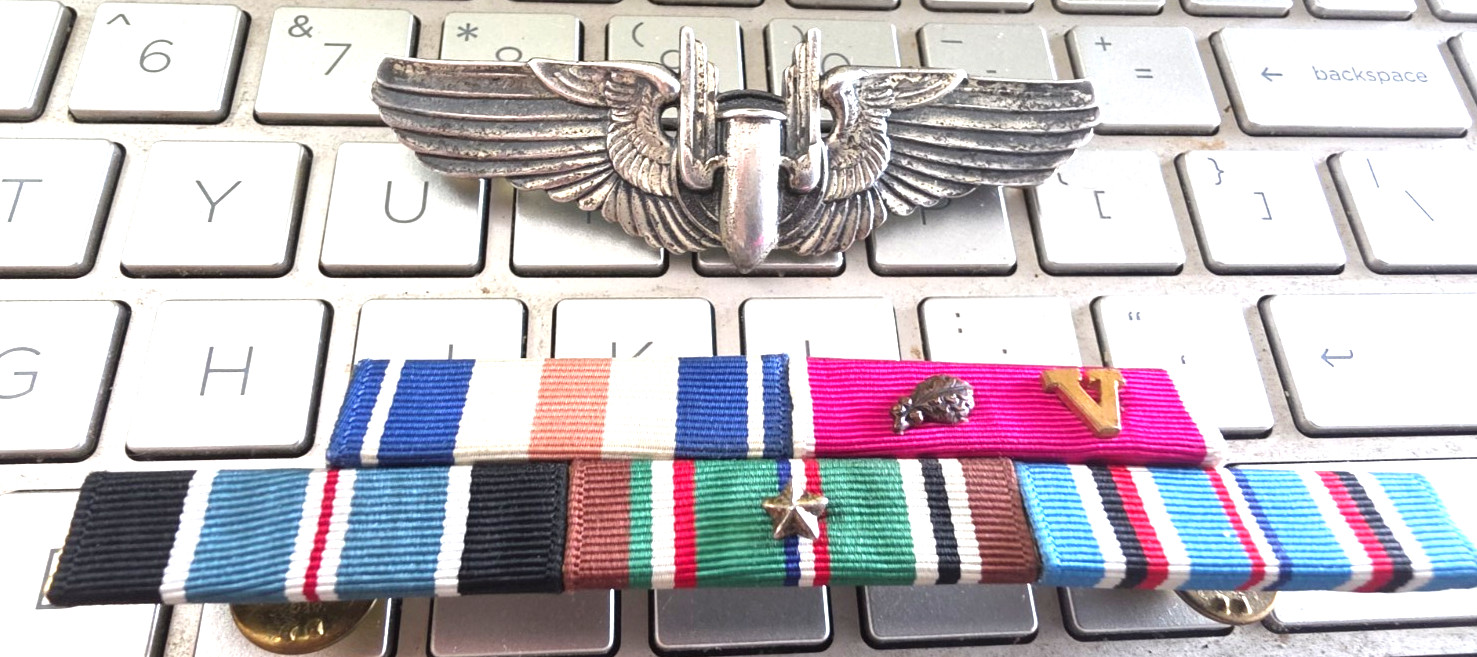
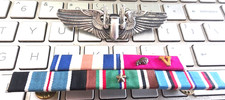
Gunner Badge
U.S. Army Air Force\'s Aerial Gunner Badge
The Aerial Gunner Badge was a military aeronautical badge of the United States Army Air Forces and was issued during the Second World War. The badge was first created and authorized on April 29, 1943[1] to recognize both the training and hazardous duty of aerial gunners, who manned defensive machineguns on board such aircraft as the Boeing B-17 Flying Fortress, Consolidated B-24 Liberator, North American B-25 Mitchell, Martin B-26 Marauder and Boeing B-29 Superfortress bombers. The Aerial Gunner Badge appeared as a standard observer badge, upon which was centered a winged bullet. It was primarily awarded to USAAF enlisted aircrewmen, but a small number of commissioned officers also qualified and were awarded this insignia, to include film actor Clark Gable
A bombardment group or bomb group was a unit of organizational command and control group of the United States Army Air Forces (USAAF) during World War II. A bombardment group was normally commanded by a colonel. The table of allowances (TOA) for personnel, aircraft and equipment grew steadily over the course of the war doubling from 35 aircraft in 1941 to 72 in February, 1945. The aircrew end strength reached upwards to two crews per aircraft.Categories
U.S. bomb groups were numbered and classified into four types: Very Heavy (VH), Heavy (H), Medium (M), and Light (L). Groups which combined bombers of differing categories into a single administrative organization were designated \"Composite\" groups. Bomber aircraft were assigned to groups by category:
- Very Heavy: Boeing B-29 Superfortress, Consolidated B-32 Dominator
- Heavy: Boeing B-17 Flying Fortress, Consolidated B-24 Liberator
- Medium: North American B-25 Mitchell, Martin B-26 Marauder
- Light: Douglas A-20 Havoc, Douglas A-26 Invader
(The USAAF also operated two fighter-bombers during the period, the Douglas A-24 Banshee and the North American A-36 Mustang. Groups with these two types were first classified as Light Bombers, then Dive Bombers, before being re-classified as Fighters.)
Tables of organization and equipmentUnit organization
The tables of organization and equipment (TO&E) for all bombardment groups were roughly the same. In 1942, existing bomb groups were expanded from three to four numbered bombardment squadrons; and most bomb groups created during the war retained this structure - B-29 groups were the exception, having only three squadrons. In addition to the flying squadrons issued Aircrew Badges, each group contained a group headquarters, a service squadron, and detachments for support of aircraft, equipment, and personnel from quartermaster, aviation ordnance, military police, chemical, signal, and maintenance companies, and from a weather squadron. These support personnel were then pooled and re-distributed among an unofficial service group and detailed for various duties as needed.
The service group provided support and technical sections for the group requirements as a whole: Flying control, Ordnance, airfield security, firefighting, Post Exchange (PX), Special Services, Mail, Transportation (\"motor pool\"), Communications, Radar, Gunnery instruction, Personal Equipment, and Weather (Meteorology). The service group also had its own mess section. The service group had approximately 30 officers and 300 to 400 enlisted men.
The group headquarters contained sections organized in the traditional U.S. Army structure: Personnel (S-1), Intelligence (S-2), Operations (S-3), and Supply (S-4). Including inspectors, headquarters organizations in practice totalled approximately 20 officers, some of whom were also pilots, and 60 to 80 enlisted men.
Each bomb squadron, in addition to its assigned flight crews, had a squadron headquarters structured similarly to the group\'s, and six technical support and maintenance sections supporting its aircraft, equipment, and personnel: Mess, Armament, Ordnance, Communications, Medical, and Engineering (aircraft maintenance). The ground support members of a bomb squadron numbered 15-20 officers and 250 to 300 enlisted men.
Functionally, bomb groups were divided into an air echelon (the collective aircrews), and a ground echelon (all supporting ground personnel within the group, including those in attached Sub Depots). Groups commonly had two deputy commanders, termed the air executive officer and the ground executive officer, to coordinate these echelons.
Personnel strengths
In 1943, a heavy bomb group had a total complement of 294 officers and 1,487 enlisted men to fly and support 48 heavy bombers; and a medium bomb group had 294 officers and 1,297 enlisted men for 64 medium bombers.
By February 1945, the size of the 125 standardized bomb group establishments had grown to:[1]
AAF Bombardment group organizationMarch 1945Type of unitType of aircraftNumber of aircraftNumber of crewsMen per crewTotal personnelOfficersEnlistedVery heavy bombardment groupB-294560112,2784621,816Heavy bombardment groupB-17, B-2472969 - 112,2614651,796Medium bombardment groupB-25, B-2696965 - 61,7593931,386Light bombardment groupA-20, A-2696963 - 41,3042111,093
The Army Air Forces also employed two composite groups with their own TO&Es: the 28th Bomb Group (15 B-24 and 30 B-25), and the 509th Composite Group (15 B-29 and 5 C-54). 19 heavy groups and one light bomb group were to be converted to very heavy groups for duty against Japan, but the war ended before the plan was carried out.
PLEASE SEE STORE WW1- WW2 MEDALS -STERLING SILVER BADGES - RARE COINS PCGS GRADED /RARE GRADED CURRENCY