When you click on links to various merchants on this site and make a purchase, this can result in this site earning a commission. Affiliate programs and affiliations include, but are not limited to, the eBay Partner Network.
The Ocean Eagle was a merchant vessel, closely tied to the historic mid-19th Century lime exporting industry of Rockland, Maine. On May 10, 1861, while carrying a valuable $20,000 cargo of Rockland lime, the Ocean Eagle was the first ship captured off the Mississippi River delta by the Confederate privateer J.C. Calhoun, which was part of the Confederate privateering campaign. Because the ship was registered in New England, it was legally condemned as a prize of war by Confederate authorities. The capture was heavily criticized as a blunder. The ship with its cargo of lime was bound for Southern merchants in New Orleans, and the capture effectively disrupted their own local commerce. The vessel remained in New Orleans until April 1862 when Union Admiral David Farragut captured the city and returned the vessel to its owners.
The ship was commanded by Andrew G. Luce, who died of yellow fever aboard the ship in 1860. His son, William, then about 21, succeeded him as master and would have been onboard along with the crew during the capture when they would have been arrested by the Confederates.
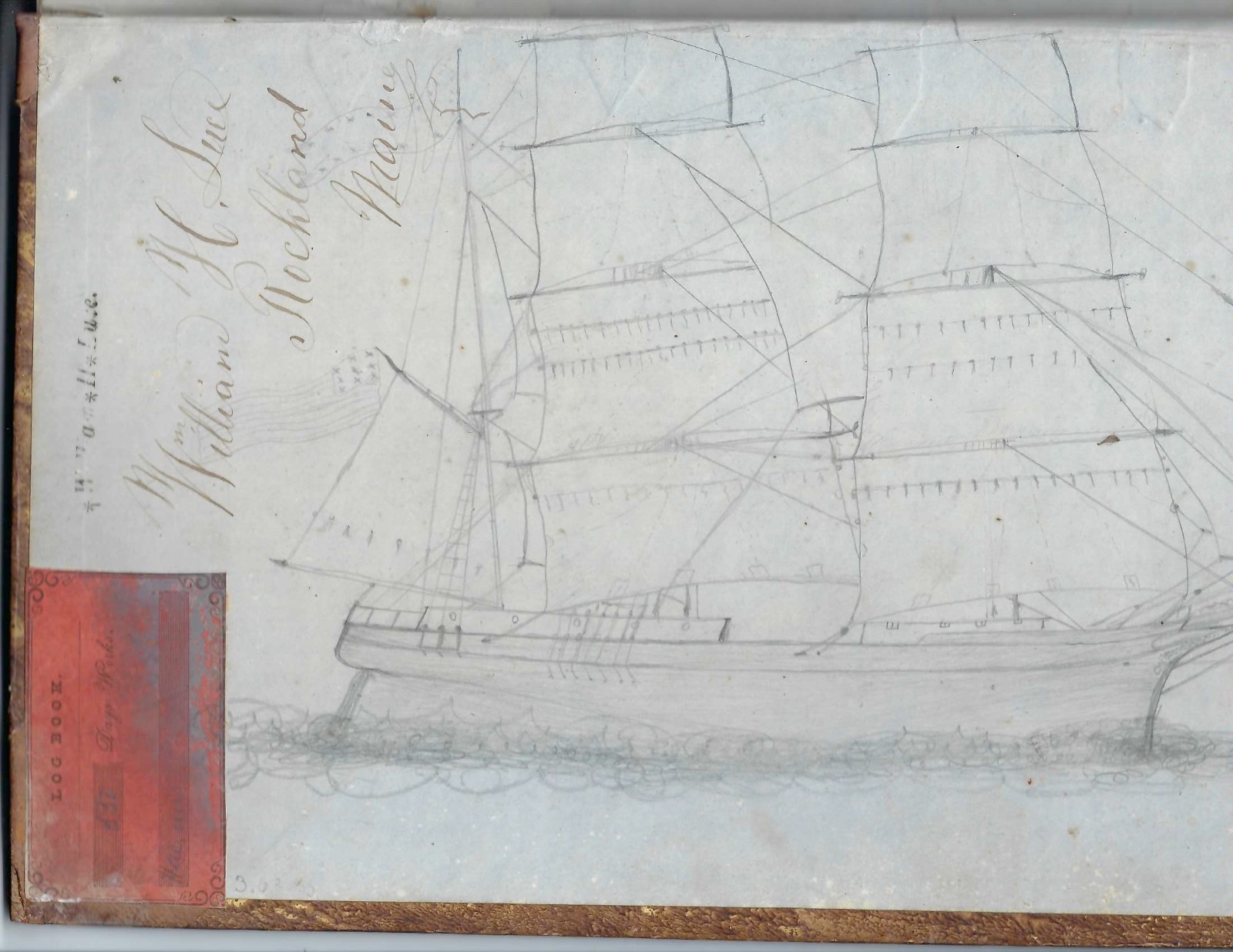
Offering an 8 ½ x 13 ¼ logbook, dating from1857 to 1860, approximately 280 pages, front and back, kept by Andrew’s son, William, as noted in front of the logbook. The logbook is filled with entries covering ship repairs, and shipments of lime, oats, cotton, sugar and gin to Bordeaux, Ireland, Liverpool, London, Vera Cruz, Rio de Janeiro and Cuba. The journal includes a pencil sketch of the ship on the inside front board with William Luce’s name at the top of the board. The logbook concludes on April 19, 1860, prior to the Confederate capture. The grouping also includes 23 letters by Andrew and William filled with details about their many voyages.
Some of the logbook entries cover the more serious activities impacting merchant ships in the 19th century, including punishing crew members who refused to work, searching for deserters and hiring African Americans (likely slaves) for labor. When James McQuaid and William Robinson refused to work, Luce turned them into the American Consul, which acted as law enforcement, on November 5th, 1857. The consul placed the men under arrest. Ship hands were obligated to work and were punished when they refused. The two men were returned to the ship on November 16th, when they apparently agreed to work. On May 12th, the captain borrowed a boat and took several men and the second mate to search for runaways. On May 16th, Luce hired three Negroes to help “stow” [arrange cargo]. On several occasions, men deserted the ship. Two men who were skippers came on board on June 3rd and recovered a stolen boat by paying a reward. A later entry noted that two men deserted and took a boat with them.
The Ocean Eagle’s many voyages are accentuated by a fine group of more than 20 manuscript letters from Andrew and William Luce addressed to Rebecca, providing some extraordinary details of the vessel’s journey and the problems encountered. Most of the letters are from Andrew to his wife Rebecca with information about the ship’s travels, sending money home and their son, William, with some mention of poor behavior of the crew. The letters were written while the ship was enroute to various destinations, such as Vera Cruz, Bordeau, Liverpool, London, New Orleans, Buenos Ayres. Some of the most descriptive letters involve Andrew Luce’s death and the removal of his remains for a burial closer to home. Two tattered sheets contain unsigned directives that the letters should be burned.
Documents and letters relating to Andrew Luce’s death and moving his remains provide fascinating details. The grouping begins with a 1 ½ pp, ALS, from GEORGE D. SMITH to Luce’s wife, Rebecca, informing her in detail of her husband’s illness and death: “On the 12 of this month at 5 pm, our beloved Captain was taken sick but he did not think it anything alarming until the next morning. Then, Mr. Luce sent for the doctor at once and he has been in attendance daily (the best physician in Rio). For six days we all felt very hopeful but, on the 7th, his sickness took a very alarming turn. The most tender care & kindest anxiety was manifested by all...All mortal care was done. God claimed his own & took to himself in heaven. He deposed this life today calmly and peacefully during the night. He spoke your much-loved name as I sat beside him. He called the Lord’s blessing on you...I could not understand all he said. His voice was so feeble and interrupted by sighs. ...You have my sincere sympathy...”
A second formal letter from JOHN APPLETON, assistant secretary of state, on April 26, 1860, 1 ½ pp, “conveying the melancholy intelligence of the death of your husband on board the Brig ‘Ocean Eagle’ in that port (Rio de Janeiro) on the 20th February last.”
A 2 pp, 9 ¾ x 9 7/8, from William Luce at Rockland [Maine], June 4th, 1866, to Wright & Co. of Rio de Janeiro addresses Luce’s request to move his father’s remains. “...You will please direct Mr. Evans to be extremely careful and not make any mistakes in getting the right coffin & remains although he knows as well as anyone that exact grave. I presume the remains are all decayed. But I should like to have it packed so there could be no danger of any accident...I hear there is a steamer running once a month to N. York. I think it would be better to send it by the steamer but if you cannot send the remains by a vessel to Boston or New York...Please write as soon as the remains are shipped so that we can prepare to have arranged for the reception of the body...”
Details of life on the seas can be found in many of the letters written during Andrew’s time as captain.
May 23, 1857, 7 ½ x 9 ¾, 2 ½ pp, Bordeaux, Andrew to his wife: “...We had a long wet and uncomfortable passage from N. Orleans but nothing very serious. William is very well and I hope considering everything he will make quite a Master. I think he is a chip off the old block. I want him to come home and attend school, and I will send him as soon as I can...” June 22, 1857: “...My mate is unsteady and intemperate. But your son is steady...He feels for the interest of the ship but he is young & inexperienced and of course I do not expect much of him.” July 28, 1857: “...I have discharged my mate Mr. Thomas so now Bill Luce and son have the sole command of the ship. Capt. Mansfield is here in the Brig...” Dec. 27th, 1857: “Enclosed you will find a draft of five thousand dollars drawn by Samuel B. Hale & Co. of this place (Buenos Ayres) ...which you be able to get discounted at the bank the proceeds to do with as you think best...I am now ready to sail for Rio de Janiero. Have got 2 loads of freight. The Royal Mail Steamer leaves here tomorrow for New England via Rio...which will take this...I am quite well...Wm is tolerable. He’s had a sick turn the last 2 or 3 weeks but now is pretty well...I hope to be in Rio in about 15 days. I have agreed to lay there thirty days required to sell the cargo of jerked beef and then hope to load for New Orleans...”
April 6th, 1858, 7 ¾ x 10, 2 pp, Vera Cruz, Andrew to his wife, “The steamer leaves in the morning for New Orleans so I thought I would write...We arrived here on the first which was a holiday...We shall get discharged by tomorrow night and shall commence loading immediately & as our cargo is already, I hope to get loaded by the 15th of the month...” April 21st, 1858: “...I should have been loaded but for the blowy day...We shall be loaded in two days. I think I shall get $5300 freight which is as much as I expected & is very good...Willam is well. He is a good, steady, honest boy but has got to be...a little lazy...but...I try to be as patient as I can...He never will excel in book...As regards business affairs, I want you to do in all matters as you think best...You know what money you have & will not probably get any more before July or August...” July 31st, 1858: (London) “I have this day got a passage on board Bark Georges bound to Thomaston for Harris...Captain McGown...belongs to Camden, the Bark to Roland Jacobs of Thomaston. She is in ballast and will sail tomorrow and will probably be home in about 35 days... Harris is about as well as usual, but he has got a little homesick. I thought it best for him to go home. I paid $25 for his passage. I gave him $7.50 and bought him sufficient clothes to make him comfortable.... You must get along with him...”
Oct. 4th, 1859, 7 ½ x 9 ½, 4 pp, Pernambuco, [South America], son William writes to his mother, “We had a very long passage to this place. Ninety days and it would have took us some 10 or 12 days more to have got to Rio. Father concluded to try this place for a market and he sold here as he heard that lumber was worse in Rio. We shall get enough to pay a middling freight but the worst of it is, we shall have to go away from her in ballast to some other place...The first of this month was my birthday. I suppose you know 20 years old, almost old enough to get married. I was in hopes that I should have been captain by this time seeing that all the romance of going to sea has worn off...”
Feb. 24, 1860, 8 ½ x 11, 3 pp, Rio de Janeiro, William to “My Respected Friend,” “My dear father breathed his last on the 21st after a short illness of 8 days of the yellow fever. He suffered great pain during the last few hours of his life, not retaining his senses. I have had him buried in the best possible manner in a lead coffin, the Americans attending his burial. I used my utmost endeavors to send his last remains to our home, knowing that it would be a source of consolation to my dear mother and friends but the law of the country is that a body shall be interred from 2 to 5 years but I have engaged the influence of the American Consul to intercede for his body to send immediately but I am afraid that he will not succeed if I have to leave him here. Here I shall erect a tablet to his memory and let him rest until some future time...”
Feb. 1860, 8 ½ x 11, 6 pp, Rio de Janeiro, William to his mother, “My Dear Mother and last parent. When you receive this sad letter, you will probably have heard the intelligence that your dear husband and my father is no more, but mother do think of me, do not give up in despair. Remember our dear family and myself and that your health is very delicate and that you must control your emotions and live for us until your time comes to join him in I hope & trust a happier home. He was a good, kind father to me. He toiled hard for our sakes and saved everything to benefit us and that he might pay his debts...He was taken sick on Sunday about 4 PM of the 13th with pain in his head & eyes, which continued through the night and on the morrow...But in the morn...he was growing worse...At 4 o’clock on Sunday afternoon, he arose from the sofa and sent to his berth where he got in himself but soon began to groan & partially sleep...He soon began to grow senseless not recognizing even me...We had the doctor ordered. We had the best English doctor in the place who visited every day. At about half past five, he expired...He murmured your dear name several times. He said the name of the Lord & God all through the night...I buried him on Thursday morn...I have used my utmost endeavors to get his remains to send home, knowing that it would be a source of great consolation to you and the rest of our family & friends but the law of the country is that a man shall be interred from two to five years before they will suffer him to be moved. I have engaged the influence of the American Consul...Rest assured that everything was done that could be done in a foreign land and that I deeply felt the sorrow for he was good and kind to me and that he toiled for my benefit to the last...I took some of his hair to send to you. Joe placed Charley & Mary & Eliza’s miniatures upon his breast and a clean white shirt & duck trousers & stockings...We had a good inner coffin and then it was cased with lead, airtight so that it can be moved at any time. We had a Christian clergyman and a short sermon at his grave and a very appropriate prayer...I will spare no pain to send him home if possible. The number of his grave is 186...”
“I shall be justified in taking charge of the vessel and shall hire as good a man as I can and endeavor to the best that I can. I have taken good care of his papers but in looking them over I could find but one insurance policy for $500...Our business is in the hands of Maxwell Wright which was in father’s opinion...a very favorable gentleman and agreeable with my opinion...I recommend to have a least $10,000 insured on the bark...From your sorrowful son, William H. Luce.”
April 17, 1860, 8 ½ x 10 ½, 3 pp, Saint Thomas, William to his mother, “I arrived in this place this day in safety after a passage of 34 days and I suppose you will have heard the sad intelligence but I sincerely hope that you will be reconciled as such was to be...I left Rio and many days after when I thought that I was leaving my poor old father behind and that I could not fetch his remains to you but mother if no accident happens to me I shall be a short time where we can correspond...Father bought some spare in Pernambuco and we intend to take a full cargo and as we have carried them around with us...I shall dispose of them tomorrow. Whether I get much for them or not, we may [get] about 50 dollars on them which will be nothing in comparison to the room that they will occupy...I shall soon be ready for New York...I hope that you will come up to New York. I will telegraph immediately on my arrival and you can answer immediately and be sure to have some letters there for me...I have some of the spares for some sperm oil. I may get my miniature taken if I get time. I came away from Rio in such a hurry that I left my insurance policy with Maxwell J. Wright and maybe he will send it on to you...Your hopeful son William H. Luce”
Oct. 4, 1860, 8 x 10, 3 pp, Marsalis, William to his mother, “I shall be ready for sea tonight. The passage was 59 days...The 1st here I received...orders to proceed to Girgenti there to take in 150 tons of Sulphur and then proceed to Messina...The Charter out as you know is 8000 dolls, part payable here and the remainder in N.Y...I have had the vessel picture painted which cost $9.00 and stopped on shore about 7 nights in a hotel as the dock water smelled very bad and I was a little sick when we first came in...With this 1200 dollars I bought a bill of exchange on Rothchild, payable to Barring so that they will collect it of Rothchild...I have not got a very good cook. It takes more provisions to find him than almost any to that we have had before so you make inquiries and if you hear of a good one perhaps, he will go with me next voyage...William H. Luce”
The logbook and the letters are in very good condition and are very readable. The logbook has been professionally rebound. In addition to the letters, writing on two tattered sheets direct the reader to “burn the letters.”
Everything we sell is guaranteed authentic forever to the original buyer. We also offer a 30-day return policy. If you discover a problem or are dissatisfied with an item, please contact us immediately. Our goal is to please every customer. We are pleased to be members of The Manuscript Society, Universal Autograph Collectors Club, The Ephemera Society, the Southern New England Antiquarian Booksellers and the Preferred Autograph Dealers and sale Houses [AM 440]