When you click on links to various merchants on this site and make a purchase, this can result in this site earning a commission. Affiliate programs and affiliations include, but are not limited to, the eBay Partner Network.
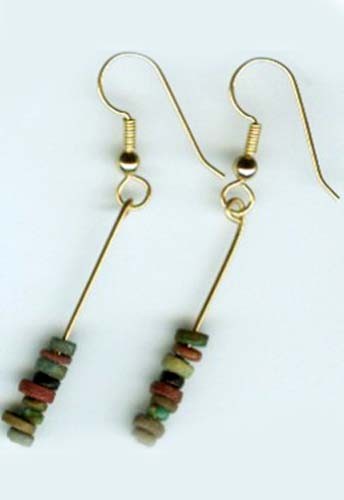
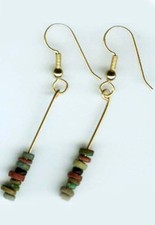
Splendid, Delicate, Brightly Colored 3,000 Year Old Ancient Egyptian Faience Disc Beads on 14kt Gold Fill French Hook Earrings.
CLASSIFICATION: Eighteen Ancient Egyptian silica ceramic/glass (“faience”) primitive silica disc beads. Contemporary 14kt gold fill french hooks and straight pins.
ATTRIBUTION: Ancient Egypt, 20th Dynasty, about 11th century B.C.
SIZE: Faience disc beads are between two and five millimeters in diameter; and between one and two diameters in thickness.
CONDITION: Excellent. Unbroken beads, brightly colored, with intact and thick glaze, well preserved.
DETAIL: A pair of earrings composed of bright colored ancient Egyptian beads constructed of faience, a primitive silica ceramic, and mounted onto 14kt gold fill french hooks and straight pins. These brightly colored faience beads are quite uncommon – not the ordinary dull tan or brown color of ordinary uncolored crushed silica. We had a very small quantity of these beads available to us. They date to approximately 1100BC, ancient Egypt's 20th dynasty. We mounted the beads onto high quality – not cheap gold plated – 14kt gold fill french hooks. Please do not confuse these with cheap gold electroplate. These are high-quality settings made right here in the USA. 14kt "Gold Fill" is a process which creates a solid gold sandwich constructed of 5% solid gold over a base metal core such as sterling silver. It is not merely an electroplate few thousandths of a millimeter of gold barely covering a base metal. This is a permanent, high quality bond which you will never wear through. Gold Fill jewelry has a gold layer 100 times thicker than merely electroplating. It is considered permanent jewelry, not costume jewelry. If you prefer, we could remount the faience beads onto 14kt solid gold french hooks, euroclicks, leverbacks, kidney wires, etc., and/or 14kt solid gold pins (at additional cost).
CONSTRUCTION: Faience, a primitive form of ceramic, was the ancient forerunner of modern glass, and was used by the Ancient Egyptians as far back as 3000 B.C. to fashion various amulets, beads, and other items of personal adornment. Most amulet/necklaces were both worn on a daily basis for protection, as well as buried with the dead to afford protection in the journey from this life to the next. Some bead necklaces were purely items of personal adornment, as these might have been so worn. Faience was produced by crushing quartz mixed with copper, and made into a paste. The paste was then placed in a mold, and then fired. The quartz would fuse, and the copper would give the resulting product a color with blue and/or green hues, which was favored by the ancient Egyptians as the color of the Nile River. Other pigments were occasionally used such as iron oxides, malachite, azurite, etc., to produce very brightly colored beads and amulets ranging from cobalt blue, to black, to red, and even white.
HISTORY: One of the greatest civilizations of recorded history was ancient Egypt. For a mere hundred dollars or thereabouts, you can possess a small part of that great civilization in the form of a very attractive necklace composed of 2,500 year old faience beads. Ancient Egyptian artifacts (amulets, beads, and other forms of jewelry) are amongst the most sought after and highly collectible artifacts from ancient Egypt. Religion was very important to the ancient Egyptians, and they worshiped many gods. These gods and goddesses often represented the natural world, such as the sky, earth, sun, or wind. The gods took the form of animals or animal/human figures. The ancient Egyptians wore amulets, small representations of these gods, as magical charms to ward off danger. They believed that these amulets, or talismans, would not only protect them in life, but in death as well, and would endow the individual wearing them with magical powers and capabilities.
While religious beliefs in ancient Egypt played a very important role in life, they played an even larger role in death. The ancient Egyptian Book of the Dead prescribed 104 different types of amulets be buried with the mummy in order to protect the deceased on his or her journey into the afterlife. Typically pinned to or wrapped within their burial shroud, it was not uncommon to find even thousands of amulets in the possession of the mummified remains of more prominent members of that ancient civilization. Typically when mummifying the deceased, there could be as many as 80 layers of linen, and it was not unusual to place at least one amulet representation of each of the more significant deities within each layer. As with the entire process of mummification and burial, the manufacture of amulets and the application of the magic spells for the benefit of the deceased, were almost always overseen by Egyptian priests.
Amulets from ancient Egypt were buried typically for between 2,500 and 3,000 years before being unearthed inside of tombs within the last century or two. Amulets typically are between one-half and two inches in size. Amulets were oftentimes worn about the neck by the ancient Egyptians, typically on a beaded necklace. The beads were most often faience beads, in colors ranging from tan to pale jade green to cobalt blue. Though the material used to string the necklaces disappeared in the eons passed while buried within the tombs of Egypt, the beads themselves survived. Oftentimes these necklaces are restrung on modern filaments, and then offered as a matching set with an amulet which can be worn or displayed with pride.
GLASS HISTORY: Naturally occurring glass, especially the volcanic glass obsidian, has been used since the Stone Age in many localities across the globe for the production of sharp cutting tools and, due to its limited source areas, was extensively traded. With respect to man-made glass, the ancient Romans were the first to mass produce glass articles, and this included glass jewelry and gemstones. In the ancient world, glass jewelry was very costly, not only for the ancient Romans, but particular so going back another 3,000 years further to ancient Egypt, Mesopotamia, and Sumeria. Though glass jewelry, especially gemstones and beads, have been fashioned for perhaps 5,000 years, very little is known about the production of glass in the ancient world.
Perhaps about 4,000 B.C. the ancient Egyptians started fashioning amulets, beads, and small vessels out of a material known as “faience”, an ancient precursor of glass created by crushing quartz sand and mixing it with an alkali binder and mineral oxides to provide color. The discovery of the techniques for producing glass was probably the accidental byproduct of the ancient production of faience. Ancient lumps of glass have been discovered in the area of ancient Mesopotamia, as well as ancient Syria and Egypt, dating as far back as 4,000 B.C. Written records from ancient Mesopotamia refer to the manufacture of glass, describing the manufacturing process as difficult and a closely-guarded secret. Initially ancient glass vessels were produced in with the use of molds of forms. Some of the earliest surviving examples were from the 15th century B.C. tombs of the wives of ancient Egypt’s Pharaoh Thutmose III. Glass beads dating to about 1,800 B.C. were produced by the Indus Valley Civilization.
Around 1,500 B.C. two new production techniques gave rise to more frequent manufacture of glass in Egypt and Mesopotamia, as well as in Minoan Crete and Mycenaean Greece. Both techniques involved the use of molten glass rods, either wrapped around a mud core, or placed within a mold. However the end product was still nonetheless frightfully expensive and the process both lengthy and labor-intensive. The disasters that overtook Late Bronze Age civilizations seem to have brought glass-making to a halt. It picked up again in its former sites, as well as in Syria and Cyprus, in the 9th century B.C., when the techniques for making colorless glass were discovered. The first glassmaking "manual" dates back to about 650 B.C., in cuneiform tablets discovered in the library of the Assyrian king Ashurbanipal. In Egypt glass-making did not revive until it was reintroduced in third century B.C. Ptolemaic Alexandria. During the Greek Hellenistic (colonizing) period many new techniques of glass production were introduced and glass began to be used to make larger pieces, notably table wares.
The term “glass” originated in the late Roman Empire in the Roman glassmaking center at Trier, now in modern Germany. The Romans utilized glass in domestic, industrial and funerary contexts. Glass was used primarily for the production of vessels, although mosaic tiles, window glass, jewelry, beads and gemstones were also produced. Roman glass production developed from Hellenistic technical traditions, initially concentrating on the production of intensely colored cast glass vessels. However, during the 1st century AD the industry underwent rapid technical growth that saw the introduction of glass blowing techniques (introduced a century earlier in Palestine and Syria), wherein a blob of molten glass was inflated either free form or into a mold by blowing through a hollow metal blowpipe. Glass blowing became widespread during the later Roman Empire, and with it the dominance of colorless or “aqua” colored glass, and the inexpensive process created huge demand for glass products, including jewelry.
Syria became the "glass factory" of the Roman Empire and glassware came to be widely disseminated throughout the Roman Empire (if you would like to learn more about ancient Roman/Syrian glass, there are two wonderful websites to start you on your voyage here and here). Roman glass ware which had already been traded as far as China and Western Asia (Roman glass has been found in first century B.C. tombs in China as well as what was Parthian Persia) now came to be exported throughout the known world in vast quantity. Glassblowing allowed glass workers to produce vessels with considerably thinner walls, decreasing the amount of glass needed for each vessel. Glass blowing was also considerably quicker than other techniques, and vessels required considerably less finishing, representing a further saving in time, raw material and equipment. Although earlier techniques dominated during the early first century A.D., by the middle to late first century earlier production techniques had been largely abandoned in favor of blowing.
Glass making reached its peak at the beginning of the 2nd century A.D., with glass objects in domestic contexts of every kind. An eight ton glass slab uncovered by archaeologists indicates that glass was being produced in very large batches contained in tanks situated inside highly specialized furnaces. Glass was seemingly manufactured on a large scale by a limited number of workshops, and then broken into chunks for distribution to a multitude of local producers of end products. Otherwise there is only limited evidence for small-scale local glass manufacture, and only in context of window glass. The first-century A.D. Roman Naturalist and Historian “Pliny the Elder” documented the furnace-production of molten glass and the development of related production technologies.
The Roman writers Statius and Martial both indicate that recycling broken glass was an important part of the glass industry, and that quantities of broken glassware were concentrated at local sites prior to melting back into raw glass. This is supported by the fact that only rarely are glass fragments of any size recovered by archaeologists from domestic sites of this period. With respect to glass jewelry, it is well known that the Romans and their successors in the East, the Byzantines (and Eastern Europe in general), were very fond of elaborate jewelry and other personal adornments. Typical jewelry included bracelets worn both on the forearm as well as upper arm, rings, earrings, and pendants, and in the classical world, glass jewelry was just as costly its counterparts made in gold and/or gemstones.
Though introduced in first century A.D. Alexandria, the use of glass windows gained widespread popularity in the 6th and 7th centuries A.D. throughout Europe, mostly in conjunction with churches and royal structures. In the 8th century A.D. glass was described in Arab poetry, and in another 8th century book a Persian chemist recorded 46 recipes for colored glass (a later edition of the book included 12 additional recipes). By the 11th century clear glass mirrors were being produced in Islamic Spain. In Germany the 11th century saw the introduction of a technique which mass-produced thin sheet glass, and in the 12th century the use of stained glass rapidly became an important medium in Romanesque and Gothic art. However the mass-production of glass during the era of the Roman Empire was not matched by the modern world until the advent of the industrial revolution. Glass remained expensive through the 17th century, and glass gemstones though less expensive than natural gemstones, were still expensive. The “gemstones” in the least expensive “costume” jewelry were generally made from colored amber. Excepting of course genuine precious and semi-precious gemstones, glass “gemstones” were still the domain of relatively more costly pieces.
SHIPPING & RETURNS/REFUNDS: Your purchase will ordinarily be shipped within 48 hours of payment. We package as well as anyone in the business, with lots of protective padding and containers. All of our shipments are fully insured against loss, and our shipping rates include the cost of this coverage (through stamps.com, Shipsaver.com, the USPS, UPS, or Fed-Ex). Please be aware that postal rates are routinely hiked three times each year by the USPS, and have increased exponentially over the past decade. We set shipping rates as low as possible. However charges steep commissions on shipping charges. And we have no control over the draconian rate increases the USPS levies multiple times every year (FOUR TIMES in the past 12 months as of April of 2026). International tracking is provided free by the USPS for almost all countries. Please note that with respect to international shipments, /DHL shipping is typically less expensive than what the US Postal Service charges. But please be aware that DHL shipments generally offer very limited tracking, and inasmuch as shipments go to first, then are consolidated before finally being transferred to DHL, they tend to be pretty slow.
ADDITIONAL PURCHASES do receive a VERY LARGE discount, typically about $5 per item so as to reward you for the economies of combined shipping/insurance costs. We do offer U.S. Postal Service Priority Mail, Registered Mail, and Express Mail for both international and domestic shipments, as well United Parcel Service (UPS) and Federal Express (Fed-Ex). Please ask for a rate quotation. Please note for international purchasers we will do everything we can to minimize your liability for VAT and/or duties. But we cannot assume any responsibility or liability for whatever taxes or duties may be levied on your purchase by the country of your residence. If you don’t like the tax and duty schemes your government imposes, please complain to them. We have no ability to influence or moderate your country’s tax/duty schemes.
If upon receipt of the item you are disappointed for any reason whatever, I offer a no questions asked 30-day return policy. Send it back, I will give you a complete refund of the purchase price; 1) less our original shipping/insurance costs, 2) less any non-refundable fees. Please note that though they generally do, may not always refund payment processing fees on returns beyond a 30-day purchase window. So except for shipping costs and any payment processing fees not refunded by , we will refund all proceeds from the sale of a return item. Obviously we have no ability to influence, modify or waive policies.
ABOUT US: Prior to our retirement we used to travel to Eastern Europe and Central Asia several times a year seeking antique gemstones and jewelry from the globe’s most prolific gemstone producing and cutting centers. Most of the items we offer came from acquisitions we made in Eastern Europe, India, and from the Levant (Eastern Mediterranean/Near East) during these years from various institutions and dealers. Much of what we generate on Etsy, Amazon and goes to support worthy institutions in Europe and Asia connected with Anthropology and Archaeology. Though we have a collection of ancient coins numbering in the tens of thousands, our primary interests are ancient/antique jewelry and gemstones, a reflection of our academic backgrounds.
Though perhaps difficult to find in the USA, in Eastern Europe and Central Asia antique gemstones are commonly dismounted from old, broken settings – the gold reused – the gemstones recut and reset. Before these gorgeous antique gemstones are recut, we try to acquire the best of them in their original, antique, hand-finished state – most of them originally crafted a century or more ago. We believe that the work created by these long-gone master artisans is worth protecting and preserving rather than destroying this heritage of antique gemstones by recutting the original work out of existence. That by preserving their work, in a sense, we are preserving their lives and the legacy they left for modern times. Far better to appreciate their craft than to destroy it with modern cutting.
Not everyone agrees – fully 95% or more of the antique gemstones which come into these marketplaces are recut, and the heritage of the past lost. But if you agree with us that the past is worth protecting, and that past lives and the produce of those lives still matters today, consider buying an antique, hand cut, natural gemstone rather than one of the mass-produced machine cut (often synthetic or “lab produced”) gemstones which dominate the market today. We can set most any antique gemstone you purchase from us in your choice of styles and metals ranging from rings to pendants to earrings and bracelets; in sterling silver, 14kt solid gold, and 14kt gold fill. When you purchase from us, you can count on quick shipping and careful, secure packaging. We would be happy to provide you with a certificate/guarantee of authenticity for any item you purchase from us. There is a $3 fee for mailing under separate cover. I will always respond to every inquiry whether via email or message, so please feel free to write.