When you click on links to various merchants on this site and make a purchase, this can result in this site earning a commission. Affiliate programs and affiliations include, but are not limited to, the eBay Partner Network.
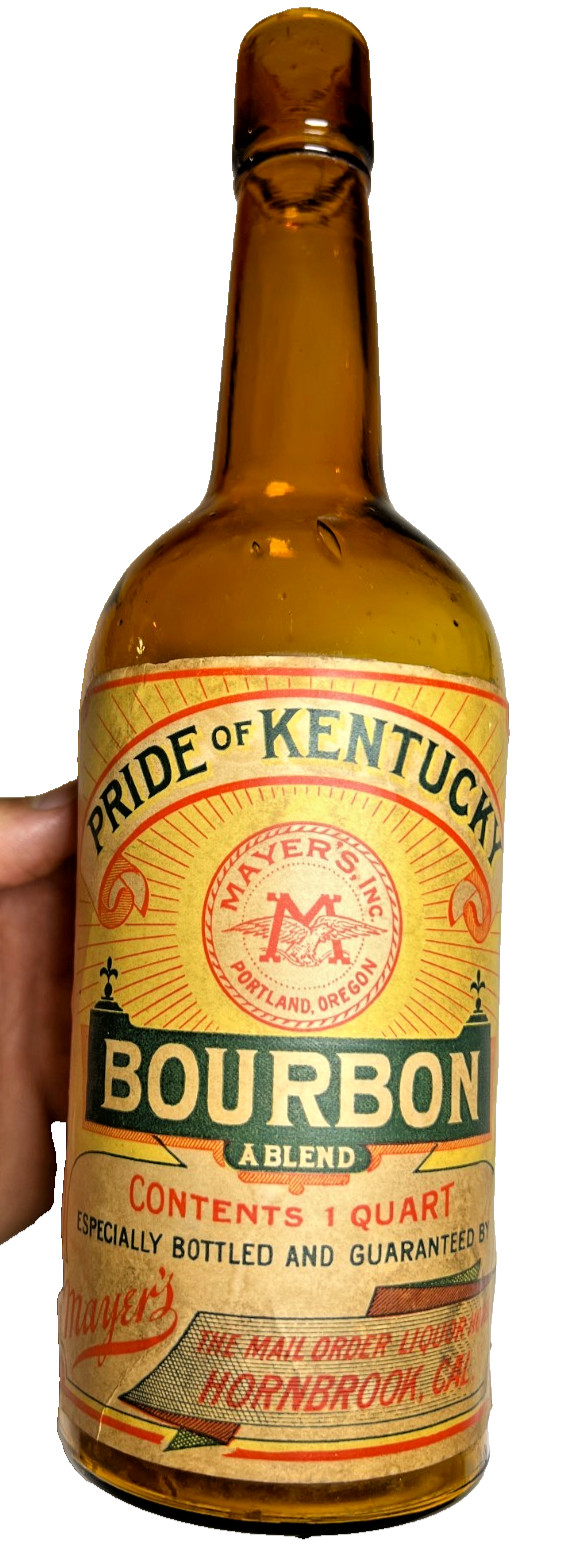
Estimated Date: 1934–1938 (most likely about 1936)
Several clues narrow it down:
- "Mayer's Inc., Portland, Oregon" – the "Inc." form was used after Prohibition.
- "A Blend" rather than "Straight Bourbon" reflects the popularity of blended whiskey during the Depression years.
- Hornbrook, California appears as the mail-order liquor house.
- No obvious federal tax strip remains, suggesting it was removed when the bottle was opened (very common).
The shape is a standard machine-made liquor bottle with an amber finish typical of the mid-1930s.
Pride of Kentucky Bourbon
One Quart
Guaranteed by
Mayer's Inc.
Portland, Oregon
Sold through
The Mail Order Liquor House
Hornbrook, California
The Story
Imagine standing beside the railroad depot in tiny Hornbrook, California in 1936.
The Southern Pacific Railroad whistles through town carrying passengers, lumber, produce—and cases of whiskey.
A customer living on a remote ranch in northern California or southern Oregon fills out a mail-order form, sends cash or a money order, and waits.
A few days later a wooden crate arrives at the station containing this very bottle.
That was normal business.
Before interstate highways and chain liquor stores, many Americans bought spirits through the mail.
This bottle represents that fascinating period.
About Mayer's Inc.
Mayer's was a long-established wholesale liquor company headquartered in Portland, Oregon.
They bottled and distributed numerous house brands rather than operating their own Kentucky distillery.
Like many wholesalers after Repeal, they purchased whiskey from Kentucky distillers and blended or bottled it under proprietary labels.
"Pride of Kentucky" was one of these brands—designed to evoke Kentucky's reputation for premium bourbon while being marketed by a Pacific Northwest wholesaler.
Why Hornbrook?
Hornbrook sat immediately south of the Oregon border.
Population was tiny, but its location was strategic.
The town was on:
- the Southern Pacific Railroad
- U.S. Highway 99
- the Oregon-California state line
It became an ideal shipping point for liquor throughout northern California and southern Oregon.
The company proudly advertised itself as
"The Mail Order Liquor House"
because much of its business never involved customers walking into a store.
What Was Inside?
The label states:
"Bourbon — A Blend."
That means it was blended whiskey rather than a straight bourbon.
Typical blends of the period contained:
- aged Kentucky bourbon
- lighter neutral grain spirits
- filtered water
- caramel coloring for consistency
These products were affordable during the Great Depression while still delivering the familiar bourbon flavor Americans expected.
Life When This Bottle Was Sold
Around 1936, America was slowly climbing out of the Great Depression.
People were:
- buying their first electric refrigerators
- listening nightly to radio dramas
- driving streamlined automobiles
- seeing paved highways expand
- watching movie stars like Clark Gable and Shirley Temple
In Kentucky, bourbon production had rebounded after the end of Prohibition in 1933.
Distilleries that had survived by making medicinal whiskey were once again producing spirits for the public.
Technology
This bottle reflects modern manufacturing for its day:
- Fully machine-made glass
- Crown or screw-cap finish depending on closure
- Mass-produced lithographed paper label
- Railroad freight distribution
- National mail-order advertising
It represents America's transition from handcrafted bottles to industrial-scale packaging.
The Label
This is really what collectors notice.
The design has:
- striking red and dark green printing
- radiant sunburst background
- large "BOURBON" banner
- eagle "M" trademark
- ornate Victorian-inspired scrollwork
Despite some edge wear and losses, it still has tremendous display appeal.
Condition
Bottle
- Excellent clean amber glass
- No chips
- No cracks
- Nice shine
- Very displayable
Label
- Strong colors
- Complete upper graphics
- Lower left loss
- Moderate staining and edge wear
- Still far better than average for a bottle approaching 90 years old