When you click on links to various merchants on this site and make a purchase, this can result in this site earning a commission. Affiliate programs and affiliations include, but are not limited to, the eBay Partner Network.
What did it take for a little sausage sign to carry the name of one of Hastings, Nebraska's biggest businesses? 🧅
There's a particular kind of American commercial art that only got made in that narrow window between the two World Wars — bold, confident, unapologetically colorful, meant to be seen across a grocer's counter and instantly understood. This K and R Countrymaid Sausage sign is exactly that kind of piece. It comes out of an era when a meat packer's advertising had to do real work: convince a butcher, a grocer, or a housewife standing at a counter that this particular ten-pound lot of sausage was the "finest quality" on offer, and do it with nothing but two colors of ink and a confident piece of design. Long before branding was a science with focus groups and market research, it was an art practiced by small regional printers working for small regional companies — and this sign is a genuine survivor of that world.
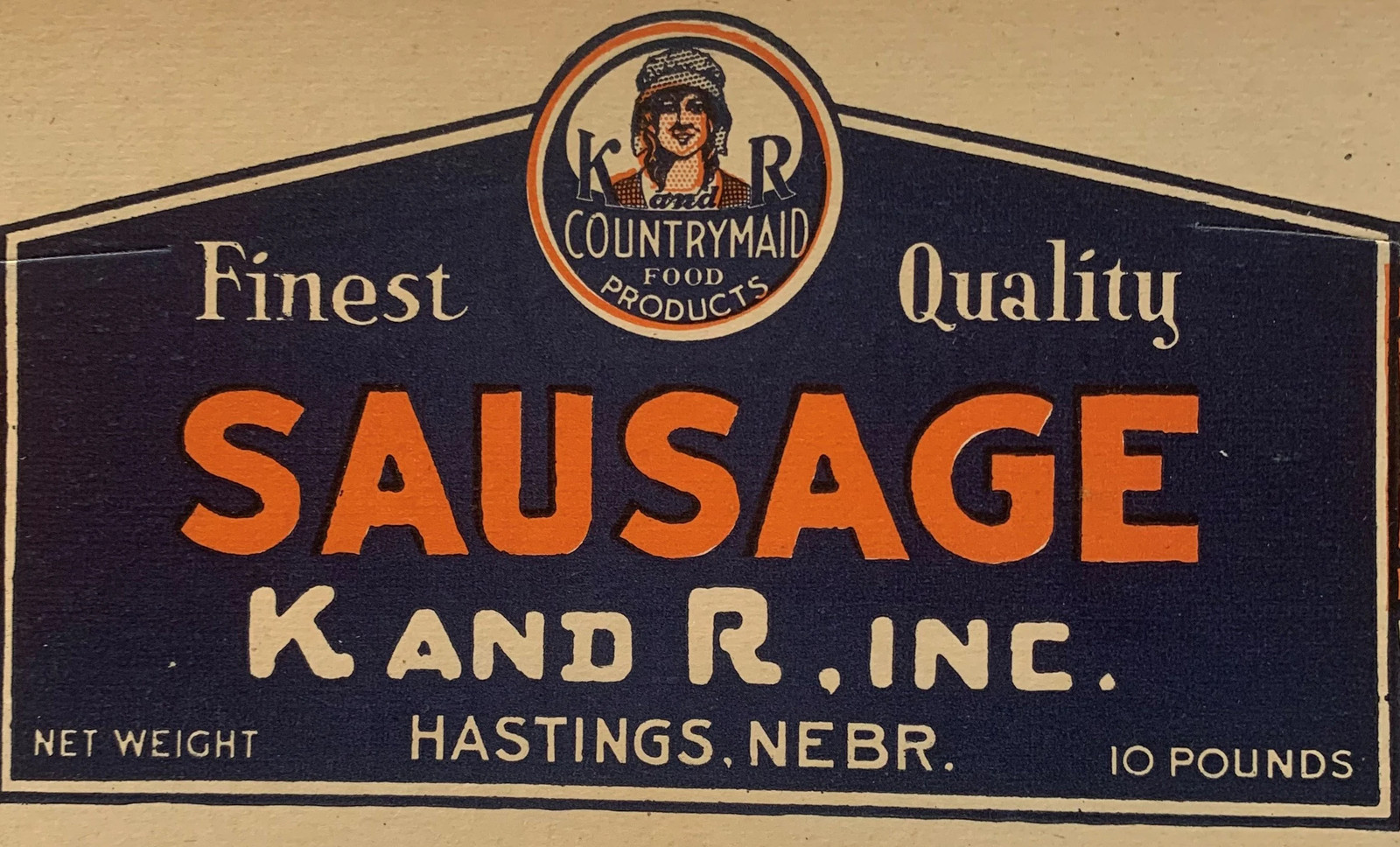
This is a New Old Stock (NOS) advertising sign for K and R, Inc. of Hastings, Nebraska, issued under their Countrymaid Food Products brand. Style — the woman's cloche hat and bobbed hair in the circular vignette, the halftone dot shading, the blocky sans-serif display lettering paired with a flowing script logotype — places this squarely in the 1920s–1930s, the interwar period when this kind of two-color offset lithography was the industry standard for food packaging graphics. The sign measures 11 x 4.25 inches, a wide banner shape with a peaked, gable-like top — clearly designed to sit as a crown piece above a shipping box or bulk sausage casing, with its pointed roofline echoing the architecture of the very warehouses these products moved through.
The design itself is a small masterclass in period commercial art. At the top, inside a circular medallion outlined in orange and navy, sits the head-and-shoulders portrait of a young woman in a fitted, patterned cloche-style hat, her "K" and "R" monogram flanking her face and the words "Countrymaid Food Products" curving beneath — this is the brand's mascot, the face meant to reassure a buyer that what's inside is wholesome, farm-fresh, and trustworthy. Below her, in cream lettering against the deep navy field, run the words "Finest" and "Quality," framing the medallion like a formal seal. Then comes the main event: "SAUSAGE" in massive blocky orange capitals, dwarfing everything else on the sign, the kind of lettering meant to be read from across a warehouse floor. Beneath that, "K AND R, INC." and "HASTINGS, NEBR." in a rustic, hand-lettered cream typeface, with "NET WEIGHT" and "10 POUNDS" anchoring the bottom corners — the bulk wholesale weight telling you immediately this wasn't a retail package for a single household kitchen, but a case sign meant for grocers, butchers, and institutional accounts.
🏭 The Brewery That Became a Meat Packing Empire
Local legend passed down among collectors of Hastings memorabilia holds that in December 1923, Karl Kauf and George Rinderspacher's company made a decision that would reshape the grocery landscape of an entire stretch of the Nebraska high plains. As the story goes, it bought a former brewery building on W. 2nd Street in Hastings — a massive red brick structure that had stood through the disruption of Prohibition and was, by the early 1920s, a building without a purpose — and moved its meat processing and wholesale grocery operation in during 1924. Old-timers recall that the building had been engineered from the start to hold cold things and process heavy product; a brewery, after all, needs exactly the kind of thick masonry, deep cellars, and cooling infrastructure that a meat packer needs too. K and R, according to the lore, saw the opportunity immediately and never looked back.
That building still stands in Hastings today — four stories of ornate red brick, arched window openings, corbeled cornices, and the kind of confident, over-built industrial architecture that small American cities put up when they genuinely believed they were going to keep growing forever. It became the home of K and R, Inc., and under the Countrymaid name, K and R grew into one of the more significant food businesses the Nebraska high plains ever produced.
🥩 A Regional Powerhouse Built on Local Livestock
Collectors who've traced the company's story say that by 1929, K and R, Inc. was counted among the three largest businesses in the entire city of Hastings — no small claim in a city that was, at the time, a genuine regional commercial hub, tied into rail lines and serving as a distribution point for farms scattered across hundreds of miles of prairie. The operation, as the legend tells it, bought Nebraska livestock locally, processed it into sausage and other meat products under the Countrymaid banner, and simultaneously ran a wholesale grocery distribution business — moving Kraft cheeses, canned fruits and vegetables, and margarine out to grocery accounts across the state and beyond. It's the kind of dual identity — packer and distributor in one — that let a company like this punch well above its weight in a mid-sized prairie town.
The rumor among those who've studied the company is that the very Depression years that broke so many American businesses in the 1930s actually allowed K and R to expand — new storage facilities, new equipment, additions built onto the old brewery footprint. The logic makes sense on its face: a company that sourced its raw product locally and distributed broadly to the stores that depended on it was far less exposed to the worst of the era's retail collapse than a business selling directly to a shrinking pool of retail customers. When you're the one supplying the shelves, the story goes, the shelves have to keep dealing with you, hard times or not.
🏛️ Fifty Years in the Same Brick Walls
By every account passed down locally, K and R occupied that same converted brewery building for more than fifty years, finally closing in 1979; food processing continued in the building until sometime in the 1980s — a run that outlasted most regional meat packers of its generation. The building itself didn't disappear with the company. It was listed on the National Register of Historic Places on 31 July 2017, and in 2018 it found a second life, converted into affordable apartments — the kind of adaptive reuse that only happens to a building solid enough, and storied enough, to be worth saving. Walk that corner in Hastings today and you're standing where sausage bearing this very sign once rolled out to grocers across the plains.
🌾 A Town Built on What Came Off the Rails
Hastings itself has always been a rail town first — a place where the wheat, corn, hogs, and cattle of the surrounding farm country converged to be sorted, processed, and shipped onward. A company like K and R didn't operate in isolation; it was one thread in a whole fabric of grain elevators, stockyards, cold storage warehouses, and wholesale houses that made small Nebraska cities into genuine commercial hubs in the first half of the twentieth century. The "Countrymaid" name and its cheerful vignette portrait weren't accidental — they were doing exactly the job that regional food branding of the era was built to do: putting a warm, trustworthy, distinctly American face on an industrial process that most city shoppers, then as now, never got to see.
🕰️ Why a Piece Like This Still Matters
Signs like this one rarely survived in this kind of unused condition. Most that left the print shop went straight onto product, into a grocer's stockroom, and eventually into the trash once the sausage was gone. A sheet held back — never applied, never used — is a genuine rarity of circumstance as much as of subject matter. For collectors of Americana, regional food industry ephemera, and small-town Midwestern business history, a NOS piece like this is a direct, unaltered window into how a company like K and R presented itself to the world at the height of its regional influence — no restoration, no reproduction, just the artwork exactly as the print shop delivered it.
🖼️ Display Ideas
- 🖼️ Framed under glass as a standalone piece of graphic Americana — the navy and orange palette holds up beautifully as wall art on its own.
- 🥓 Grouped with other vintage meat-packing or grocery ephemera for a themed kitchen or dining room gallery wall.
- 🏡 Displayed in a Nebraska or Midwest-themed collection alongside other Hastings or regional business memorabilia.
- 🧰 Set in a shadow box with a butcher's tool, a meat hook, or an old scale for a dimensional country-store display.
- 📚 Tucked into an archive sleeve as part of a growing collection of early American food branding and advertising art.
- 🎁 Given as a gift to anyone with roots in Hastings, Nebraska, or a passion for small-town Midwestern commercial history.
🎁 Who Collects These
Pieces like this tend to find their way to a few particular kinds of collectors: those chasing regional Americana and small-town business history, meat-packing and butcher-trade ephemera enthusiasts, graphic design historians drawn to early offset lithography and interwar advertising typography, and Nebraska history buffs building out a picture of their state's early commercial life one artifact at a time. It also has natural appeal to anyone with a personal or family connection to Hastings — a sign like this is a tangible piece of a town's working history, the kind of thing that turns "my grandfather worked at the old cold storage building" into something you can actually hold.
❓ FAQIs this an original sign, or a reproduction?
This is an original New Old Stock (NOS) piece — unused stock from the era it was printed, not a modern reprint.
What era does this sign date to?
The design elements — the woman's cloche hat and bobbed hairstyle in the vignette, the halftone dot printing, and the blocky display lettering — place it in the 1920s–1930s, the interwar era of American commercial food advertising.
What was Countrymaid, and who made it?
Countrymaid was the food products brand of K and R, Inc., a meat packing and wholesale grocery company based in Hastings, Nebraska.
Was this sign ever used on an actual product?
No — it's New Old Stock, meaning it left the print shop but was never applied to a product. It survives exactly as it was printed.
What size is the sign?
It measures 11 x 4.25 inches (roughly 28 x 10.8 cm), a wide banner shape with a peaked top.
Does the "10 pounds" on the sign mean anything special?
It reflects the bulk wholesale weight the sign was designed for — meant for cases sold to grocers and butchers rather than individual household packages.
Is the K and R building from the sign still standing?
Local history holds that the former brewery building K and R occupied in Hastings still stands today, later listed on the National Register of Historic Places and eventually converted into apartments.