When you click on links to various merchants on this site and make a purchase, this can result in this site earning a commission. Affiliate programs and affiliations include, but are not limited to, the eBay Partner Network.
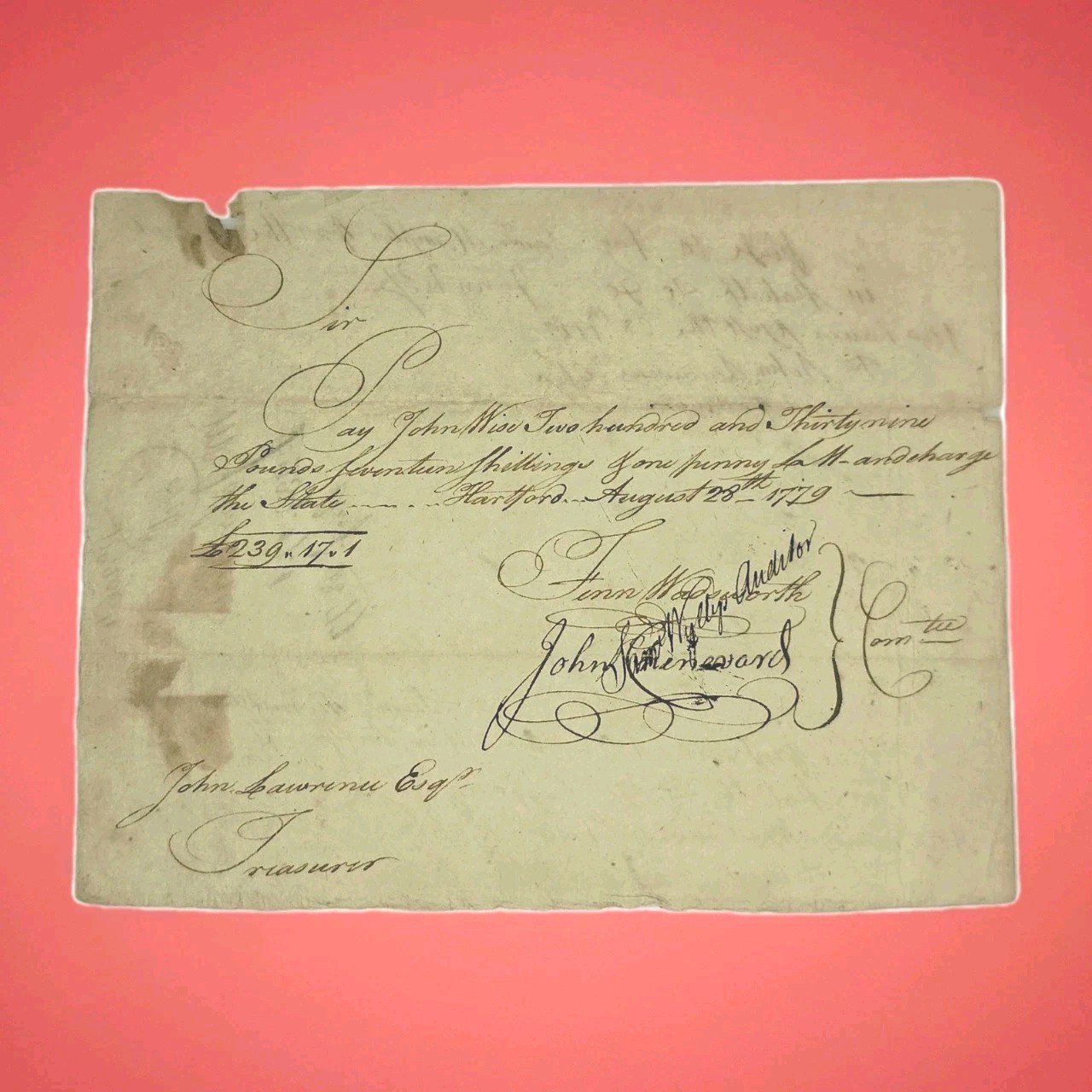
1779 Revolutionary War Connecticut Treasury Warrant“For the Continental” — Major Wartime Reimbursement DocumentSigned by Brigade Major Fenn Wadsworth & Samuel Wyllys
Original Revolutionary War-era Connecticut treasury warrant dated August 28, 1779, ordering payment of the enormous sum of:
£239-17s-1d lawful money
during one of the most chaotic and militarily significant periods of the American Revolution in Connecticut.
The document explicitly references payment:
“for the Continental”
strongly indicating a substantial wartime reimbursement, supply settlement, logistical expenditure, or military support payment connected to the Patriot war effort.
This is not a routine receipt or minor militia pay slip. The amount involved was extremely large for 1779 Connecticut and would have represented a major wartime financial transaction.
Historical Importance
The timing of this document is extraordinary.
Issued only weeks after the devastating British raids on New Haven, Fairfield, and Norwalk in summer 1779, Connecticut was in full emergency mobilization mode:
- militia forces were rapidly assembling,
- supplies were being procured,
- transportation and provisioning networks were strained,
- and state officials were scrambling to support Continental operations following the destruction along the coast.
Given:
- the very large amount,
- the military-connected signers,
- the “for the Continental” wording,
- and the August 1779 date,
this treasury warrant very likely relates to:
- major military supply reimbursement,
- troop support expenditures,
- transportation or quartermaster-related accounting,
- or emergency wartime logistical support following the British coastal attacks.
Important Revolutionary War FiguresFenn Wadsworth (1752–1785)
Revolutionary War officer who served as Brigade Major under General James Wadsworth from 1776–1779. Brigade Majors were key military administrative officers responsible for:
- troop coordination,
- logistics,
- military recordkeeping,
- and wartime operational administration.
Following active field service, Wadsworth later served on Connecticut’s Pay-Table Committee, overseeing military expenditures and Revolutionary War finance. His appearance on this document strongly supports the interpretation that this was a significant military-finance reimbursement tied to Continental support operations.
Samuel Wyllys (1739–1823)
Prominent Connecticut Revolutionary officer who served in the Continental Army and later became a Major General of Connecticut militia and Secretary of the State of Connecticut. Wyllys was deeply involved in Connecticut wartime military administration and organization during the Revolution.
Samuel Humiston (1743–1809)
Countersigned to Samuel Humiston, Revolutionary War militia officer serving as:
Lieutenant, 17th Company Trainband, 2nd Regiment.
Born in New Haven and later residing in Hamden, Humiston participated in Connecticut’s wartime militia structure supporting the Patriot cause.
John Wise
The named payee of the warrant.
John Wise was a New Haven constable known from Connecticut court records for his 1778 prosecution for “failure to muster” after town officials argued his civic duties were too important to abandon during wartime. His appearance here one year later handling a major Continental-related treasury payment suggests he may have been deeply involved in local wartime administration, provisioning, logistics, or emergency support operations following the British raids.
John Lawrence
Treasurer of Connecticut during the Revolutionary War and official responsible for wartime state financial disbursements.
Partial Transcription
“Sir please to pay Saml Humiston for the Continental…”
“Pay John Wise Two hundred and Thirty nine Pounds Seventeen shillings One penny Lawful and charge the State…”
Dated:
Hartford & New Haven
August 28, 1779
Amount:
Original 18th-century laid paper with expected folds, edge wear, handling wear, and period ink oxidation consistent with Revolutionary War treasury use. Manuscript text and signatures remain bold, attractive, and highly displayable.
An outstanding Revolutionary War Connecticut military-finance manuscript tying together Continental support operations, militia administration, treasury reimbursement, and the emergency wartime response following the British coastal raids of 1779.