When you click on links to various merchants on this site and make a purchase, this can result in this site earning a commission. Affiliate programs and affiliations include, but are not limited to, the eBay Partner Network.
Description
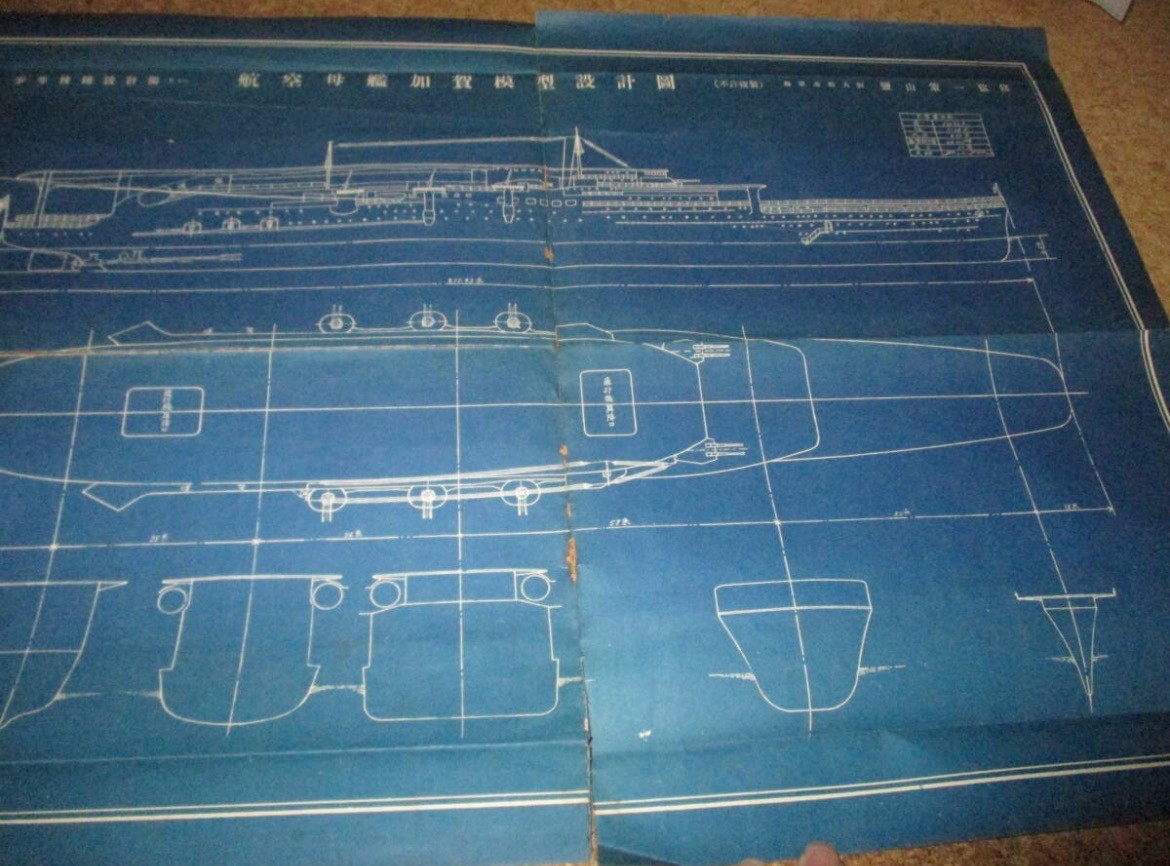
This is a large prewar Japanese model-construction blueprint depicting the Imperial Japanese Navy aircraft carrier Kaga in her early configuration.
The upper section is printed with the following wording:
少年技師設計図
Young Engineer’s Design Plan
Aircraft Carrier Kaga Model Construction Blueprint
Supervised by Imperial Japanese Navy Constructor Lieutenant Kenzan Sakuichi
The title Kaigun Zosen Taii, translated here as “Imperial Japanese Navy Constructor Lieutenant,” was an official naval engineering rank associated with warship design and construction. Because the Imperial Japanese Navy was dissolved following Japan’s defeat in 1945, the use of this naval title supports the identification of the blueprint as a genuine prewar or wartime-period publication rather than a later postwar hobby reproduction.
From Pearl Harbor to Midway
Kaga became one of the best-known aircraft carriers of the Imperial Japanese Navy.
On December 7, 1941, she participated in the attack on Pearl Harbor together with the carriers Akagi, Soryu, Hiryu, Shokaku, and Zuikaku. Aircraft launched from these six carriers struck the United States Pacific Fleet in Hawaii, opening the Pacific War between Japan and the United States.
Only six months later, Kaga took part in the Battle of Midway in June 1942. During that battle, American carrier aircraft attacked the Japanese fleet, and Kaga was lost together with Akagi, Soryu, and Hiryu.
Kaga therefore stands at both ends of the Imperial Japanese Navy’s early wartime carrier story: the dramatic success at Pearl Harbor and the devastating defeat at Midway.
Kaga’s Early Three-Level Flight Deck
The vessel shown here is not Kaga’s better-known Pearl Harbor configuration.
Instead, the blueprint depicts her original and highly experimental three-level flight-deck arrangement. Kaga and Akagi were the only aircraft carriers completed with three superimposed flight decks, reflecting a period when aircraft-carrier design and operational doctrine were still being developed. Kaga was later extensively reconstructed with a single full-length flight deck.
This early configuration makes the blueprint especially interesting. It records the transitional period when the Japanese Navy was still experimenting with how aircraft should be launched, recovered, stored, and operated aboard a large warship.
More Than a Children’s Hobby Plan
Although issued as an educational model-building plan rather than as an official shipyard construction drawing, it contains detailed technical illustrations, including:
- Overhead deck arrangement
- Gun positions and other fittings
- Principal dimensions and specifications
Prewar model construction was not viewed only as entertainment. It also introduced young people to drafting, mechanics, shipbuilding, aviation, and practical engineering.
The printed supervision credit of an Imperial Japanese Navy construction officer gives this piece a stronger historical connection than an ordinary commercial model plan.
The blueprint has been stored folded and shows age-related wear, including fold lines, staining, discoloration, small holes, splits, and damage along the central folds. These signs of use and age form part of its history.
A remarkable surviving document from the formative years of Japanese naval aviation—showing Kaga before Pearl Harbor and Midway made her one of the most recognized aircraft carriers of the Pacific War.
Own a Piece of History.
Shipping
Fedex or Japan post
International Buyers - Please Note:
Import duties, taxes, and charges are not included in the item price or shipping cost. These charges are the buyer's responsibility. Please check with your country's customs office to determine what these additional costs will be prior to offerding or buying.
Thank you for your understanding.