
Rare Late 1800s “Pain’s ‘The Last Days of Pompeii’” Pyrodrama: Grand Rapids, MI For Sale

Rare  Late 1800s “Pain’s ‘The Last Days of Pompeii’” Pyrodrama: Grand Rapids, MI
When you click on links to various merchants on this site and make a purchase, this can result in this site earning a commission. Affiliate programs and affiliations include, but are not limited to, the eBay Partner Network.

Buy Now

Rare Late 1800s “Pain’s ‘The Last Days of Pompeii’” Pyrodrama: Grand Rapids, MI:
$385.00

In 1876, a massive theatrical and pyrotechnic production spectacle was staged in downtown Grand Rapids, MI. Ten dates were scheduled for late September and early October. The start time was 8 p.m. to enhance the fireworks.


The production was based on an 1834 book by Edward Bulwar-Lytton. Years later, James Pain, a British pyrotechnical, adapted the book for a theatrical drama followed by a massive display of fireworks. Pain performed these “pyryodramas” throughout the country. His first production was at Coney Island NY.


The original 10-day event occurred at the Grand Rapids “New Amphitheatre”. The city constructed a temporary 10,000 seat amphitheatre on Island No. 2, located on Grand River Ave., just west of the Union Depot.


The first 8 pages of this program are historical accounts of the last days of Pompeii, occurring in 79 A.D.


Page 8 gives the context for the pyrodrama.


The scene begins with a procession of citizens making their way to the Temple steps. They are there to witness a foot race of the boys of Pompeii.


After the race, there’s a conflict.


Diomedes “reads an edict against the Christians” and orders the Symbol of Isis to be brought out of the temple. Two women in the crowd refuse to kneel before Isis and priest quickly usher them into the temple. They will be executed.


A gladiator rushes from the crowd and begs Diomedes to spare the women, but he refuses. The gladiator threatens war after being rebuffed and leaves.


The women exit the temple, dressed in white, and led to the stake, where they will be burned to death. Their heads are raised to Heaven and their arms are folded to represent the Cross. They plead for their lives, but Diomedes refuses.


The women’s robes are lit by fire and, suddenly, the gladiator returns with others to rescue them.


Then, all Hell breaks loose.


First, there’s an earthquake. Then Vesuvius erupts. That’s when the fireworks (literally) started.


The original ten performances were held in 1876, but some inscription on the back page would indicate that this program was from a later date. The inscription reads: Will + Franc Spring: Spring and I went to this show on Sept. 21, 1889.


Although most of the inside pages have small tears or missing chunks, they do not interfere with reading the graphics. Fortunately the cover is immaculate.


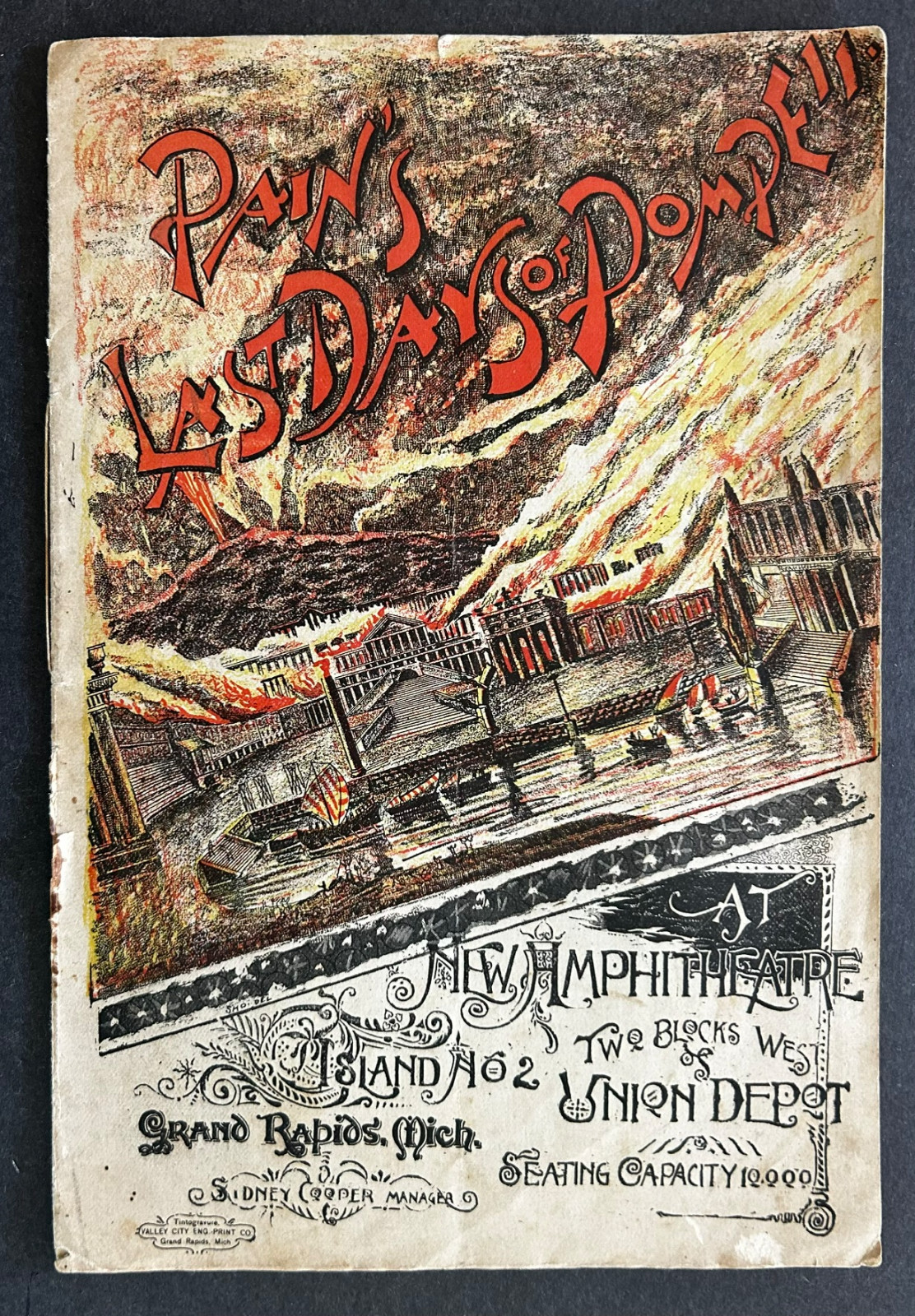
The cover was done by Valley City Eng. Print Co. using one of the early forms of Tintogravure.


The design is spectacular. There’s highly detailed scene outside the temple with Vesuvius in the background, ready to erupt. Even the graphics below the illustrations are artwork themselves.


The program measures 6 x 8 1/2 inches and is 8 pages.


I’ve only seen two other versions of this program, with different artwork (not as nice)—one for Denver and one for Cincinnati. I doubt iffy—if any others—exist for the Grand Rapids production.


Buy Now


Other Related Items:


Related Items:

bromodiaz Rock Rare 150mg picture

bromodiaz Rock Rare 150mg

$65.00


Vintage 1984 Elias Brothers (BIG BOY) Rare Restaurant Advertising Sign  picture

Vintage 1984 Elias Brothers (BIG BOY) Rare Restaurant Advertising Sign

$89.99


RARE 1920s VINTAGE HARVARD UNIVERSITY BRASS  EMPLOYEE ID BADGE PIN - ATHLETICS  picture

RARE 1920s VINTAGE HARVARD UNIVERSITY BRASS EMPLOYEE ID BADGE PIN - ATHLETICS

$128.96


deneme bonus