When you click on links to various merchants on this site and make a purchase, this can result in this site earning a commission. Affiliate programs and affiliations include, but are not limited to, the eBay Partner Network.
Executive Summary
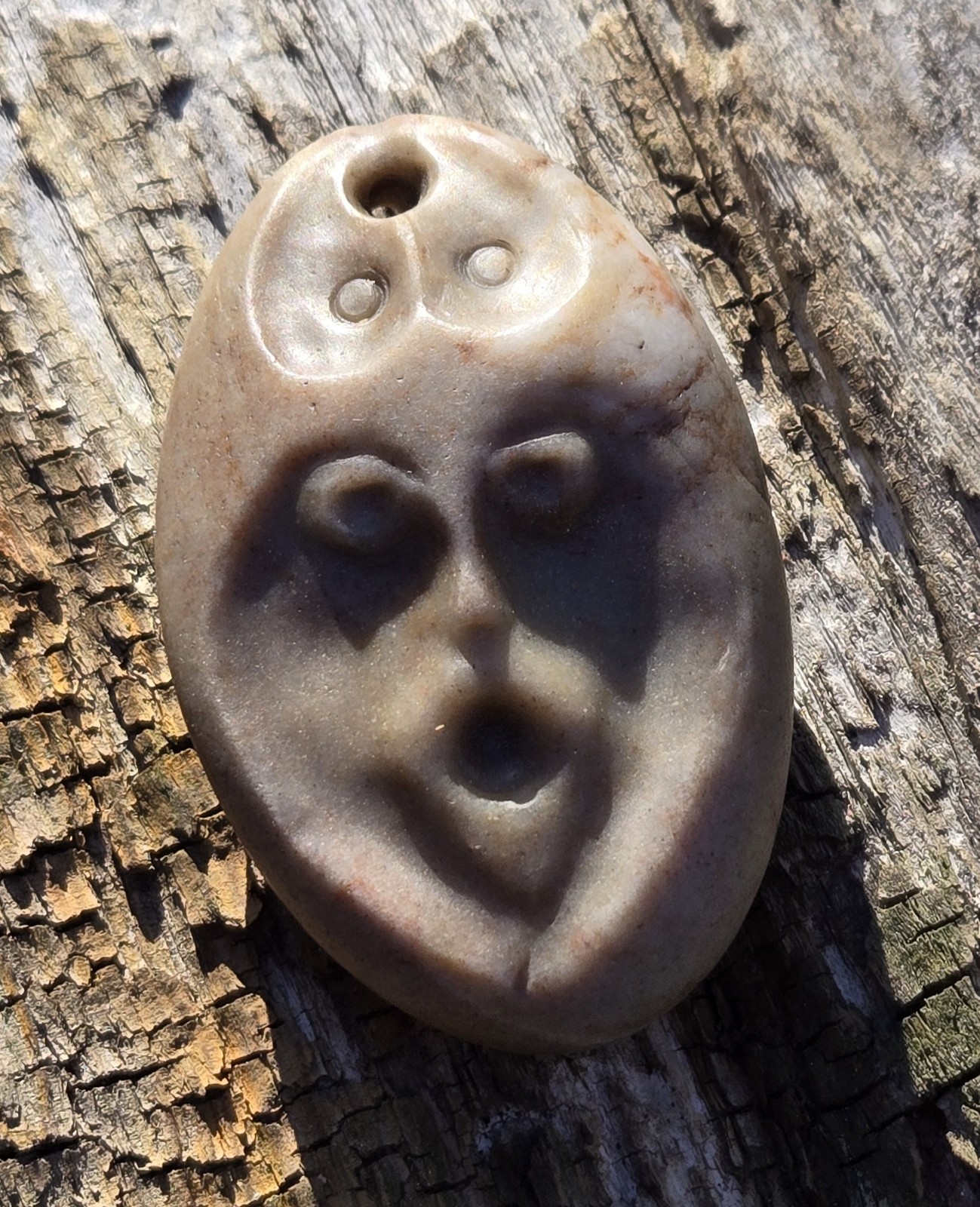
Presented for acquisition is an exceptionally rare, museum-grade portable art object of British Celtic origin, dating to the Late Iron Age, 2nd Century BC to 1st Century AD, within a Romano-British transitional framework. Because the piece is unstratified—meaning it lacks closed archaeological stratification contexts—its chronological attribution relies entirely on stylistic typology, surface analysis, and material context.
In terms of artistic style and mechanics, close parallels can be drawn to high-status portable metalwork and horse-mount fittings from the same era—such as elite harness mounts and scabbard plates featuring repoussé and plastic-style modeling. Just as master metalworkers manipulated sheet bronze to create shifting, multi-tiered anthropomorphic and zoomorphic illusions, this carver utilized the natural contours of the stone matrix to achieve the same visual fluidity. The artifact exhibits a sophisticated tripartite iconographic structure, integrating three distinct registers into a single stone matrix, aligning directly with the academic framework established by Professor Miranda Aldhouse-Green regarding Celtic animism, shapeshifting, and the sacred fluidity between human and animal forms. Furthermore, comparative iconographic analyses of multi-tiered apotropaic art bridge these pre-Christian motifs with broader stylistic traditions, reflecting ancient protective concepts mirrored in comparative talismanic and symbolic studies.
Technical Specifications & Physical Data
- Dimensions: Height: 66mm | Width: 42mm | Max Thickness: 30mm
- Format & Mass: Substantial, ergonomic hand-held portable form designed for tactile interaction at 98 grams.
- Material Matrix & Technology: Fashioned from an extremely hard natural quartzite matrix (measuring approximately 7 on the Mohs scale), requiring specialized abrasive manufacturing techniques—such as deliberate grinding using sand abrasives—to execute the intricate sculptural design. It is bisected by a striking, diagonal quartz crystal ribbon inclusion that physically and visually structures the artwork.
- Surface Pathology, Patination & Wear Analysis: Exhibits complex surface metrics including deep mineral patination tones, soft river-tumbled smoothing juxtaposed with deliberate ancient abrasive tool marks, and organic wear-polish accumulated across centuries of handling and environmental exposure.
- Suspension Feature: Integrated terminal featuring period hourglass drilling exhibiting authentic, ancient wear-polish consistent with high-status suspension or amuletic use.
Provenance & Geographical Context
- Recovery Context: Recovered close to a known Iron Age settlement site.
- Route Alignment: Situated along the corridor of the Wicks Highway, a historical Roman trackway branching off Ermin Street and running toward the strategic Roman fort of Longthorpe, underscoring a multi-period landscape of high activity and transit.
Iconographic & Stylistic Analysis
- Obverse (Primary Human Register): Executed in the classic Le Tène Plastic Style, depicting a stylized human countenance featuring prominent bearded and mustached lower features paired with characteristic "spectacle" eyes.
- Reverse / Superior Register (Avian Element): Positioned in reverse orientation above the primary face, presenting a stylized barn owl therianthrope, capturing the shifting boundary between avian and human perception.
- Reverse / Tertiary Register (Canine-Human Hybrid): Displaying a distinct lupine/human hybrid motif that utilizes the natural contours of the stone and the diagonal quartz vein as a structural boundary, completing a rare tripartite narrative of transformation.
Academic Context, Bibliography & Comparative Framework
In the context of late Iron Age portable art, the presence of a structured tripartite motif on a single amulet is exceptionally scarce. Drawing from the scholarship of Professor Miranda Aldhouse-Green, animals and liminal creatures held profound spiritual status in Celtic religion, acting as mediators between the secular and the divine. The seamless merging of human, avian, and lupine forms highlights the artifact's function as an elite apotropaic and shamanic talisman, drawing on broader comparative motifs of multi-faceted protective symbolism found across ancient artifact analyses.
Select Bibliography & Academic References
- Aldhouse-Green, Miranda: Works concerning Celtic animism, ritual iconography, shapeshifting, and zoomorphic representation in Iron Age Britain.
- Cunliffe, Barry: Comprehensive archaeological frameworks regarding Late Iron Age societies, economy, art styles, and material culture transitions in Britain and continental Europe (cf. Iron Age Communities in Britain).
Provenance (Geo-referenced)
This artifact was recovered from a stratified, collapsed paleo-riverbank section. The location is precisely geo-referenced at: 52°30’10.10”N 0°16’29.89”W. The field context showed a sectional matrix of peat and sand, indicating a recovery depth in the section of approximately 4 feet.
Crucially, the item owes its incredible survival to being sealed in an anaerobic, oxygen-free environment within the matrix, which arrested the typical decay of both the organic bone structure and the remaining iron hardware.
This location is less than half a mile from a known, documented Iron Age settlement site, placing the artifact within its contemporary social and religious landscape. (Note: It is also close to the Roman Road Ermine Street, though its contextual depth confirms an earlier Iron Age deposition.)
General Reference material and further reading:
Where possible ancient artefacts may be referenced to similar material observed in the following publications within my collection:
- British Artefacts Vol.1, 2 and 3: Brett Hammond [Greenlight Publishing 2010]:
- Celtic & Roman Artefacts: Nigel Mills [Greenlight Publishing 2007]:
- SPQR: A History of Ancient Rome: Mary Beard [Profile Books 2015]:
- 50 Bronze Age Artefacts: Portable Antiquities Scheme: Dot Boughton [Amberley Publishing 2021]:
- Pottery in Britain 4000BC to AD 1900: Lloyd Laing [Greenlight Publishing 2003]:
- British Iron Age Coins In The British Museum: Richard Hobbs [British Museum 1996]:
- Swords of The Viking Age: Ian Peirce: [The Boydell Press 2003]:
Proceedings of the Prehistoric Society Volume 85: [Cambridge University Press 2019].
- Mesolithic Europe: Geoff Bailey / Penny Spikins [Cambridge University Press 2008]
- Viking Art: James Graham-Campbell: [Thames & Hudson, London 2018]
- Roman Coins Vol. 1, 2 & 3: David R Sear: [Spink London 2000]:
- The Roman Cavalry: Karen R. Dixon: [B. . Batsford 1997]:
- Rome’s Saxon Shore: Coastal Defenses of Roman Britain AD 250 – 500: Nic Fields [Osprey Publishing 2006]:
- Amulets of Ancient Egypt: Carol Andrews: [University of Texas Press / British Museum Press 1994]:
The Uniforms of the Roman World: Military dress, weapons, artillery, ships, siege engines and fortifications: Kevin F. Killey: [Anness Publishing 2017]:
Where possible finger rings may be referenced to similar material observed in the following publications within my collection:
- Victorian and Albert Museum CATALOGUE OF FINGER RINGS 1930: C.C.Oman [Anglia Publishing. 1991 – Now out of print]:
- Finger Rings: Diana Scarisbrick / Martin Henig: [Ashmolean Museum Oxford. 2003]:
- Ancient Rings An Illustrated Collectors Guide: T. N. Polio: [McFarland & Co Inc. 2018:
- 1000 Rings: Inspiring Adornments of the Hand: Le Van, Marthe; Ebendorf, Robert [W: Lark Books 2004]:
Copyright Ancient Pasts 2026 All rights reserved
Celtic, Iron, Age, Therianthropic, Human, Animal, Hybrid, Amulet, Talisman, Visage, Bovine, Artifact, Paleo, River, Channel, La, Tène, Plastic, Style, Antiquity, Relic, Pagan, Tribal, Sculpture, Carving, Historic, Rare, Collectible, Archaeologi