When you click on links to various merchants on this site and make a purchase, this can result in this site earning a commission. Affiliate programs and affiliations include, but are not limited to, the eBay Partner Network.
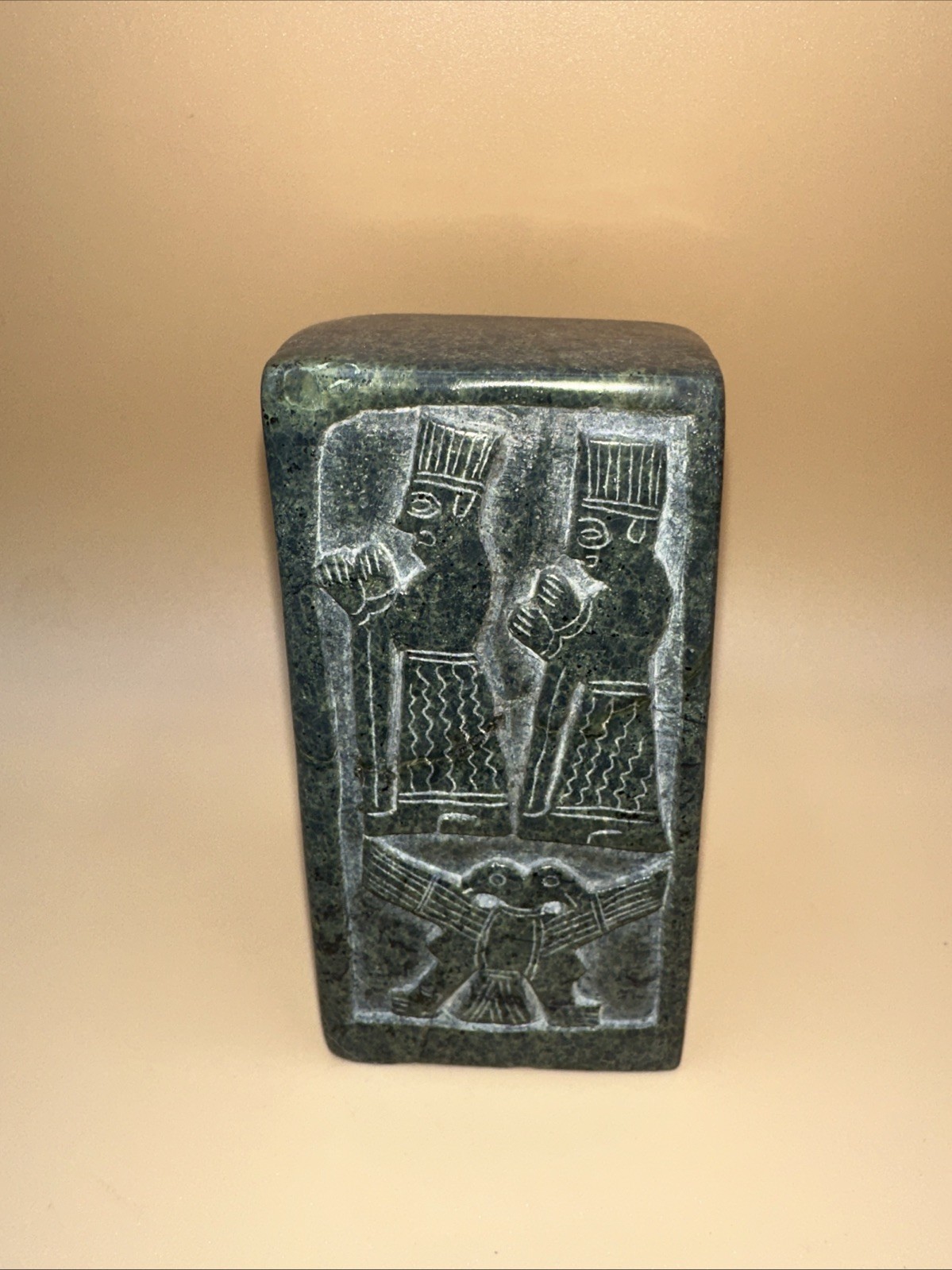
This is a Beautiful Vintage Replica Decorative Stone Piece (looks like a green- tone granite?) with hand-carved relief Symbolic Hittite Empire Hieroglyphic Figures.
This piece was originally found at a very nice Estate Sale and was believed to have been acquired and made in Hattusa (Çorum Province), Turkey.
It measures 3.75” high x 2" x 2" at base, & 2” x 1.75” at top.
This is very heavy for such a small work of replica Hittite art.
If you like to collect Vintage Decorative Pieces with Hieroglyphic Style Designs on them this is a beautiful piece to add to your Collection!
**INFORMATION FOUND ONLINE REGARDING HITTITE ( Turkish ; inscribed rock ) was a sanctuary of Hattusa , the capital city of the Hittite Empire, today in the Çorum Province, Turkey.
This was a holy site for the Hittites , located within walking distance of the gates of the city of Hattusa.
It had two main chambers formed inside a group of rock outcrops.
Access to the roofless chambers were controlled by gateway and building structures built right in front of them, however only the foundations of those structures survived today.
Most impressive today are the rock reliefs of Chambers A and B portraying the gods of the Hittite pantheon.
One of the uses of the sanctuary may have involved the New Year's celebrations ceremonies.
It was in use at least since late 16th century BCE, but most of the rock carvings date to the reign of the Hittite kings Tudhaliya IV and Suppiluliuma II in the late 13th century BCE, when the site underwent a significant restoration.
The most impressive is Chamber A, which contains rock-cut relief of 64 deities in procession.
The left wall shows a procession of male deities, wearing the traditional kilts, pointed shoes and horned hats. Mountain gods are also shown with scaled skirts to symbolise the rocky mountains.
The right wall shows a procession of female deities wearing crowns and long skirts.
The only exception to this divide is the goddess of love and war, Shaushka (Mesopotamian goddess Ishtar / Inanna ) who is shown on the male procession with two female attendants. This is likely to be because of her male attributes as the goddess of war.
The processions lead to a central scene of the supreme couple of the pantheon: the storm-god Teshub and the sun-goddess Hebat (Hepat/ Khepat.) Teshub stands on two mountain gods whilst Hebat stands on a panther. Behind Hebat are shown their son Sharruma, daughter Alanzu and a granddaughter.
The smaller and narrower Chamber B has fewer but larger and better preserved reliefs.
It may have served as a mortuary mausoleum or memorial for the Hittite king Tudhaliya IV.
It is intriguing to note how the Hittite practise of assimilating other cultures' gods into their own pantheon is in evidence at Yazilikaya.
The Mesopotamian god of wisdom, Ea ( Enki ) is shown in the male procession and the god Teshub was a Hurrian god who was syncretized with the Hittite storm-god.
Hebat's original consort was changed into her and Teshub's son (Sharruma) and she was later syncretized with the Hattic sun-goddess of Arinna.
It is believed that the wife of the Hittite king Hattusili III, Puduhepa, who was the daughter of a Hurrian priestess, also played a role in the increasing Hurrian influence on Hittite culture.
“TESHUB"Teshub was the Hurrian god of sky and storm .
Taru ( Luwian Tarhun / Tarhunt- / Tarhuwant- / Tarhunta ) -- a word derived from the Hattic root *tarh "to defeat, conquer" -- was the name of a similar ( Indo-European , pre- Hittite ) Hattic Storm God, whose mythology and worship as a primary deity continued and evolved through descendant Luwian and Hittite cultures.
Teshub reappears in the post-Hurrian cultural successor kingdom of Urartu as Tesheba , one of their chief gods; in Urartian art he is depicted standing on a bull.
Teshub is depicted holding a triple thunderbolt and a weapon, usually an axe (often double-headed ) or mace . The sacred bull common throughout Anatolia was his signature animal, represented by his horned crown or by his steeds Seri and Hurri , who drew his chariot or carried him on their backs.
Please see all photos for details)
Give a present that will last a lifetime…..