
When you click on links to various merchants on this site and make a purchase, this can result in this site earning a commission. Affiliate programs and affiliations include, but are not limited to, the eBay Partner Network.
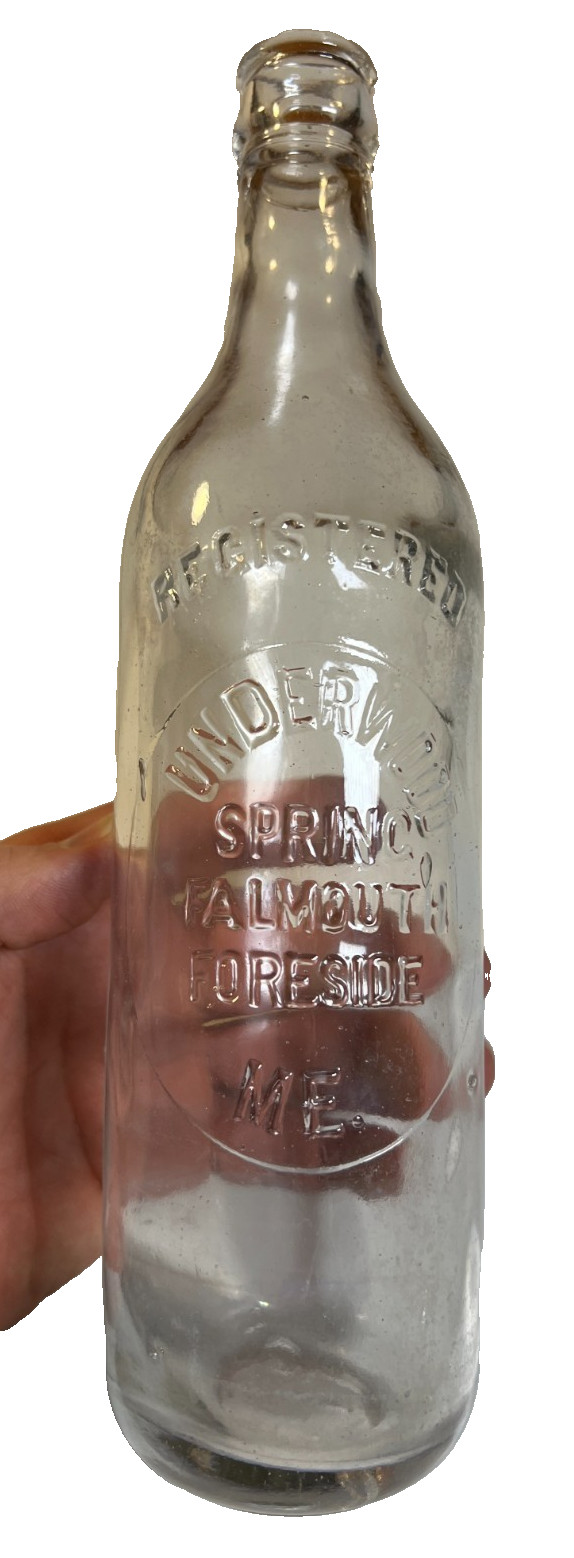
Antique REGISTERED UNDERWOOD SPRING Water Bottle FALMOUTH FORESIDE ME Applied Crown Top 10.25”
A sharp, early coastal Maine soda/mineral water bottle from Falmouth Foreside, this “REGISTERED UNDERWOOD SPRING” example captures the moment when local spring water went from bucket-and-dipper to branded, bottled refreshment. Crisp embossing, a hand-applied crown finish, and just enough age haze to prove it earned its miles.
Precise Date
Circa 1905–1915
Why:
- Applied crown finish (you can clearly see the tooled/applied seam at the lip) places it pre-automatic bottle machine dominance (pre ~1915)
- Embossed, local “spring” branding was most common in the 1900–1915 regional bottling boom
- Lack of machine-perfect uniformity and the base characteristics support early semi-hand production
Description
- Height: 10.25"
- Embossing: “REGISTERED / UNDERWOOD SPRING / FALMOUTH FORESIDE / ME.”
- Top: Applied/tooled crown finish
- Base: Rounded with stable heel (stands easily)
- Condition:
- No chips or cracks
- Light haze and shoulder ghosting
- Faint internal water ring a few inches above base
- Clean, readable embossing
The Maker & Source
Underwood Spring – Falmouth Foreside, Maine
This wasn’t a massive national bottler—it was a local spring-based operation, likely tapping one of the many naturally mineralized coastal springs that made Maine a quiet hotspot for bottled water before it was trendy (or came in $4 plastic).
“Registered” on the shoulder wasn’t just flair—it signaled:
- A protected brand name
- An attempt to build trust in a market flooded with “mystery water” and questionable tonics
These small operations typically:
- Bottled natural spring water or lightly carbonated mineral water
- Sold regionally to Portland-area homes, hotels, and summer visitors
Contents & Use
This bottle most likely held:
- Natural spring water or lightly carbonated mineral water
By this period, bottlers were leaning into:
- “Purity”
- “Healthful minerals”
- Clean, local sourcing
It wasn’t just a drink—it was marketed as a health product.
Marketing Angle (what they were selling emotionally)
Early 1900s bottled water ads leaned hard into:
- “From the source to you” purity
- Digestive and restorative benefits
- Escape from city contamination
And in coastal Maine specifically:
- Sold to summer tourists and wealthy seasonal residents
- Positioned as part of the “healthy seaside life”
Basically: drink this and become the kind of person who vacations in Falmouth.
Life at the Time (1905–1915 snapshot)Technology
- Transition from hand/tooled bottles to semi-automated production
- Early automobiles sharing roads with horses
- Electricity spreading, but not universal
Medicine
- Germ theory accepted, but treatments still primitive
- Bottled water seen as safer than municipal supplies
- “Health waters” were a legit category—not snake oil (well… less snake oil)
Politics
- Progressive Era reforms underway
- Trust-busting, labor reform, food safety laws growing
- Maine: strong temperance movement (hello, bottled alternatives to alcohol)
Big Events in Maine (same era)
- Portland & coastal tourism boom – wealthy summer residents fueling demand for bottled goods
- Expansion of rail lines and coastal shipping, making distribution easier
- Growth of sanitation awareness, increasing bottled water demand
- Maine already dry statewide before national Prohibition—boosting non-alcoholic bottled beverages