When you click on links to various merchants on this site and make a purchase, this can result in this site earning a commission. Affiliate programs and affiliations include, but are not limited to, the eBay Partner Network.
HISTORIC 19TH-CENTURY NATIVE AMERICAN CATLINITE PIPE MATERIAL
SITTING BULL / JUDGE JOHN H. BURNS FAMILY PROVENANCE
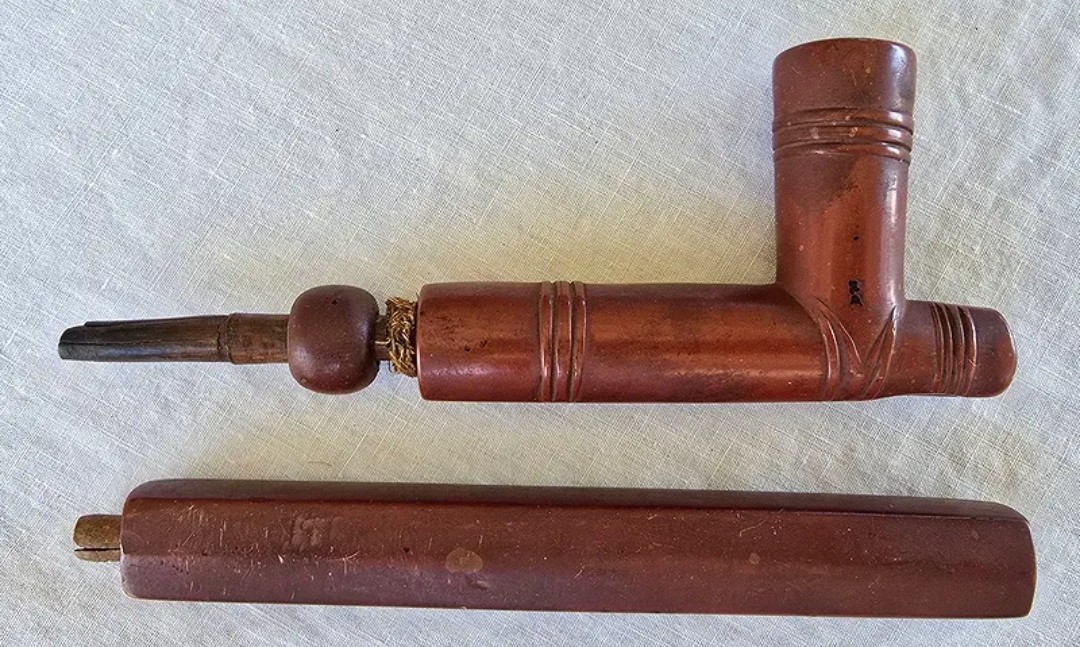
Offered is an exceptional historic Native American pipe lot consisting of two associated antique Catlinite (pipestone) components preserved within the Judge John H. Burns family archive: a hand-carved Catlinite pipe bowl assembly and a highly unusual separate faceted Catlinite pipe stem.
IMPORTANT: The bowl assembly and separate stem were acquired together from the Burns family archive but are recognized as associated period components rather than an originally manufactured matched set. They do not connect together. They are being offered together exactly as acquired.
THE CATLINITE PIPE BOWL
The bowl assembly is hand carved from richly colored Minnesota pipestone displaying attractive natural variation, honest wear and a deep, untouched patina acquired through age and handling.
The bowl exhibits traditional form and craftsmanship consistent with historic Plains Indian pipe bowls. Its integral Catlinite stem section utilizes an aged tapered wooden connector peg wrapped with early historic cordage.
Particularly distinctive is the large hand-carved sliding Catlinite bead ball mounted on the wooden shaft, an unusual feature associated with historic Siouan pipestone artistry. The bead remains intact and moves freely along its axis.
THE FACETED CATLINITE STEM
Accompanying the bowl is a separate and highly unusual solid Catlinite pipe stem.
Rather than the more commonly encountered round form, this piece has been carved into a beveled, multi-sided polygonal profile. It exhibits considerable age, surface patina and honest evidence of historical use.
Dark granular smoking residue remains visible within its hollow interior chamber.
Its original hand-fitted wooden connector plug remains present and displays a dark aged patina together with historic age cracks.
Because these two components are not believed to have been originally made as a single pipe, they are specifically being described and sold as ASSOCIATED ANTIQUE COMPONENTS.
JUDGE JOHN H. BURNS PROVENANCE
These pieces were preserved within the documented family archive of Judge John H. Burns (1851–1939) and were acquired directly through his lineal descendants.
Burns was a prominent Black Hills frontier attorney, magistrate, newspaper correspondent and later Lawrence County Judge. Contemporary newspaper accounts referred to him as \"The Indian Judge\" and documented his extensive involvement with Native American communities throughout the Northern Plains.
His remarkable frontier history is independently represented throughout the larger Burns archive by original photographs, correspondence, legal material, published field dispatches and other historical documents.
Among the surviving material is Burns\' own handwritten vest-pocket Native language translation lexicon compiled during his years on the frontier.
SITTING BULL PROVENANCE
Most significantly, an official signed family provenance declaration executed by Judge Burns\' great-grandson documents the continuous lineal descent of this material through the Burns family.
According to that signed family record, the historic pipe material was personally given to Judge John H. Burns by Hunkpapa Lakota leader Sitting Bull.
This family provenance exists within a much larger surviving archive documenting Burns\' extraordinary involvement in Northern Plains history.
Burns\' July 27, 1877 published battlefield dispatch for the Chicago Tribune documents his presence in Montana Territory and his survey of the Little Bighorn battlefield alongside Native guides.
Another surviving document from the archive, dated December 20, 1890 at Pine Ridge Agency and signed by Chief of Scouts Frank Grouard, U.S. Deputy Marshal George E. Bartlett and interpreter Louis Shangreau, honors Burns for his role in negotiations that brought Chief Strike and 117 Hunkpapa and Brulé lodges peacefully from the Badlands encampments immediately following Sitting Bull\'s death.
SOUTH DAKOTA STATE ARCHIVES
The larger Judge John H. Burns family archive is registered with the South Dakota State Archives under:
Collection Entry Identifier: H2007-080
Box Identifier: 03642 C
The combination of the signed family declaration, continuous Burns family descent and the extensive surviving documentary archive provides unusually substantial historical context for these pieces.
Catlinite bowl assembly including wooden insert:
Approximately 7-1/2 inches long
Separate faceted Catlinite stem including wooden insert:
Approximately 7-1/2 inches long
Overall assembled length:
Not applicable. The two components do not connect.
CONDITION
Both components are in fine antique condition consistent with substantial age, historical use and long-term family preservation.
The Catlinite bowl and integral stone stem exhibit age-related handling wear, surface scratches and a deep natural patina. The large carved Catlinite sliding bead remains intact and moves freely.
The separate faceted Catlinite stem displays surface wear and patina consistent with age and retains dark granular smoking residue within its hollow interior.
Both wooden connector elements exhibit substantial age, dark patina and historic age cracks. Please examine all photographs carefully for the exact condition.
The two primary components are associated rather than an original matching set, DO NOT CONNECT TO ONE ANOTHER, and are offered together exactly as they descended with the Burns family material.
An exceptional opportunity to acquire historic 19th-century Native American Catlinite pipe material with documented Judge John H. Burns family provenance and a signed family declaration recording its historical association with Sitting Bull.