When you click on links to various merchants on this site and make a purchase, this can result in this site earning a commission. Affiliate programs and affiliations include, but are not limited to, the eBay Partner Network.
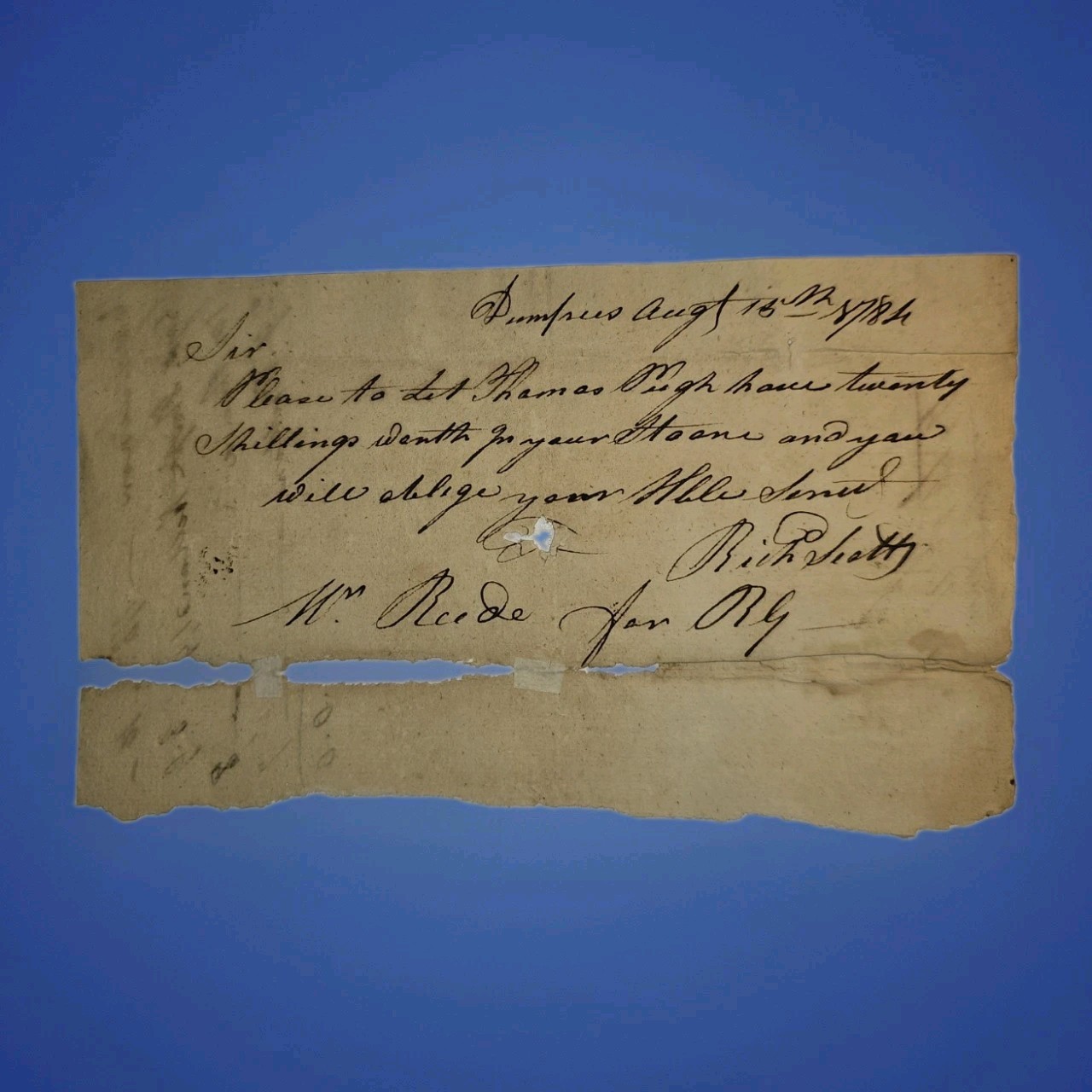
Offered here is an original 1784 handwritten store order and merchandise account from Dumfries, Prince William County, Virginia, issued by Richard Scott authorizing Thomas Pugh to receive twenty shillings’ worth of goods from a local merchant identified on the document as “Mr. Reide.”
The order is dated August 15, 1784, just one year after the Treaty of Paris formally ended the American Revolutionary War. Dumfries was then an important Potomac River tobacco port and commercial center serving planters, merchants, tradesmen, and residents of Northern Virginia.
What makes this document especially interesting is that the reverse records the goods actually issued against the order, providing a rare glimpse into an ordinary retail transaction in post-Revolutionary Augt 15th 1784
Sir.
Please to let Thomas Pugh have twenty
Shillings worth in your Store and you
will oblige your Hble Servt
Richd Scott
Mr Reide
for R.S.
Reverse merchandise account:
6 yds Linen — 1/8
2 yds Strip’d Holland — 1/9
1 oz Thread
24 Buttons
£1 . 0 . 0
Docketed:
Richd Scott
15 Augt 1784
The authorized amount of twenty shillings equaled one pound, and the reverse appears to record the goods supplied to Pugh against that allowance.
Richard Scott
Richard Scott was associated with the commercial and landholding community of Dumfries and Northern Virginia during the years immediately following the Revolution.
The signer is very likely connected with the Richard Scott who appears in later Dumfries mercantile records and may be Richard Marshall Scott, a figure who became prominent in Northern Virginia commerce and public life.
Richard Marshall Scott was involved in Potomac customs and mercantile activity and later became associated with banking, real estate, law, and public service. He held property interests in the Dumfries area and was part of a broader Scott family engaged in regional commerce.
Because the present manuscript predates some of the better-documented records associated with Richard Marshall Scott, the precise identification should be regarded as probable rather than absolutely proven without a direct signature comparison.
Regardless of the exact Scott identification, the document clearly establishes that this Richard Scott possessed sufficient commercial credit in Dumfries to authorize a third party to obtain merchandise on his account.
Thomas Pugh
Thomas Pugh was the person authorized by Scott to receive the goods.
A man of that name appears in Northern Virginia administrative records before the Revolutionary War, including a 1772 Loudoun County road order concerning maintenance of a road toward Leesburg. That individual is a plausible candidate for the Thomas Pugh named here, although there is not yet enough evidence to state that the two men were definitely the same person.
The transaction itself gives an interesting clue to Pugh’s relationship with Scott. Rather than receiving money, Pugh was authorized to obtain specific goods on Scott’s credit. This may indicate that he was an employee, tradesman, tenant, debtor, dependent, or other associate.
The merchandise he obtained was strongly oriented toward clothing production or repair:
6 yards of linen, 2 yards of striped Holland, thread, and 24 buttons.
“Holland” was a recognized period term for a fine linen textile, originally associated with Dutch manufacture and later used more generally for certain grades of closely woven linen cloth.
“Mr. Reide” and Huie, Reid & Co.
The order is addressed to “Mr. Reide,” and the historical context strongly suggests an association with Huie, Reid & Co., a prominent mercantile partnership operating at Dumfries during this period.
Huie, Reid & Co. was part of the Scottish-American merchant network that played an important role in the Potomac tobacco economy. Firms such as this supplied imported and domestic merchandise to local customers while extending credit against personal accounts, agricultural production, and commercial relationships.
James Reid was associated with Huie, Reid & Co., and surviving records confirm that the firm was operating in Dumfries during the 1780s.
The wording of the order fits exactly with the store-credit system used by such merchants: Scott directs the merchant to provide goods to Pugh and charge the amount to Scott’s account.
This makes the manuscript not simply a receipt, but a surviving example of the personal credit economy of early American Virginia.
Historical Significance
This small document captures an unusually complete transaction from the first years of the new United States.
It preserves:
An original 1784 Dumfries, Virginia manuscript
The signature of Richard Scott
The name of Thomas Pugh
A likely connection to Huie, Reid & Co.
A complete £1 store-credit order
An itemized list of clothing and textile goods
Evidence of everyday post-Revolutionary commerce
Northern Virginia / Prince William County history
Potomac tobacco-port mercantile activity
The presence of both the authorization and the merchandise account is particularly appealing, because the buyer can see not only that credit was extended but exactly how the twenty-shilling allowance was spent.
Condition
Original 18th-century manuscript showing significant age and use.
The document has substantial fold and separation damage, including a major horizontal separation, additional vertical splitting, edge losses, small holes, toning, staining, and general fragility.
Despite the condition issues, the historically important portions remain quite legible, including:
Dumfries, the 1784 date, Richard Scott’s signature, Thomas Pugh’s name, the reference to Mr. Reide, the twenty-shilling amount, and much of the reverse merchandise account.
Please review all photographs carefully, as they form an important part of the condition description.
A fascinating and research-worthy 1784 Dumfries, Virginia store-credit manuscript, combining early American commerce, named Northern Virginia residents, textile history, and a likely connection to one of the important mercantile firms of the Potomac tobacco trade.